Pages

Notes on Use of This Blog


1. I have a policy that I always reply to comments on my blog, even if it's just to say thank you.

2. Please don't submit comments that include your own web address. For obvious reasons, they will not be published.

3. I'm now on Twitter - @RichardPegler1
Showing posts with label Bullfinch. Show all posts

Sunday, 7 April 2024

Slow March Pt.1 - 1st to 15th March,2024

For reasons previously explained, I didn't get out much during March, and most of the excursions I did manage have been covered in previous posts. This will be an account of some of my other observations in the first half of the month.

Friday, 1st March          Garden

Much to our delight, the male Brambling was still visiting us on most days. I was pleased to get a shot of this bird in flight - albeit a rather poor one.
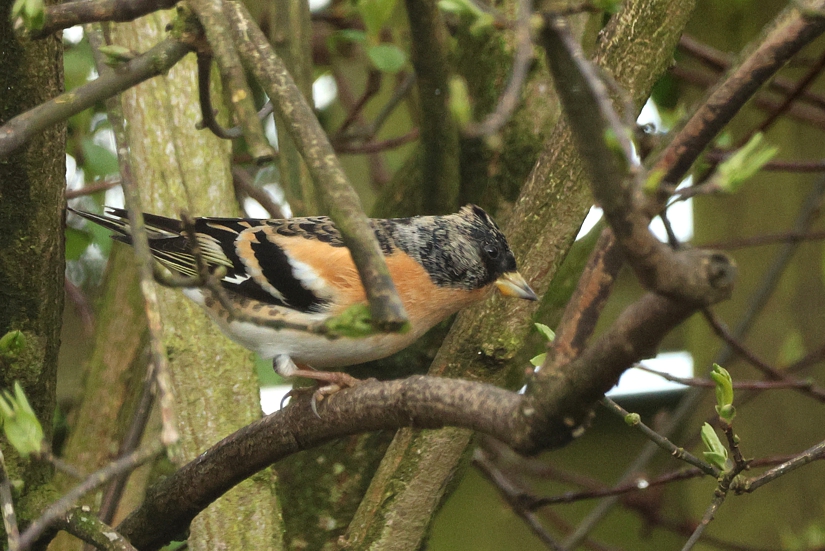


Brambling (Fringilla montifringilla) (male) - our garden

Saturday, 2nd March          Staunton Harold  :  Melbourne Pool

On 29th February, Lindsay and I had visited Melbourne. During that visit, we'd called in at a charity shop in the grounds of Melbourne Hall and Lindsay had spent a little while browsing through the books there. After we'd got back home again, she did some resaerch on a cookery book she'd seen there and come to the conclusion that she wished she had bought it. That day, I'd also taken a walk beside Melbourne Pool and thought I'd seen what might have been a Red-crested Pochard in the distance. This bird is rated locally as being 'uncommon, probably feral'. It is, nevertheless, a very attractive duck.
 
A Saturday is not a good day to visit Melbourne as it gets very busy, and car parking can be hard to find. It made sense, therefore, for me to visit Melbourne on my own this day, not having to worry about parking too far away from the shop for Lindsay to walk. It also meant that I could take more time out to walk round the pool.
 
Due to a long-term road closure and the official diversion route being a long one, I took a short cut through Staunton Harold deciding to stop there briefly to see if the Cattle Egret was still there. A swan greeted me as I arrived.

Mute Swan (Cygnus olor) - Staunton Harold
It took me a little while to find the egret, as it was tucked down in some reeds. Eventually it woke up and became more visible and, by moving further along the road, I got a better photo.
 
Cattle Egret (Bubulcus ibis) - Staunton Harold

Having returned to my car, I headed off to Melbourne and did manage to find a parking space quite close to Melbourne Hall. I hurried to the charity shop and was relieved to find the book that Lindsay wanted was still there. I quickly took it back to the car, and set off to Melbourne Pool with my camera.

I won't trouble you with most of the photos that I took, but this one, of a Black-headed Gull landing on the water, I thought was a bit unusual.

Black-headed Gull (Chroicocephalus ridibundus) - Melbourne Pool

From the road on the east side of the pool I could see a Red-crested Pochard in the far distance - this was with my lens at the full 400mm.
 
Red-crested Pochard (Netta rufina) (male) - Melbourne Pool

If the duck stayed in the same area, I would be able to photograph it from a well-used footpath that ran closer to its location, so I set off in that direction, taking another shot of Black-headed Gull as I did so.

Black-headed Gull (Chroicocephalus ridibundus) - Melbourne Pool

I got to a point where I could get some closer shots, but the bird was still at quite a distance.
 
Red-crested Pochard (Netta rufina) (male) - Melbourne Pool
I then stood behind the trunk of a tree, in the hope that the bird would come even closer - I suspect that this was to the amusement of the several passing dog-walkers. It did, eventually come a little closer, and I got some better shots, although far from perfect, before it drifted out into the centre of the pool. In the first image, below, it is enjoying a good scratch.
 
Red-crested Pochard (Netta rufina) (male) - Melbourne Pool

I returned home, happy to have seen my target, whilst earning a few brownie-points with Lindsay.

Sunday, 3rd March          Garden

The Hedgehogs came out of hibernation early this year, and we have had up to three different ones visit us in a night. On this occasion, there was a bit of an altercation between two hogs, as can be seen in the video below. The cat that appears is one of many that visit our garden (at least five), and I have named 'Ghost'.
 
Hedgehog (Erinaceus europaeus) - our garden
 
Monday, 4th March          Garden
 
A female Blackcap had now become a regular visitor, and was very fond of the 'flutter butter' that I make (blitzed peanuts in lard). She was back to this treat several times a day.

Blackcap (Sylvia atricapilla) (female) - our garden
Tuesday, 5th March          Garden

On this day, the male Brambling brought a female with him. Sadly, it seems that she was not impressed enough to return.

Brambling (Fringilla montifringilla) (female) - our garden

We were still getting frequent visits by three Carrion Crows. This is one of them on that day.

Carrion Crow (Corvus corone) - our garden
Sadly, Stock Dove has become a less frequent visitor, and when we do see one, it is usually a single bird.
 
Stock Dove (Columba oenas) - our garden
Friday, 8th March          Garden
 
Here is the Blackcap again on her favourite twig from which she launched herself into the 'flutter butter' feeder.
 
Blackcap (Sylvia atricapilla) (female) - our garden

Saturday, 9th March          Garden
 
A visit by Great Tit is not unusual in our garden, and they usually go for our sunflower hearts or flutter butter. However, I don't recall ever before seeing one probing in the moss on the wall, like a Wren often does. I missed the shot of the probing, but here is the bird.
 
Great Tit (Parus major) - our garden

Sadly, this next shot is my last one of the male Bullfinch that had been visiting our garden several times a day all winter. Three days later it was taken by a Sparrowhawk, dashing our hopes that, one day, he'd find a mate and bring her to visit.
 
Bullfinch (Pyrrhula pyrrhula) (male) - our garden

Tuesday, 12th March          Garden
 
It had been mainly male Siskins that had shown up in our garden, so the arrival of a female this day was a real pleasure. I only managed shots on a feeder, however.

Siskin (Spinus spinus) (female) - our garden

I was quite excited when a female Sparrowhawk landed on the trellis at the bottom of the garden as, usually, it is male Sparrowhawks that we see.

Sparrowhawk (Accipiter nisus) (female) - our garden

It did not stay long in that position, but shot off to the left round the back of our viburnum, reappearing a second or two later, landing on the ground in front of its previous position. I didn't spot anything in its talons, but could tell from its actions that it had got prey. I still couldn't spot the prey when it saw me and departed at speed. However, when I zoom in close to my photos of it on the ground I can just detect the red breast of a male Bullfinch in its talons, and the lack of subsequent sightings of our Bullfinch bears this out.
 
Sparrowhawk (Accipiter nisus) (female) - our garden

Wednesday, 13th March          Garden
 
This day was quite remarkable, in that we had a group of six Siskin visit - four males and two females. The best photo that I could manage, however, was of just three males on a feeder.

Siskin (Spinus spinus) (male) - our garden

Friday, 15th March          Garden

This day, a male Sparrowhawk stopped briefly in the Rowan outside my study.

Sparrowhawk (Accipiter nisus) (male) - our garden


I'll bring this account to a close now. With luck, Pt.2 will follow in about a week's time. In the meantime, please take good care of yourselves and Nature. Thank you for dropping by - - - Richard

Sunday, 25 February 2024

Soggy Situations - 15th to 21st February, 2024

It has not just been Lindsay's lack of mobility that has limited my time out in the last few weeks, but an unprecedented amount of rainfall has been a major factor too. This has rendered most of the local wildlife spots to be unpleasantly muddy and waterlogged and, in some cases, impassable. Once again, therefore, this blog post will be mainly concerned with observations from the windows of my study (which now doubles as Lindsay's bedroom, where she has an adjustable hospital bed) and our conservatory.

Thursday, 15th February          Garden

In the afternoon, I collected Lindsay from hospital, two days after her knee replacement. In the morning, however, I did note a good number of birds in the garden, including two female Siskins - we'd previously only seen one visiting this winter, although we'd seen singles of both male and female.

Siskin (Spinus spinus) (female x 2) + House Sparrow & Greenfinch - our garden
The female Blackcap was still visiting occasionally, and she showed up on this day. 

Blackcap (Sylvia atricapilla) (female) - our garden
Friday, 16th  February          Garden

The only bird I photographed this day was a Great Tit. Great Tit is a very common bird, but an irregular visitor to the garden. Of late, however, I am frequently hearing its distinctive calls.

Great Tit (Parus major) - our garden
Saturday, 17th February          Garden

The male Brambling returned on this day. It continues to avoid posing nicely for me.

Brambling (Fringilla montifringilla) (male) - our garden
Sunday, 18th February          Garden

It's a poor shot, I know, but I include it as it does show the exquisite markings on the back of a male Brambling.

Brambling (Fringilla montifringilla) (male) - our garden
I have recently become conscious of the fact that I tend to overlook the most common birds that visit our garden when it comes to photography. With this in mind, I took some shots of the very common Chaffinch. They are rather beautiful birds.

Chaffinch (Fringilla coelebs) (female) - our garden

Chaffinch (Fringilla coelebs) (male) - our garden

Monday, 19th February          Garden  :  Kelham Bridge Nature Reserve

On this day, in the morning, we were visited by both male and female Siskin, and I managed to get a record shot of the male up in the Rowan, outside my study window.

Siskin (Spinus spinus) (male) - our garden

That afternoon, Lindsay stated that she was feeling very confident about her situation, and encouraged me to go out. I settled on a short visit to Kelham Bridge Nature Reserve as I hadn't been there for a while. I expected it to be very muddy, and so took my wellington boots. However, it was far more muddy than I anticipated. The paths were treacherous and I could see where people had skidded on the mud. In places the water on the path was quite deep and in othe places I found that the mud was deep and strong enough that, on a few occasions, I nearly lost a wellie.

I spent some time at the first hide which was devoid of people and nothing interesting was observed in the twenty minutes that I was there. The only thing I photographed was a squirrel.

Grey Squirrel (Sciurus carolinensis) - Kelham Bridge NR
I then made my way, gingerly, to the second hide which was busy with people and no window seats available. However, I didn't have to wait long. There was little to see on this occasion, but it was good to chat with people. Initially, I just had distant views of Coot and Little Grebe.

Coot (Fulica atra) - Kelham Bridge NR
Eventually, one of the Little Grebes came very much closer. I do have a soft spot for this species.


Little Grebe (Tachybaptus ruficollis) - Kelham Bridge NR
A Coot also came a little closer.

Coot (Fulica atra) - Kelham Bridge NR
Shortly before I left, a Kingfisher flashed through. I reckon that it was in view for less than two seconds. The consensus was that it had probably gone to the pool where the first hide is, but there was a less muddy route to the entrance gate available, and none of us wished to check out that possibility. It was time for me to get back to Lindsay and cook tea, so I took the less muddy route which turned out to be much quicker and safer.

Tuesday, 20th February          Garden

I was greatly excited this day as, for the first time in many years, we had two Brambling visit the garden, as can be seen in the image below, with them high up in our nut tree.

Brambling (Fringilla montifringilla) - our garden
Sadly, one soon departed and only one came down to feed. I did not get to see whether the one on the right was male or female. The male that came to feed was a little more obliging.


Brambling (Fringilla montifringilla) (male) - our garden

I usually find it impossible to determine the sex of a Stock Dove but, for the first time ever, on this occasion I saw the puffing up of the neck on this bird, which surely suggests that this was a displaying male.


Stock Dove (Columba oenas) (male?) - our garden

Wednesday, 21st February          Garden

It's always good to see a Bullfinch and even better to see a Brambling, but to get two together is a real treat - even if they were on a feeder.

Bullfinch (Pyrrhula pyrrhula) (male) + Brambling (Fringilla montifringilla) (male) - our garden
- - and I'll end with a Bullfinch.

Bullfinch (Pyrrhula pyrrhula) (male) - our garden
With luck, my next blog post will be in about a week's time but, at the current rate of progress, it might be a bit thin on material! In the meantime, please take good care of yourselves and Nature. Thank you for dropping by - - - Richard

Sunday, 18 February 2024

More February Observations - 8th to 14th February, 2024

I have made the decision that, even though my free time is currently limited, I will try to make the effort to continue to output a blog post on an approximately weekly basis. With my ability to get out into the wild severely limited, my observations have, primarily, been of birds in our garden, and it is likely to continue that way for a few weeks. Here's an account of some of my sightings.

Thursday, 8th February          Garden

The weather this day was absolutely foul, with heavy rain all day, which caused local flooding. The rain on the windows of the conservatory made it difficult to identify anything but the most obviously plumaged birds. One such bird that visited was a Pied Wagtail. I tried the technique of placing the lens hard up against the glass of the window as I have found, in the past, that this can sometimes 'see through' the rain. To some extent, this technique worked, as shown below.

Pied Wagtail (Motacilla alba yarrellii) (female) - our garden
Saturday, 10th February          Garden

This was the best day of the year so far, with 20 species of bird visiting the garden. There was, however, one disappointment and that was when Lindsay alerted me to a bird that she said was behaving like a Chaffinch, but looked wrong. I took a look and spotted a fine male Brambling. However, I had already put my camera in the conservatory, ready for the breakfast session and it disappeared before I could get to the camera. This resulted in rather a lot of time spent gazing out of the window, camera at ready, in the hope of its return. 

All I photographed that day was a male Bullfinch.


Bullfinch (Pyrrhula pyrrhula) (male) - our garden

Sunday, 11th February          Garden

To my absolute delight, the Brambling visited again this day, and I managed a few photos, albeit at a distance as it was approximately 15 metres away from my position in my study. These images are very heavily cropped from the original.

Brambling (Fringilla montifringilla) (male) - our garden
We finished the week with, what for us was, a remarkable tally of twenty six species of bird landing in our garden during the seven days.
 
Monday, 12th February          Garden
 
I photographed a few birds this day. Coal Tit used to be a regular visitor to our garden some years ago, but nowadays we probably only average one or two sightings in a month. This one was photographed in poor light high in a tree at the far side of the garden, but at least it is a record of its visit.
 
Coal Tit (Periparus ater) - our garden

The female Blackcap is continuing to make the occasional visit. I wish she would find a mate to bring to the party.


Blackcap (Sylvia atricapilla) (female) - our garden

Chaffinches are daily visitors to the garden, and I really should pay more attention to them with the camera. These birds often come to a part of the garden which is quite close to my study window. However, it seems to be the females that I manage to photograph. I really must try harder to get some images of the more colourful males.

Chaffinch (Fringilla coelebs) (female) - our garden
Wednesday, 14th February          near Plumtree, Nottinghamshire  :  Garden
 
I have been backwards and forwards to a hospital near Nottingham over the past couple of weeks, in connection with Lindsay's knee replacement. On one of those journeys, I remarked to Lindsay that a group of run-down barns, close to the road in a very rurl location, looked as if they might be a place that hosted an owl. On Tuesday 13th she had her knee operation, and on the Wednesday morning I went to visit her in hospital, but decided to spend ten minutes by the barns to see if any owls might be around. I didn't spot any owls but there did seem to be a few feral pigeons.

Unlike some areas of the UK, I very rarely see a feral pigeon in our area, even in our local town. Feral pigeons are decended from Rock Dove stock which have been domesticated. This, I believe, was the first species of bird ever to domesticated - apparently over 5,000 years ago! Over the years, escapees have become naturalised and are now a regular feature of cityscapes. They are interbreeding with wild doves, and there are many variations in plumage.

Given the above, I was quite surprised to find that the only birds sighted in the vicinity of the barns were feral pigeons. I took some shots of a male making amorous advances on a female.

Feral Pigeon (Columba livia domestica) (male + female)- near Plumtree, Nottinghamshire
I got home, after visiting Lindsay, to find a Bullfinch and Siskin feeding together.

Bullfinch ( (Pyrrhula pyrrhula) (male) + Siskin (Spinus spinus) (male) - our garden

This brings me to the end of this post. I am pleased to report that Lindsay is recovering nicely, although she is likely to remain totally dependent on me for support (cooking, cleaning, washing, etc.) for a week or two. She's got two return visits to the hospital, which is an hour's travel away from home, scheduled for this coming week.
 
Hopefully, I'll be back with another blog post in about a week's time. In the meantime, please take good care of yourselves and Nature. Thank you for dropping by - - - Richard