Pages

Notes on Use of This Blog


1. I have a policy that I always reply to comments on my blog, even if it's just to say thank you.

2. Please don't submit comments that include your own web address. For obvious reasons, they will not be published.

3. I'm now on Twitter - @RichardPegler1
Showing posts with label Buzzard Common. Show all posts

Sunday, 14 April 2024

Slow March Pt.2 - 16th to 31st March,2024

This blog post gives an account of some of the highlights of what was a rather gentle month in terms of excursions, but included a few welcome harbingers of spring.

Sunday, 17th March          Nature Alive, Coalville

It was a relatively sunny day, and quite warm too. I fancied a short trip out, but had to take into consideration the fact that, being fine weather after a period of poor weather, and a Sunday also, most of my usual haunts that were not still under water would be busy with people. I had heard of the Nature Alive nature reserve in Coalville but never visited. It was formed on a brown-field site of a relatively small area, trapped between a railway line, the Coalville ring road, and a small retail park. It has some ponds, the largest of which was formed by mining subsidence.

Having parked my car and entered the site, I walked up the slope to the embankment (on which a railway branch line to Swarkestone to the north once ran), and then descended the other side and found myself confronted by a torrent of water about 4 inches (10cm) deep running down the path towards me. Fortunately I had put on wellingtons, so was able to pass along the path undeterred. It was only about 15 metres until I reached dry land and was able to explore.

In one of the two smaller ponds I found there was a Coot having a splash-about.

Coot (Fulica atra) - Nature Alive
At the main lake, a pair of drake Mallards were having an interaction.
 
Mallard (Anas platyrhynchos) (male) - Nature Alive
One of them then approached me, possibly hoping to be fed!
 
Mallard (Anas platyrhynchos) (male) - Nature Alive
I carried on past the main lake, finding a few insects enjoying the flowers in the sunshine.
 
Buff-tailed Bumblebee (Bombus terrestris) - Nature Alive

Hairy-footed Flower Bee (Anthophora plumipes) (male) - Nature Alive

There were some eye-catching clumps of Marsh Marigold around.
 
Marsh Marigold (Caltha palustris) - Nature Alive
Arriving back at the main lake, there were two drake Shoveler in the distance.

Shoveler (Spatula clypeata) (male) - Nature Alive
Before I left, I could not resist taking a shot of one of the many magnificent clumps of Primrose that were on the site.

Primula (Primula vulgaris) - Nature alive

Monday, 18th March          Garden

This was a very special day, due to our first (and, so far, only) sighting of the year of Redpoll in our garden. It was a splendid male, and I did manage some shots, although I'd have been happier if I got some that were not on a feeder. Lesser Redpoll is a 'red-listed' species.

Lesser Redpoll (Acanthis cabaret) (male) - our garden
Tuesday, 19th March          Saltersford Valley Country Park  :  Donisthorpe Rail Trail

A quick visit to Saltersford Valley CP in the afternoon was a little disappointing in that the boardwalk was still closed, water levels were very high, and paths were still flooded. I saw nothing of real interest and only photographed a Mute Swan which appeared to have some staining from the discoloured water caused by leakage from the old coal mine workings.

Mute Swan (Cygnus olor) - Saltersford Valley CP
As I had spent so little time here, I decided to check out the disused railway line that is now a public trail, accessible from by the church on Church Street, Donisthorpe.

Again I found little to occupy me, but I did manage to get some photos of a Red-legged Partridge - a species that I have not photographed for a while.

Red-legged Partridge (Alectoris rufa) - Donisthorpe Rail Trail
The only other photos I took were of a lone wild violet.

Common Dog Violet (Viola riviniana) - Donisthorpe Rail Trail
Wednesday, 20th March          Garden  :  Bardon Hill area

We were visited by two male Siskin on this day, and I managed a few shots of one of them, away from the feeders.

Siskin (Spinus spinus) (male) - our garden

The previous day, there had been reports of a group of approximately 25 Waxwings on an industrial estate near Bardon Hill. As Bardon Hill is quite local to me, I felt compelled to visit for what might be my last chance of seeing a Waxwing of the season. I did a bit of research on Google Earth and sorted out where I was going to park in an area where most roads are very busy with trucks. 

Having parked, I only had to walk a couple of hundred metres before I spotted the flock in a distant tree, a little away from the area that they had been reported in. I took some records shots, as shown below.

Bohemian Waxwing (Bombycilla garrulus) - Bardon Hill Industrial Estate
I counted 31 birds before I retraced my steps back to the road that my car was parked on, in the hope of being able to find another viewpoint for the birds that was perhaps a little nearer and not into the light, although it was not particularly bright weather.

I soon realised that there was no prospect of seeing the perched birds from this road and, to my dismay, the flock flew over my head and headed south in the approximate direction of the road that I was on. I followed the road to the end, but saw no sign of the Waxwings anywhere, although I did get a distant view of a Buzzard perched in a tree.

Common Buzzard (Buteo buteo) - Bardon Hill area
Thursday, 21st March          Garden

At the back end of last year, we had got used to regular visits from Magpie. However, this year they have become rather more elusive. On this day, two Magpies visited and I managed to catch one snaffling some dried Black Soldier-fly lavae that I'd tipped out of one of the Hedgehog feeding trays.

Magpie (Pica pica) - our garden
Friday, 22nd March          Our Conservatory

I noticed a small spider crawling up the window frame in our conservatory. I have not been able to positively identify it, but believe it to be one of the Philodromus species. If I had to make a guess, I'd say a female Philodromus dispar. It was released into the wild.

possible (Philodromus dispar) (female) - our conservatory
That afternoon I went to Calke Explore, which I have already reported on.

Friday, 29th March          Garden

This was something of a red letter day, as a Comma butterfly visited the garden - the first of the year. It was a bit tatty, so I believe it to be one that had emerged from winter hibernation.

Comma (Polygonia c-album) - our garden
Although a very common bird, the male Chaffinch is rather handsome.

Chaffinch (Fringilla coelebs) (male) - our garden

Saturday, 30th March          Garden  :  Willesley Wood

This was a good day for buterflies in the garden, with Brimstone, Peacock, and Small Tortoiseshell being seen. I only got usable photos of the Small Tortoiseshell.
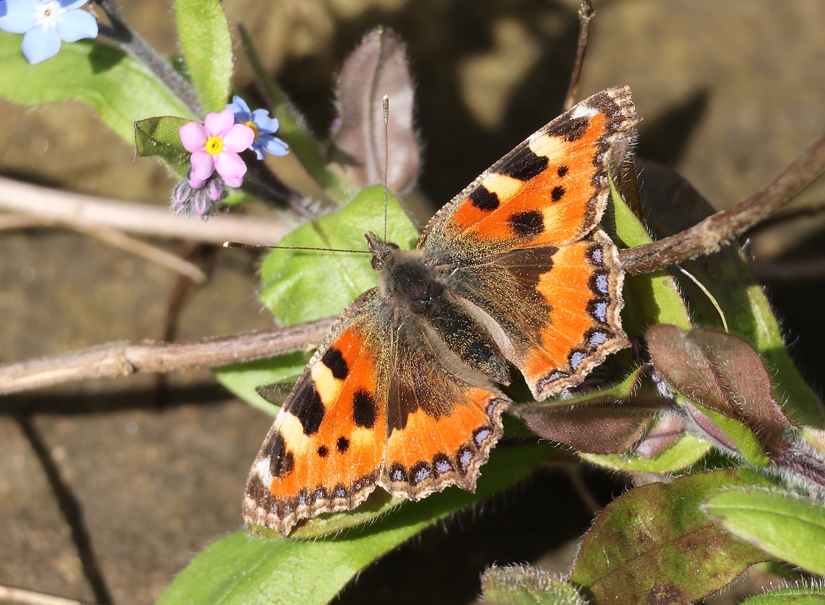
Small Tortoiseshell (Aglais urticae) - our garden
I was also pleased to see my first Bee-fly of the year.

Dark-edged Bee-fly (Bombylius major) - our garden
Seeing the butterflies in the garden prompted me to visit a local place which has been relatively productive for butterflies, including Brimstone.

I arrived and parked the car - although it is close to home, the road between my house and Willesley Wood is very dangerous to walk along as it is a narrow bendy road, running between dense hedges and has no verges.  There is, therefore, no option but to walk in the road, along which cars tend to travel at high speed.

As soon as I entered the site, I saw a Brimstone butterfly but it was distant and mobile, and soon disappeared. 

There were very deep puddles along the path and I was glad that I was wearing wellingtons. As I approached Thortit Lake I was astounded by how high the water level was. I suspect that it was about a metre above its usual level, and was approximately 4 inches (100 cm) deep over the path at one point. I wish, now, that I had taken some photos to illustrate this.

A female Mute Swan was busy tidying a nest, possibly incubating eggs, and it struck me that while this nest was currently like an island near the edge of the water, and quite safe from the many dogs that are walked here, when the water level receded to its normal situation the nest would be some distance from the water, and high and dry.

Mute Swan (Cygnus olor) (female) - Thortit Lake

A little further on, the male swan was dabbling around. That tree trunk, surrounded by water, is usually well out of the water.

Mute Swan (Cygnus olor) (male) - Thortit Lake

Close by, there was a Coot which seemed more confiding than I'm used to with this species.

Coot (Fulica atra) - Thortit Lake

There was little happening on the north side of the lake so I headed off in an anti-clockwise perambulation. Reaching the path on the south side of the lake, I was surprised to see water reaching up to the path. Usually, water is not visible from this path as it is about 150 metres away, through densely packed trees. 

At one point, I had nice views of a Heron.

Grey Heron (Ardea cinerea) - Thortit Lake


I also found my second Bee-fly of the year!

Dark-edged Bee-fly (Bombylius major) -Willesley Wood

I then headed back to my car, stopping to photograph a very tatty Peacock by the exit gate.

Peacock (Aglais io) - Willesley Wood

I was just about to get into my car, when a Brimstone flew by and stopped briefly, further up the lane. I followed it for a while and eventually it stopped long enough for me to take a record shot.

Brimstone (Gonepteryx rhamni) (male) - Willesley Woodside

Sunday, 31st March          Garden

Not a particularly eventful day but I had a rare opportunity to photograph a Wren in the garden - it is not the presence of the Wren that is rare, but the opportunity to photograph one, as they are forever on the move and soon vanish!

Wren (Troglodytes troglodytes) - our garden
 

Thus ended what I believe was the wettest March on record. Fortunately, the weather seems to be improving a little and spring has now sprung - fingers are crossed that we continue to get some more helpful wildlife watching opportunities.

As usual, I expect my next blog post to be in about a week's time. In the meantime, please take good care of yourselves and Nature. Thank you for dropping by - - - Richard


Sunday, 17 March 2024

So That's The Way To Do It!! - March, 2024

This post is a bit technical and, if it is not of interest, you might just want to scroll down to the pictures - I will not be in the least offended!

It is almost exactly a year since I bought my current camera set-up. My kit was getting worn out, and in need of service, but it was also getting a little too heavy for me to carry about over long distances, so I looked into going mirrorless. Having been an avid Nikon user for about twenty years, that is where I first looked. I had been using a Nikon D7200 body with a Sigma 50-500 lens. I found that if I wanted to go down the Nikon route it would cost me a small fortune, and save me virtually nothing in weight. This caused me to look at Canon. I found that there was a suitable alternative from Canon in the form of their EOS R7 with their RF 100-400 lens. This came in at about a third of the price of the current Nikon offering! Yes, the lens was not quite as versatile as was the 50-500, but the set up came in at half the weight of my exisitng Nikon set-up. Furthermore, the 32.5 megapixel cropped sensor of the R7 versus the 24.2 megapixel cropped sensor of the Nikon, made up, somewhat, for the loss of reach of the lens.

Although I was immediately impressed by what I had bought, it took me quite some time to get used to the switch between Nikon and Canon. I now feel that I'm fairly well accustomed to it.

If there is a downside to the set-up it is that the largest aperture available with the RF 100-400 is F5.6 at 100 mm (F8 at 400 mm), meaning it's a little more difficult to use at low light levels, although the lack of noise at high ISOs is rather good, and compensates for this to some extent.

One of the features of the Canon R7 is the AI driven focus facility. This can be set to recognise animals (including birds) and focus on the eyes. In servo focus mode, once the focus has been achieved, the focus will track the item, no matter where it moves to in the frame. I found this to be very useful, but I was having difficulty in achieving that initial focus, especially when the subject was a fast-flying small bird at a distance.

We now come forward to 4th March this year. I was aware of the facility to set up the R7 with three separate custom settings (C1, C2, C3), easily accessible from the dial on the top of the body. I had briefly played with this in the early days of owning the camera, but kept putting of actually using this facility. On this day, I decided that it was time to do something about it.

I frequently take photos of birds, etc. that are in confusing backgrounds or have intervening foliage in front of them. I therefore have my camera set for 'spot focus' for most of the time. It was only when reading up about the facilities of the camera that I found a recommendation that for moving subjects in an open background (sky, for example), the thing to do is to use 'whole area' focus. The AI looks for the nearest object in frame that conforms to the target focus (animals) and locks onto it.

I then set up C3 to incorporate this focus facility together with servo focus, which takes changing distance into account.

So that I can quickly get back to my static subject in a confusing background, I set up C1 accordingly.

C2 is not yet set up but I am reserving that to potentially use in the dragonfly season with settings more suited to photographing dragonflies in flight with confusing backgrounds.

The very next day, I went out specifiacally to put the C3 custom setting to the test. This is what I found.

Tuesday, 5th March          Sence Valley Forest Park

I set off in the ealy afternoon with Sence Valley Forest Park being only ten minutes from our home. Having parked my car, I entered the site, stopping to photograph a pair of Canada Geese beside the path by Goss Water. Here's one of them.

Canada Goose (Branta canadensis) - Sence Valley FP
Out on the water, but fairly close in, were some Black-headed Gulls. This one was transitioning into summer plumage

Black-headed Gull (Chroicocephalus ridibundus) - Sence Valley FP

The tern rafts, installed by the excellent Leicestershire and Rutland Ornithological Society (LROS) were occupied by Cormorants. I love the punk 'hairstyle' of a Cormorant in 'courtship' plumage.

Cormorant (Phalacrocorax Carbo) - Sence Valley FP
As  I approached the northern end of Goss Water, I saw some gulls in the air in the distance. I quickly flipped the dial on my camera round to C3 and sharted shooting. To say that I was impressed by the results is an understatement. If only I had used this setting before. Here is a heavily cropped shot - not the best in the world but it will illustrate the situation.

Black-headed Gull (Chroicocephalus ridibundus) - Sence Valley FP
- and here is the image that it was cropped from. The camera has found the subject and followed it  until it was way off centre.

Black-headed Gull (Chroicocephalus ridibundus) - Sence Valley FP
Here are a couple more shots from that short session. The first is in winter plumage and the second in full summer plumage.

Black-headed Gull (Chroicocephalus ridibundus) - Sence Valley FP
I made a short diversion up to Usbourne Pool, seeing nothing of interest, and then retraced my steps a while and wandered on to the ramp that leads down to the water's edge of Horseshoe Lake. A Mute Swan was here, hoping to be fed.
 
Mute Swan (Cygnus olor) - Sence Valley FP

Although the majority of gulls present were Black-headed Gulls, I am relatively positive that these two, sitting on posts out in the water, were Common Gulls - but I'm not very good at gulls! Common Gulls are not a species that I'm used to seeing in these parts.
 
Common Gull (Larus canus) - Sence Valley FP
Here's another shot of a Black-headed Gull, part-way through its transition to summer plumage.
 
Black-headed Gull (Chroicocephalus ridibundus) - Sence Valley FP
I then headed to Stonebridge Pool and made a circuit of the pool, stopping in at the hide on the way, but seeing little of interest. The only thing I photographed was a Tufted Duck at the northern end of the pool.

Tufted Duck (Aythya fuligula) (male) - Sence Valley FP

I was on my way back to my car when I heard the distinct call of a Common Buzzard somewhere. One of the problems of wearing the sort of hearing aids that I do is that I have no sense of direction of what it is that I'm hearing. However, I soon located the Buzzard as it emerged from behind trees and made some circuits high above Horseshoe Lake. I quickly turned the dial on my camera to C3 and was back in business again!


Common Buzzard (Buteo buteo) - Sence Valley FP

Switching back to C1, I took a few more shots as I passed Goss Pool once more.
 
Black-headed Gull (Chroicocephalus ridibundus) - Sence Valley FP

Canada Goose (Branta canadensis) - Sence Valley FP

I was, of course, highly delighted with this newly-found facility on the camera - my only regret being that it took me a year to find it! I suspect that there are people out there that are astounded by my ineptitude - I'll use my age, and the many distractions I have had over the past twelve months as my excuse!

My next blog post might feature another local visit - one that did not give me the ability to exercise those new settings. Or it might not!

In the meantime, please take good care of yourselves and Nature. Thank you for dropping by - - - Richard
 

Thursday, 28 September 2023

Local Observations - 3rd to 13th September, 2023

Header image (while this post is current) - Common Buzzard - Thortit Lake on 6th September, 2023  

With this post I am, at last, reporting sightings in the same month as they happened!

Sunday, 3rd September            Garden  :  Donisthorpe Wood  :  Saltersford Valley Country Park

In the morning, I spent some time in the garden doing some general tidying up, during which I was keeping an eye open for wildlife on any items I pruned. This resulted in me finding a number of shieldbugs of three different species. I am rather fond of shieldbugs, so this was very pleasing, although I know little about them. All but one of the shieldbugs found were on the sunflower heads.

Hawthorn Shieldbug (Acanthosoma haemorrhoidale) (adult) - our garden
Hairy Shieldbug (Dolycoris baccarum) (adult) - our garden

Common Green Shieldbug (Palomena prasina) (3rd instar nymphs) - our garden
On this day, I was booked on an afternoon walk organised by Groundwork Five Counties in conjunction with The National Forest. This was billed as a 'Bug Hunt'. I turned up to the news that the designated guide had called in sick with Covid. However, a well-experienced substitute had been found. What I was not prepared for was the nature of the walk, which largely consisted of swiping sweep-nets through tree branches and ground vegetation, and examining what was in the nets. This was not my thing really, as I much prefer to seek and photograph items in their natural habitat. 

There were, nevertheless, some interesting items found and a few photos taken.

Beside the entrance to Donisthorpe Woodland from the car park was a fine example of Robin's Pincushion. Robin's Pincushion (also known as the 'Bedeguar Gall') is a gall caused by the larvae of a tiny gall wasp, Dipoloepis rosae. It is quite common.

Robin's Pincushion - Donishorpe Woodland
There were a few grasshoppers around.

Lesser Marsh Grasshopper (Chorthippus albomarginatus) - Donisthorpe Woodland
One of the items swept from its resting place was the beautiful caterpillar of the Pale Tussock moth. Unfortunately, this creature was still suffering from the shock of being displaced and didn't straighten itself out from its defensive curled state.

Pale Tussock (Calliteara pudibunda) (larva) - Donisthorpe Woodland
One of our eagle-eyed participants - a fellow dragonfly enthusiast - spotted scars on a willow that was overhanging an isiolated remnant of the Ashby Canal. These scars were left by the oviposition of the Willow Emerald Damselfly. This species is rapidly expanding its territory in UK and was first reported in our county in 2019. This damselfly bores into branches that are above water and lays its eggs. When they hatch, the newly-hatched nymphs drop into the water to start the aquatic stage of their life

Oviposition scars of the Willow Emerald Damselfly (Chalcolestes viridis) by Donisthorpe Woodland
Although a Migrant Hawker dragonfly was seen beside the canal I didn't manage any photos. There were, however, Common Darter dragonflies seen in several locations.

Common Darter (Sympetrum striolatum) (male) - Donisthorpe Woodland
There was an element of hilarity created when a Common Darter landed on the cap of the dragonfly enthusiast that had found the Willow Emerald scars.

Common Darter (Sympetrum striolatum) (female) - Donisthorpe Woodland
Saltersford Valley Country Park is only about a mile (1.6km) from Donisthorpe Woodland, and is one of my favourite dragonfly spots. My new pal, Lance - the fellow that had found the damselfly scars, and owner of the dragonfly magnet cap - was not aware of this place, so I took him there after the walk.

Surprisingly, there were more Migrant Hawkers than there were Common Darters - and they were landing. Lance was delighted as he got his first Migrant Hawker photos of the year.

Migrant Hawker (Aeshna mixta) (male) - Saltersford Valley CP

Wednesday, 6th September          Thortit Lake

A mid-afternoon visit to Thortit Lake - my nearest dragonfly hotspot - turned out a little different to what I was expecting.

I was not surprised to find Brimstone near my entrance point, off Willesley Woodside.

Brimstone (Gonepteryx rhamni) (male) - by Willesley Woodside
Although I saw several Migrant Hawker and a couple of Brown Hawker dragonflies, I was seeing Ruddy Darters almost everywhere - it was quite remarkable as, until this time, I had seen very few of this species this year.

I have been a little uncertain about showing the first shot, below, as it is not a good photo, but there's something about it that I find pleasing.


Ruddy Darter (Sympetrum sanguineum) (male) - Thortit Lake

This next one's for my good friend David.

Ruddy Darter (Sympetrum sanguineum) (male+femal in cop) - Thortit Lake

At one point I noticed a juvenile Moorhen that was running with ease across the dense algae covering on an area of the lake. Look at the size of its feet!

Moorhen (Gallinula chloropus) (juvenile) - Thortit Lake
. . . . .and another shot of a Ruddy Darter - this time, side-on.

Ruddy Darter (Sympetrum sanguineum) (male) - Thortit Lake
On my way back to the car, I was alerted to the presence of Common Buzzards by their distinctive calls. There were four of them together, high up and distant. However, they broke away from each other and one came close enough for some photos.

Common Buzzard (Buteo buteo) - Thortit Lake
Thursday, 7th September          Garden

It was around this time that a male Sparrowhawk started to make a nuisance of itself. So far, we have not seen it catch anything, but we are alerted to its presence by the sound of warning calls from the birds and the occasional thump as a bird, in panic, strikes a window. We have lost a few birds in this way over the years, but on many an occasion I have gone out to a bird that has been stunned, and wandered around the garden with it in my warm hand for up to an hour before it revives and flies away. 

Sparrowhawk (Accipiter nisus) (male) - our garden
Wednesday, 13th September          Thornton Reservoir and Brown's Wood

It had been a week since I had been out and prompted by a message from my new pal, Lance, who had been to Thornton Reservoir and seen "lots of Willow Emerald Damselflies and lots of Emerald Damselflies at Brown's Wood", I thought that I'd check it out as I'd not yet connected with Willow Emerald Damselflies this year. I was uncertain as to what my chances were as it had been a day of torrential rain the day before.

I arrived at Thornton Reservoir to find the car park all but full. Fortunately I was in our very small Smart, so was able to find a parking space. 

From the car park, drawn by an unusual call, I found an alien! It was, I believe, a Chinese Goose, the origins of which were, of course, extremely dubious.

Chinese Goose (Anser cygnoides) - Thornton Reservoir
As I approached the cafe area, a juvenile Moorhen scuttled down the slipway.

Moorhen (Gallinula chloropus) (juvenile) - Thornton Reservoir
Outside the cafe, there is a Willow that ovehangs the water. Here I saw a Migrant Hawker dragonfly and an emerald damselfly that settled but I couldn't get focus on before it flew. I am 95% sure that it was a Willow Emerald Damselfly. I waited patiently for a long while, but it didn't return.

The shape of Thornton Reservoir reminds me of a human double tooth, with the dam forming the biting surface and the two inlet arms being the roots of the tooth. The path to Brown's Wood leads off from just past the first inlet. My target was the two ponds that are in Brown's Wood. I had not been there before, and I soon found myself a little lost. In the end, I had to resort to finding my position on Google Earth, and chcking my progress as I went.

In the end, I found the two ponds. Little of the pond edge was accessible at the first pond and I got very wet feet and legs in the long grass. 

To cut a long story short, I got a grabbed shot of a warbler that I believe to be a Chiffchaff (dark legs on another even worse shot than this one).

probable Chiffchaff (Phylloscopus collybita) - Brown's Wood

There were a few Ruddy Darters and Common Darters.

Ruddy Darter (Sympetrum sanguineum) (male) - Brown's Wood

Common Darter (Sympetrum striolatum) (male) - Brown's Wood

I also found a damselfly that had me puzzled for a while, until I realised that it was an immature female Common Blue Damselfly.

Common Blue Damselfly (Enallagma cyathigerum) (immature female) - Brown's Wood
At the second pond, nothing was visible for a while and then a male Southern Hawker showed up. I tried for some flight shots but failed. It then flew off. I hung around for anther twenty minutes but it didn't show again. 

As I had a commitment later that afternoon it was time to head back. I had originally intended to do a complete circuit of the reservoir, but I had not left myself enough time so I headed back the way that I had come.

I saw more on the way back than I did on the way out. There were adult Moorhens out on the water.

Moorhen (Gallinula chloropus) - Thornton Reservoir

I saw several Common Blue Damselflies, and two of them were engaging in strange abdomen waving.


Common Blue Damselfly (Enallagma cyathigerum) (male) - Thornton Reservoir

There were also young Little Grebes around, with an adult not too far away. The water disturbance in front of this chick is where the adult has just dived.

Little Grebe (Tachybaptus ruficollis) (chick) - Thornton Reservoir
A juvenile Moorhen looked very confident out on the water.

Moorhen (Gallinula chloropus) (juvenile) - Thornton Reservoir

After Mallard, Tufted Duck must be our most common duck, but they are rather handsome.

Tufted Duck (Aythya fuligula) (male) - Thornton Reservoir

My last photos before I left were of a Red Admiral butterfly on ivy.

Red Admiral (Vanessa atalanta) - Thornton Reservoir
By the end of the visit, I had not seen a single Emerald Damselfly and only seen one possible Willow Emerald Damselfly. However, it had been an interesting visit which included new territory for me, and was, therefore, a worthwhile one.

My next post, probably in about a week's time, will bring matters as good as up-to-date.

In the meantime, please take good care of yourselves and Nature. Thank you for dropping by - - - Richard