Lindsay and I reached the milestone of 50 years of married bliss on 24th June this year. To celebrate our Golden Wedding Anniversary, we'd decided on a short break in Dorset. We both love the isle of Portland and this was our chosen destination for a celebration break so, in October last year, we booked a three-night stay at The Heights Hotel on Portland. This is how we fared.
Thursday, 23rd June Ashby de la Zouch, Leicestershire to Portland, Dorset
The day was cool and mainly cloudy, with the occasional sunny spell. We set off at around 10.00 and took a scenic route, rather than the motorway, being on the Fosse Way (an ancient Roman road) for much of the first half of our journey, and stopping at one of our favourite lunch stops, the White Hart Inn at Ashton Keynes, which is near the head of the River Thames. The food and service were, as always, excellent.
Further on in our journey, we saw a sign to Chettle Village Store which seemed to offer refreshments, so we decided to investigate. This turned out to be a real gem, with top quality foods, etc.. I had a cold drink and a cake, and Lindsay had what she described as one of the best coffees she'd ever tasted!
We arrived at The Heights Hotel at about 17.30 and were pleased to find that our room was on the ground floor and not far from Reception. When booking, I'd informed the hotel that we'd like one of their superior rooms as we were celebrating our golden. On entering the room we found a card and a couple of presents for us (the tin was packed with delicious shortbread biscuits) - a nice touch!
 |
gifts from the hotel in our hotel room
|
Dinner in the hotel that evening was very enjoyable, but the portions were rather more than we could manage. The view from our dining table would have been pretty spectacular if it wasn't misty. That's the famous Chesil Beach heading round to the left. I quote from Wikipedia:- "Chesil Beach (also known as Chesil Bank) in Dorset, England, is one of three major shingle beach structures in Britain. Its name is derived from the Old English ceosel or cisel, meaning "gravel" or "shingle". It runs for a length of 29 kilometres (18 mi) from West Bay to the Isle of Portland
and in places is up to 15 metres (50 ft) high and 200 metres (660 ft)
wide. Behind the beach is the Fleet, a shallow tidal lagoon. Both are
part of the Jurassic Coacst and a UNESCO World Heritage Site, and together form an SSSI and Ramsar Site". |
view from our dinner table at The Heights Hotel
|
We slept relatively well that night, but pre-sleep reading was impossible because only a very low level of lighting was available in the room.Friday, 24th June Portland Bill ; Crab House Cafe ; Chesil Beach ; Radipole Lake ; Lodmoor
There was a very good spread on offer for a buffet breakfast, with a view identical to that for dinner the previous night, including the mist!
After breakfast, we set off for Portland Bill, the southernmost end of the Isle of Portland. Lindsay wanted to sit on rocks on the headland while I was keen to get to the small disused quarry, close to Portland Bird Observatory, known as the Obs Quarry. The reason was that this had been home to Little Owls on my previous visits.
Virtually no birds were seen on my way to the quarry and, although my botany knowledge is as good as non-existent, I found myself taking photos of flowers along the way. In my captions to these I will give what I believe to be the common name for them, but will not give any scientific names as that suggest a degree of certainty to the ID! - Thank you to Conehead54 for ID confirmation
 |
| Common Centaury (Centaurium erythraea) - Portland Bill, Dorset |
 |
| Knapweed (Centaurea nigra) - Portland Bill |
 |
| Knapweed seed heads (Centaurea nigra) - Portland Bill |
Reaching the quarry, I was seeing Marbled White butterflies. Because of the wind, they were keeping tucked down in the vegetation for most of the time, and difficult to photograph.
 |
Marbled White (Melanargia galathea) (male) - Portland Bill
|
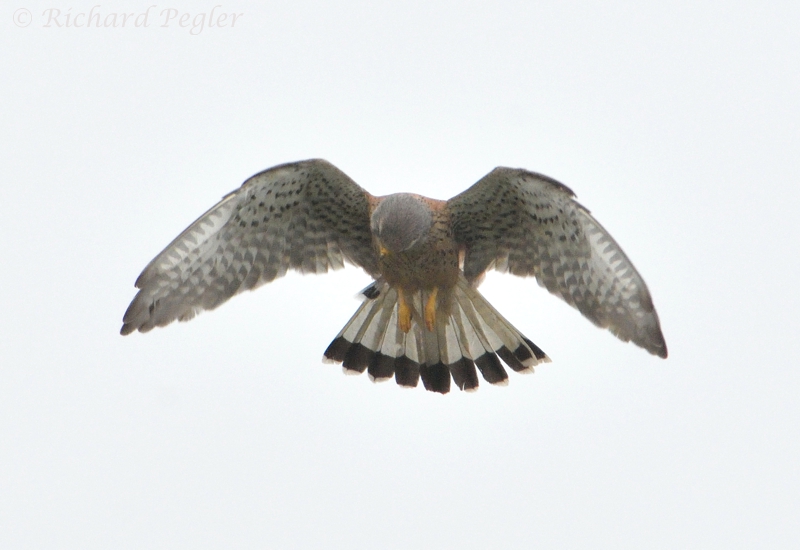
I was impressed by a Kestrel which was hunting nearby and was slowly heading in my direction. It was absolutely fascinating to watch how this bird was hovering with its body and wings moving with the wind, but its head was staying precisely in the samme spot as it tracked its prey.
 |
Common Kestrel (Falco tinnunculus) (male) - Portland Bill
|
I'd been by the quarry for a while when I noticed a young lady with binoculars approaching from the direction of The Obs, and she confirmed that she worked at The Obs and that, sadly, the Little Owls hadn't been in the quarry for a couple of years or more. She did, however, confirm that there were two pairs nesting on the nearby coast.
I found myself resorting to photographing insects once more.
 |
| hoverfly (Syrphus ribesii) (female) - Portland Bill |
 |
Small Skipper (Thymelicus sylvestris) (female) - Portland Bill
|
It was time to return to the headland to find Lindsay. She was drinking a coffee outside the cafe there, so I took the opportunity to have a quick look round for birds.
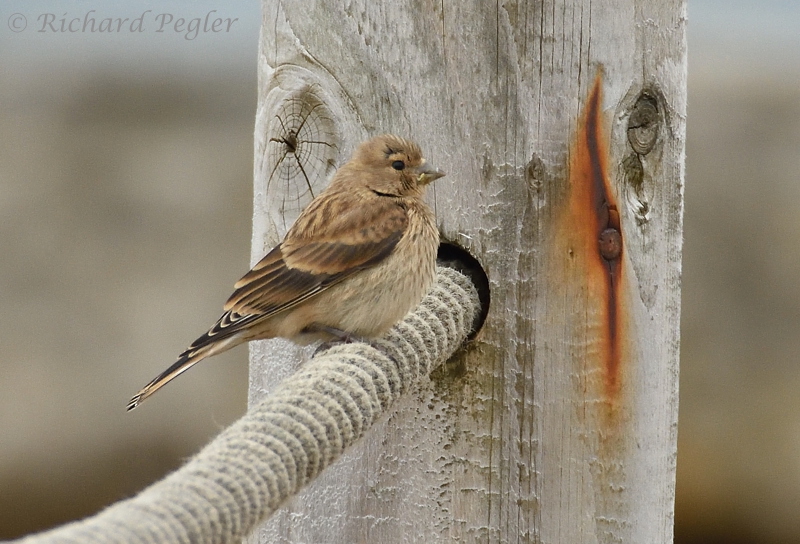
What I believe to be a young Linnet was on the path-side ropes.
 |
Linnet (Linaria cannabina) - Portland Bill
|
A Great Black-backed Gull was standing at a place that, from the debris around it, seems to have been its dining room!
 |
Great Black-backed Gull (Larus marinus) - Portland Bill
|
Rock Pipit is a reliable species here, and I was not disappointed.
 |
| Rock Pipit (Anthus petrosus) - Portland Bill |
|
|
It was now time to head over the causeway from Portland to the Crab House Cafe that is at the northern end of the causeway. This is one of our favourite lunch destinations and the fish here is always superb. In the display cabinet we noticed King Crab (otherwise known as Spider Crab). These were absolutely huge and, as this was a special occasion, we decided to go for it. Our waiter asked us if we had had King Crab before (we hadn't) and then warned us that these were not the easiest of things to tackle. We were undaunted. Before we were served, I popped out to the ablutions and on my way back was accosted by the waiter who asked if I wanted a large or medium crab. I said "two large ones please", to which he replied that Lindsay had already requested a medium one, so I let it stand at one large one for me and a medium one for Lindsay.
When the cutlery arrived, as well as the usual nut-crackers and crab-picks, we were provided with a full-sized ball-peen hammer and a polythene bag. The waiter explained that it would be necessary to strike the claws with the hammer, but that the polythene bag should be placed over it whilst doing so, to stop the bits and juices flying everywhere!
The crabs eventually arrived and, confusingly, the shells (which had been filled with a thick tasty sauce) had been swapped around so that the smaller crab was served with the larger shell. This image shows the situation before being rectified.
 |
King Crab meal - the Crab House Cafe, Chesil Beach
|
The crabs took us a full hour to demolish, and I never touched the pot of fries! We agreed that, while it had not been the tastiest of crabs we'd experienced, the meal had been thoroughly entertaining and memorable, and perfect for the occasion. As we departed, the crash of hammers striking crabs was still continuing as other diners attacked theirs!
Our next stop was at the Chesil Beach Visitor Centre where Lindsay wanted to buy some items in the excellent shop run by the local Wildife Trust. I took the opportunity while there to take a wander along the inland side of Chesil Beach which encloses The Fleet. At first I was seeing little, with this small crab, in decidedly poorer condition than the one I'd just eaten, being all that I initially photographed.
 |
crab - Chesil Beach
|
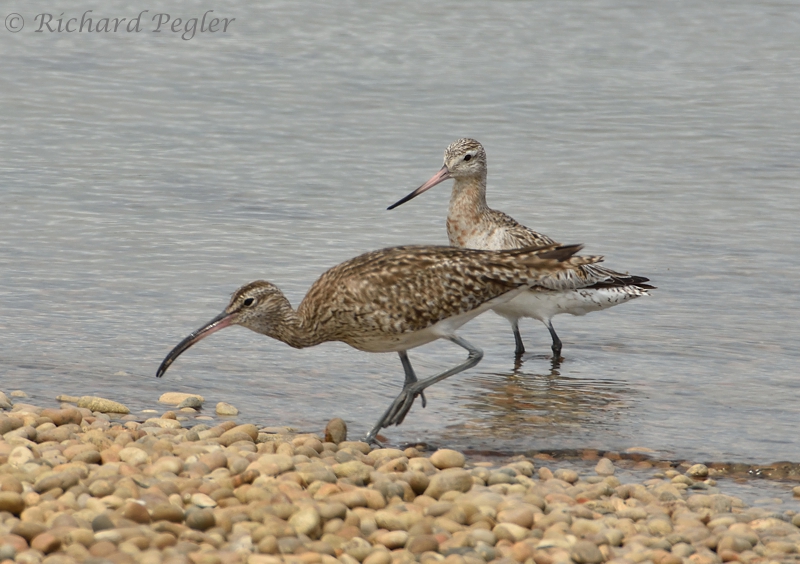
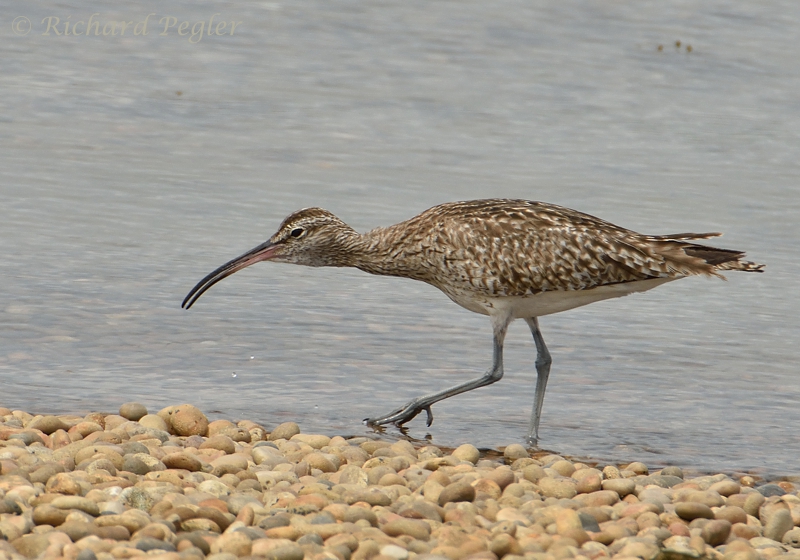
Walking in a westerly direction near the edge of The Fleet, I was pleased to find a Whimbrel and a Bar-tailed Godwit which seemed to have befriended each other.
 |
| Whimbrel (Numenius phaeopus) + Bar-tailed Godwit (Limosa lapponica) - The Fleet |
 |
| Bar-tailed Godwit (Limosa lapponica) - The Fleet |
|
 |
| Whimbrel (Numenius phaeopus) - The Fleet |
|
We then headed into Weymouth to make a brief visit to the RSPB reserve at Radipole Lake. Lindsay elected to stay in the visitor centre there, leaving me to wander into the reserve. I was hoping to see dragonflies, but only found a Blue-tailed Damselfly on a fence. I felt a bit silly the following day when I bumped into a dragonfly enthusiast who kindly pointed out that Radpole Lake was saline!
 |
| Blue-tailed Damselfly (Ischnura elegans) (female, fa. violacea) - Radipole Lake, Weymouth, Dorset |
Because I only allowed myself three quarters of an hour, I didn't spend long in any one spot. I only photographed a very obliging Dunnock on the path, and a very distant Great White Egret. I can't help but wonder how this species manages to accurately and rapidly control the movement of such a long and slender neck !
 |
| Dunnock (Prunella modularis) - Radipole Lake |
 |
Great White Egret (Ardea alba) - Radipole Lake
|
When I was almost back to my starting point, I spotted a small rodent beside the path. I'm relatively confident that this was a Bank Vole, but I will be happy to be corrected. The tail was a little hairy, rather than smooth or scaly.
 |
Bank Vole (Myodes glareolus) - Radipole Lake
|
At the visitor centre, one of the team there suggested to Lindsay that the nearby RSPB reserve at Lodmoor would be worth a visit, so we went there so that I could briefly check it out. It seemed like an attractive place, and in the short space of time that I was there I took a few photos.
 |
Black-headed Gull (Chroicocephalus ridibundus) - Lodmoor, Dorset
|
My experience of Grey Heron is that it is an extremely nervous bird, totally unapproachable and will take off if it sees you moving a hundred metres away. I was, therefore, more than a little surprised when one came wading past me as I was standing out in the open on the path at the edge of the water. It was so close that I had to wind the lens back to 240mm to fit it in!
 |
Grey Heron (Ardea cinerea) - Lodmoor
|
Dinner at the hotel that evening was again pleasant, but still with over-large portions of everything. The view was still misty!
All things considered, we'd had a pretty enjoyable anniversary!
Saturday, 25th June Berryfield Quarry ; Lodmoor ; Portland Museum ; Berryfield Quarry ; Portland Bill
We awoke to a warm day with much sun, but still very breezy. At breakfast we were, at last, able to fully enjoy the view from our breakfast table.
 |
| view from our breakfast table at The Heights Hotel |
The tourist map of Portland, freely available around the island, showed two locations marked as Butterfly Reserve. Lindsay fancied a visit to the Portland Museum, and the car park that serves the museum was beside one of these - Perryfield Quarry Butterfly Reserve. As we arrived well before the time that the museum opened at 10.30, I scrambled up the slope from the car park (much too steep for Lindsay to attempt) onto the reserve. It proved to be a magical place, full of flowers and butterflies. There was, however, still a problem with the stiff breeze that kept the butterflies low in the vegetation while blowing about, making photographing them difficult.
I was pleased to see good numbers of Pyramidal Orchid in fine condition.
 |
Pyramidal Orchid (Anacamptis pyramidalis) - Perryfield Quarry Butterfly Reserve, Portland
|
Here are some of the butterflies - the Common Blue that I saw was extremely worn!
 |
| Common Blue (Polyommatus icarus) (male) - Perryfield Quarry |
 |
| Red Admiral (Vanessa atalanta) - Perryfield Quarry |
 |
| Small Skipper (Thymelicus sylvestris) - Perryfield Quarry |
 |
| Large Skipper (Ochlodes sylvanus) (female) - Perryfield Quarry |
 |
| Meadow Brown (Maniola jurtina) (male) - Perryfield Quarry |
 |
| Marbled White ( Melanargia galathea) (male) - Perryfield Quarry |
 |
| Marbled White ( Melanargia galathea) (female) - Perryfield Quarry |
I didn't spend long here as Lindsay was sitting in the car in the car park, and we got to the museum just as it opened. It was an interesting museum, and we were the only visitors during our time there. Just before leaving, we enjoyed an ice cream, purchased at the entrance lobby.
A trip to try and find the Governor's Community Garden was disappointing as we could not find anywhere to park close enough for Lindsay to manage, and the nearby cafe did not have anything in that was suitable even for a light lunch, so we set off to find somewhere more appropriate and happened on The Little Ship Inn, near to the start of the causeway to the mainland. Lunch here, and the service were both absolutely excellent.
After lunch, we went to Lodmoor once more so that Lindsay could have a look around, as she'd not joined me on the reserve the previous day.
A drake Teal was particularly confiding.
 |
Teal (Anas crecca) (male) - Lodmoor
|
There were some distant Cormorants.
 |
Cormorant (Phalacrocorax carbo) - Lodmoor
|
There were plenty of Common Tern around.
 |
Common Tern (Sterna hirundo) - Lodmoor
|
Black-headed Gull were also present in good numbers, and not always without conflict!
 |
| Black-headed Gull (Chroicocephalus ridibundus) - Lodmoor, |
I'm completely stumped with the ID of this next gull, other than that it's immature and does not look particularly happy or healthy.
 |
gull sp. - Lodmoor
|
As we left, I found a caterpillar crossing the path. I'm relatively certain that this was the larva of an Oak Eggar moth.
 |
Oak Eggar (Lasiocampa quercus) (larva) - Lodmoor
|
Earlier, when I'd been at Perryfield Quarry, I thought I'd found a way in that Lindsay could manage and, as she expressed a wish to see the orchids, we returned to the car park. This descision was reinforced by a wish to have another ice cream at the museum.
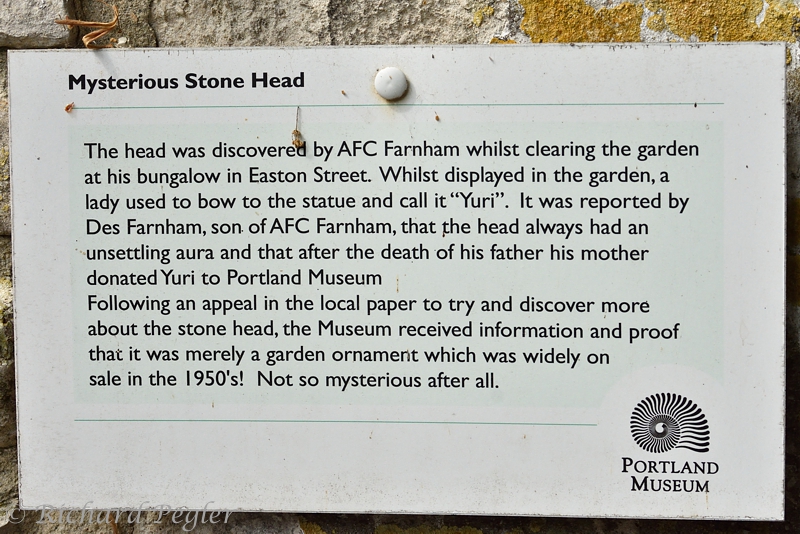
At the museum, I couldn't resist taking shots of one exhibit!
 |
Exhibit at Portland Museum
|
After ice cream, I did a quick recce and did find a manageable route into Perryfield Quarry for Lindsay. I photographed little on this occasion but was pleased to see a Ringlet butterfly.
 |
Ringlet (Aphantopus hyperantus) (male) - Perryfield Quarry
|
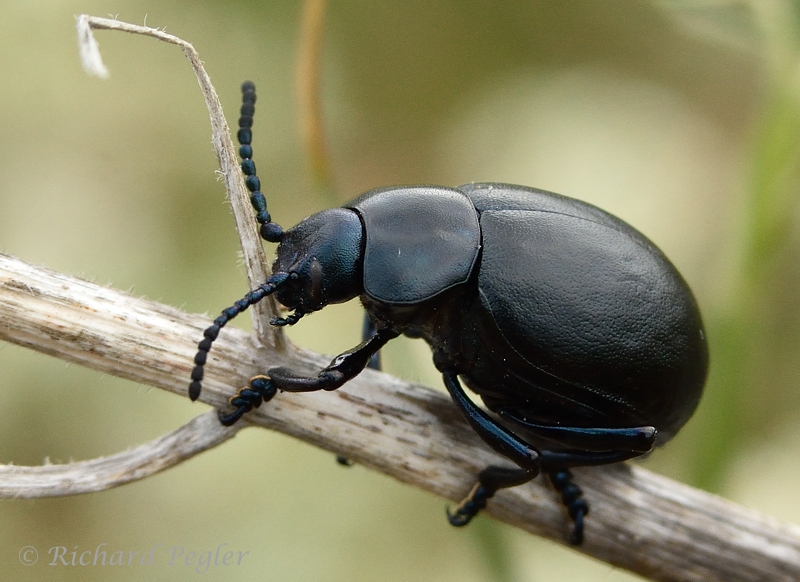
I also photographed two rather large beetles. These were at locations probably around 200 metres apart, but were of the same species - Bloody-nosed Beetle - so named bcause, when threatened, they exude a distasteful red substance from their mouths. They are flightless, and what might appear to be two separate wing cases are, in fact, fused together.
 |
Bloody-nosed Beetle (Timarcha tenebricosa) - Perryfield Quarry
|
Lindsay requested a return to the headland of Portland Bill, and I was more than happy to oblige.
Someone I know has a penchant for lighthouses. This is a particularly fine one, in my opinion - I hope that you agree, David!
 |
Portland Bill Lighthouse
|
I spent a little while being enchanted by the action of waves on the rocky coast.
 |
The Coast - Portland Bill
|
I took my last photos of the break, which were of common birds.
 |
| Great Black-backed Gull (Larus marinus) - Portland Bill |
 |
| Rock Pipit (Anthus petrosus) - Portland Bill |
Dinner that night was much the same as on the preious two nights.
Sunday, 26th June Portland to Ashby de la Zouch
After breakfast, we set off homeward. Happily, our route took us close to Chettle Village Store once more, and we stopped in to buy the locally produced makings of a picnic lunch to be consumed en-route. Lindsay chose a pie, and I chose an enormous sausage roll as the prime item for consumption. Lindsay said her pie was absolutely wonderful, and my sausage roll was the best I've ever tasted! We stopped to consume these just inside the grounds of Highclere Castle, which was closed to visitors for an event.
We reached home in the mid-afternoon at the end of what had been a most enjoyable break. If it sounds as if I had abandoned Lindsay for great swathes of time, I assure you that I hadn't, with my lone wanderings being brief during this special occasion.
This brings me to the end of this account. I intend my next blog post to be the final part of my account of our May visit to the Outer Hebrides and this will probably appear in about a week's time.
In the meantime, thank you for your visit. Please take good care of yourselves and Nature - - - Richard
Footnote to Pete:- If it seems that I've hijacked your recent blogpost titles, Pete, I had decided on the title for this post even before we left Dorset - it's just an accidental coincidence!
Footnote 2:- When proof reading this post I, fortunately, noticed that in my first sentence I'd missed the first 'e' out of 'milestone' - I'm not kidding! At least I hadn't substituted an 'l' for the 'e'!