This is the third, and final, part of my report on our excellent stay on the Isles of Scilly this autumn. You can find Pt.1 here:- http://peglerbirding.blogspot.com/2020/10/scilly-sojourns-septemberoctober-2020.html, and Pt.2 here:- http://peglerbirding.blogspot.com/2020/11/scilly-sojourns-septemberoctober-2020.html
It had been a mixed start to our stay weather-wise, which even led to our arrival being delayed by a day. Sadly, the poor weather was to continue up to the time of our departure. Here is an account of our last days of the break.
Saturday, 3rd October
The forecast was for continuing very windy weather, but with some sunny spells. Scillonian III was not sailing that day, due to the weather, neither was the Gry Maritha which brings supplies from the mainland to the islands, but flights were back in action.
My plan was to start with visiting some inland locations before taking a coastal path and braving the high winds.
As I set off, I was delighted to see a Wheatear on the beach below our base. I was seeing more Wheatear on the beaches than I was inland during this visit!
 |
Wheatear (Oenanthe oenanthe) - Littleporth
|
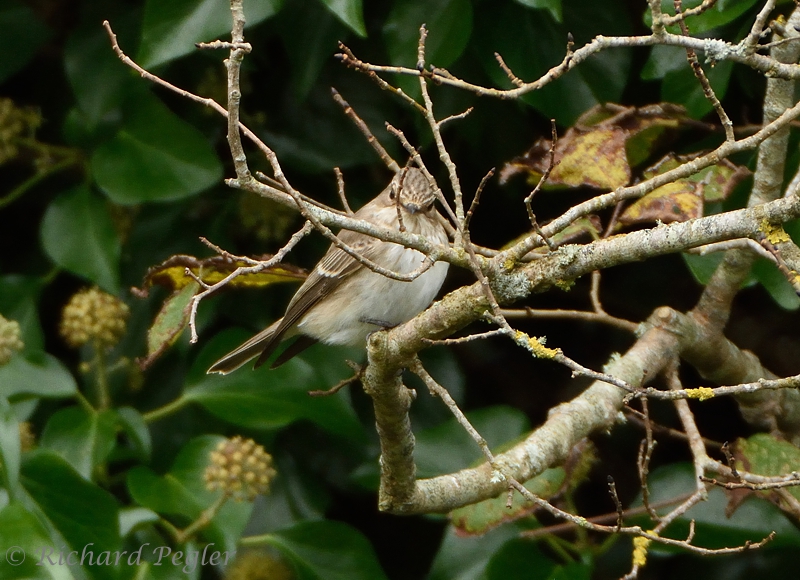
I then made my way up Buzza Hill, turning left at the top to gain the Old Town road. As I reached the entrance to the road to Carn Gwaval, I noticed a group of three people looking intently into a field. They kindly informed me that they had been looking at a Spotted Flycatcher. It soon re-appeared and I was quite surprised to see it catch a Red Admiral butterfly which it took to a tree on the far side of the field.
 |
Spotted Flycatcher (Muscicapa striata) - Carn Gwaval
|
After a while, it came a little closer and I got a better shot.
 |
| Spotted Flycatcher (Muscicapa striata) - Carn Gwaval |
There had been a Jack Snipe reported visible from the screen beside the ISBG hide on Lower Moors, so I thought that I'd take a look. As I arrived, a gentleman who was coming away said that it was just about visible just to the right of the rock opposite the screen. 'Just about visible' was an accurate description but I did manage a few record shots. On examining my shots, however, I am fairly well convinced that this was a Common Snipe rather than a Jack Snipe as the bird appears to have a pale stripe along the top of its crown, and no dark line above the eye. I do not know whether this bird had been mis-identified or I was looking at a different bird, but it was exactly in the place as described!
 |
Snipe (Gallinago gallinago) - Lower Moors
|
I set off back to Old Town and took the road that heads round the eastern side of Old Town Bay and then the path round Porth Minick, stopping at the eastern end to photograph a Speckled Wood butterfly, before heading up to Church Point where, on the edge of the airport runway turning circle, I found another Wheatear - this one wan't on a beach! It seemed to be feeding well and has a caterpillar in the second image.
A Goldcrest on the loop trail at Higher Moors managed to avoid my camera and I passed through without spotting anything else of interest.
Beside the road opposite the northern entrance to Higher Moors, I found another Speckled Wood ssp. insula to photograph. I had never noticed how, under certain lighting conditions, this species shows a blue-greenish colour in the wings - parhaps it is a feature of the subspecies?
 |
Speckled Wood (Pararge aegeria, ssp. insula) - by entrance to Higher Moors
|
From here, I set off for Old Town, noticing a Grey Heron on the far side of a field by the airport turn. My initial thought was that it was a long way from water, but I see that it was probably only around 200 metres from the water in Lower Moors. It's a pity that that fence wire was there!
 |
| Grey Heron (Ardea cinerea) - near Airport turn |
I called in at Lower Moors once more, and the Snipe was still there in the same place, but had moved its head. My record shots do nothing to convince me that it was anything but a Common Snipe.
 |
| Snipe (Gallinago gallinago) - Lower Moors |
I had been out walking for a few hours by now, and was getting tired and hungry so it was time to head back to base.
In the field before the road to the Medical Centre, there were Rabbits. I photographed one before realising that it was in an extremely poor state through Myxomatosis, so I will not present an upsetting image of it here.
I took the Buzza Tower route back to base, stopping by the end of Littleporth beach to photograph a Chiffchaff.
 |
Chiffchaff (Phylloscopus collybita) - Littleporth
|
I didn't feel up to doing much more that day, having been out in a strong wind, carrying camera gear, and without a sit-down for just over four hours. However, I did pop out onto the sea wall path at Littleporth for half an hour later that afternoon, when the tide was in.
It was good to see the Porthcressa Three cruising past.
 |
the Porthcressa Three - Littleporth
|
I also took more shots of Rock Pipit, and was surprised at how vertiginous a rock face the Rock Pipit can cling to.
 |
Rock Pipit (Anthus petrosus) - Littleporth
|
Sunday, 4th October
This was to be our last full day on the Scillies, with us taking a flight back to the mainland the following morning. The morning was forecast to be very windy with showers, with the afternoon being cloudy but extremely windy. Transport between the islands and the mainland does not operate on Sundays, but even if it did, it would not be operating this Sunday!
It had just been published that various trails on St Mary's were now open. These trails are a feature of the migration season when landowners give permission for birders to follow set routes, clearly marked out by the Isles of Scilly Bird Group, across their land. I had never experienced these routes before, so resolved to try one, and also to visit the Standing Stones field which was also open under the same arrangements.
In the morning, I stayed close to base, just spending time along the path at the bottom of the garden. The Stonechats were busy at the western end of the beach. Yes, we've managed to get all this way on this blog post without a Stonechat until now!
 |
Stonechat (Saxicola rubicola) (female) - Littleporth | Stonechat (Saxicola rubicola) (male) - Littleporth
|
|
I took a shot of a gull without paying much attention to it, and now find that I am uncertain of its identity. My feeling is that it's a Black-headed Gull, and that the light conditions are stopping the black 'ear-smudge' from showing. The long red legs and the bill colouration seem to indicate this. The head and bill seem very slim and elegant, however, but I am not used to looking at Black-headed Gull at this sort of angle. Please correct me if I am wrong.
 |
Black-headed Gull (Chroicocephalus ridibundus) - Littleporth
|
Oystercatchers were at the waterline. |
| Oystercatcher (Haematopus ostralegus) - Littleporth |
I had only had a couple of very distant sightings of seals during this stay but, on this occasion, one did come a little closer to enable me to identify it.
 |
Grey Seal (Halichoerus grypus) - Littleporth
|
|
A Grey Heron put in an appearance.
 |
Grey Heron (Ardea cinerea) - Littleporth
|
At mid-day I went back to base to get myself an early light lunch and then set off in the afternoon with waterproof equipment in case of rain.
I set off up Buzza Hill and then turned towards Old Town, stopping at Carn Gwaval Lane to see if the Spotted Flycatcher was still there - it was, but it was not very cooperative before it flew over the road and down towards the School.
 |
| Spotted Flycatcher (Muscicapa striata) - Carn Gwaval |
A quick look from the screen at ISBG hide on Lower Moors showed nothing of interest, so I turned round and wandered over Standing Stones Field to the gate by the school playing fields. By the gate I spotted a tiny bird flitting around in a rather dense tree, and felt sure that I had found another Goldcrest. It then suddenly showed and flew off, distinctly showing the head markings of a Firecrest! I tried for some time to relocate the bird but failed.
I returned to Old Town Bay, where I found a Pied Wagtail.
 |
Pied Wagtail (Motacilla alba ssp. yarrellii) - Old Town Bay
|
I had a quick look at Porth Minnick in extremely windy conditions and was not surprised to see nothing. I then returned to Old Town Bay and took the path in front of the church towards Carn Léh. From by Carn Léh, the Peninnis Trail starts and takes a twisting route up the hillside through cattle fields to a point on King Edward's Road on Peninnis. The trail yielded absolutely nothing of interest, but it was very windy on the trail.
I then decided to go onto Peninnis Head, but this turned out to be an uncomfortable experience in the gale. I did, however, take a shot of a sheltering Meadow Pipit.
 |
Meadow Pipit (Anthus pratensis) - Peninnis
|
It started to rain again, which was rather unpleasant on Peninnis and I headed for home, taking the King Edwards Road - Buzza Hill route rather than the exposed western Peninnis path.
My last photos of the holiday were, appropriately, of Stonechat, back at Littleporth!
 |
| Stonechat (Saxicola rubicola) (female) - Littleporth |
 |
| Stonechat (Saxicola rubicola) (male) - Littleporth |
The rest of the day was spent sorting out ready for our departure the following morning.
Monday, 5th October
We were booked on the 10h10 flight to Land's End, which meant a relatively early start so that we could have breakfast, and dismantle bedding, etc. in line with the request of the property owners. It was good to know that they too were being extremely cautious about exposure to the Covid virus. Paulger's Transport came to pick us up at 09h10 and we arrived at the airport in good time and found ourselves in a queue to check in at a desk that was unmanned.
When the check-in opened, it was a speedy and painless process, but Lindsay and I were a little disappointed at being given boarding tickets for seats Nos. 16 and 17. On this 17-seat plane, seats 15,16,and 17 are in a back row of three seats and it meant, so we thought, that one of us would have someone sat right beside us. When called to the briefing room, we were pleasantly surprised to find that there were only six passengers on the plane and the nearest person to us was two rows away on the opposite side of the plane!
We took off on time and had a pleasant flight back to the mainland. Baggage was soon reclaimed and we were back in our car and on our way home. The journey was uneventful and relatively pleasant, with comfort stops made en-route. Home was reached by 16h30.
Weather-wise, it had probably been our worst stay on the Scillies, and the birding hadn't been brilliant compared to previous visits either - again through weather conditions affecting the birds and limiting my own excursions to see them. However, Lindsay and I both agreed that it was probably our most enjoyable stay there as it was a much-needed change from the relative drudgery of the year since our visit there in March this year, just days before lock-down.
I'd set out with just four prime wildlife objectives for the visit, and am more than happy that I achieved three of them - I just failed on Wryneck. Three out of four ain't bad (as someone once said) and it's always good to be left with something that needs to be achieved in the future!
My thanks to all concerned for a great stay, with particular mention for Jenny Hicks, the Isles of Scilly Bird Group, the Isles of Scilly Wildlife Trust, Hugh Town Co-op and Becky's Scilly Cakes! We are booked to return twice next year, and hope that we will be able to take up those bookings - time will tell!
My next post will be a catch up on things back at home since my last post on local matters up to 27th September. I suspect that it will be a thin one, as not much has been observed wildlife-wise since then, due to other activiteies and poor weather.
We are now in full lockdown once more, and only permitted out locally in order to take exercise or go shopping. We do not intend to do much of the latter!
Until the next time, take great care and stay safe, but make the most of any wildlife opportunities that come your way.