Pages

Notes on Use of This Blog


1. I have a policy that I always reply to comments on my blog, even if it's just to say thank you.

2. Please don't submit comments that include your own web address. For obvious reasons, they will not be published.

3. I'm now on Twitter - @RichardPegler1
Showing posts with label Coot. Show all posts

Sunday, 14 April 2024

Slow March Pt.2 - 16th to 31st March,2024

This blog post gives an account of some of the highlights of what was a rather gentle month in terms of excursions, but included a few welcome harbingers of spring.

Sunday, 17th March          Nature Alive, Coalville

It was a relatively sunny day, and quite warm too. I fancied a short trip out, but had to take into consideration the fact that, being fine weather after a period of poor weather, and a Sunday also, most of my usual haunts that were not still under water would be busy with people. I had heard of the Nature Alive nature reserve in Coalville but never visited. It was formed on a brown-field site of a relatively small area, trapped between a railway line, the Coalville ring road, and a small retail park. It has some ponds, the largest of which was formed by mining subsidence.

Having parked my car and entered the site, I walked up the slope to the embankment (on which a railway branch line to Swarkestone to the north once ran), and then descended the other side and found myself confronted by a torrent of water about 4 inches (10cm) deep running down the path towards me. Fortunately I had put on wellingtons, so was able to pass along the path undeterred. It was only about 15 metres until I reached dry land and was able to explore.

In one of the two smaller ponds I found there was a Coot having a splash-about.

Coot (Fulica atra) - Nature Alive
At the main lake, a pair of drake Mallards were having an interaction.
 
Mallard (Anas platyrhynchos) (male) - Nature Alive
One of them then approached me, possibly hoping to be fed!
 
Mallard (Anas platyrhynchos) (male) - Nature Alive
I carried on past the main lake, finding a few insects enjoying the flowers in the sunshine.
 
Buff-tailed Bumblebee (Bombus terrestris) - Nature Alive

Hairy-footed Flower Bee (Anthophora plumipes) (male) - Nature Alive

There were some eye-catching clumps of Marsh Marigold around.
 
Marsh Marigold (Caltha palustris) - Nature Alive
Arriving back at the main lake, there were two drake Shoveler in the distance.

Shoveler (Spatula clypeata) (male) - Nature Alive
Before I left, I could not resist taking a shot of one of the many magnificent clumps of Primrose that were on the site.

Primula (Primula vulgaris) - Nature alive

Monday, 18th March          Garden

This was a very special day, due to our first (and, so far, only) sighting of the year of Redpoll in our garden. It was a splendid male, and I did manage some shots, although I'd have been happier if I got some that were not on a feeder. Lesser Redpoll is a 'red-listed' species.

Lesser Redpoll (Acanthis cabaret) (male) - our garden
Tuesday, 19th March          Saltersford Valley Country Park  :  Donisthorpe Rail Trail

A quick visit to Saltersford Valley CP in the afternoon was a little disappointing in that the boardwalk was still closed, water levels were very high, and paths were still flooded. I saw nothing of real interest and only photographed a Mute Swan which appeared to have some staining from the discoloured water caused by leakage from the old coal mine workings.

Mute Swan (Cygnus olor) - Saltersford Valley CP
As I had spent so little time here, I decided to check out the disused railway line that is now a public trail, accessible from by the church on Church Street, Donisthorpe.

Again I found little to occupy me, but I did manage to get some photos of a Red-legged Partridge - a species that I have not photographed for a while.

Red-legged Partridge (Alectoris rufa) - Donisthorpe Rail Trail
The only other photos I took were of a lone wild violet.

Common Dog Violet (Viola riviniana) - Donisthorpe Rail Trail
Wednesday, 20th March          Garden  :  Bardon Hill area

We were visited by two male Siskin on this day, and I managed a few shots of one of them, away from the feeders.

Siskin (Spinus spinus) (male) - our garden

The previous day, there had been reports of a group of approximately 25 Waxwings on an industrial estate near Bardon Hill. As Bardon Hill is quite local to me, I felt compelled to visit for what might be my last chance of seeing a Waxwing of the season. I did a bit of research on Google Earth and sorted out where I was going to park in an area where most roads are very busy with trucks. 

Having parked, I only had to walk a couple of hundred metres before I spotted the flock in a distant tree, a little away from the area that they had been reported in. I took some records shots, as shown below.

Bohemian Waxwing (Bombycilla garrulus) - Bardon Hill Industrial Estate
I counted 31 birds before I retraced my steps back to the road that my car was parked on, in the hope of being able to find another viewpoint for the birds that was perhaps a little nearer and not into the light, although it was not particularly bright weather.

I soon realised that there was no prospect of seeing the perched birds from this road and, to my dismay, the flock flew over my head and headed south in the approximate direction of the road that I was on. I followed the road to the end, but saw no sign of the Waxwings anywhere, although I did get a distant view of a Buzzard perched in a tree.

Common Buzzard (Buteo buteo) - Bardon Hill area
Thursday, 21st March          Garden

At the back end of last year, we had got used to regular visits from Magpie. However, this year they have become rather more elusive. On this day, two Magpies visited and I managed to catch one snaffling some dried Black Soldier-fly lavae that I'd tipped out of one of the Hedgehog feeding trays.

Magpie (Pica pica) - our garden
Friday, 22nd March          Our Conservatory

I noticed a small spider crawling up the window frame in our conservatory. I have not been able to positively identify it, but believe it to be one of the Philodromus species. If I had to make a guess, I'd say a female Philodromus dispar. It was released into the wild.

possible (Philodromus dispar) (female) - our conservatory
That afternoon I went to Calke Explore, which I have already reported on.

Friday, 29th March          Garden

This was something of a red letter day, as a Comma butterfly visited the garden - the first of the year. It was a bit tatty, so I believe it to be one that had emerged from winter hibernation.

Comma (Polygonia c-album) - our garden
Although a very common bird, the male Chaffinch is rather handsome.

Chaffinch (Fringilla coelebs) (male) - our garden

Saturday, 30th March          Garden  :  Willesley Wood

This was a good day for buterflies in the garden, with Brimstone, Peacock, and Small Tortoiseshell being seen. I only got usable photos of the Small Tortoiseshell.
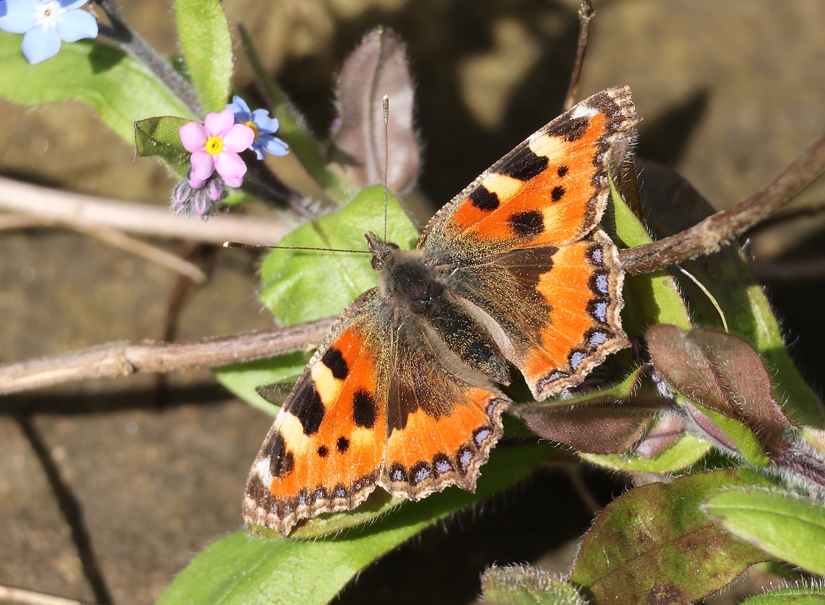
Small Tortoiseshell (Aglais urticae) - our garden
I was also pleased to see my first Bee-fly of the year.

Dark-edged Bee-fly (Bombylius major) - our garden
Seeing the butterflies in the garden prompted me to visit a local place which has been relatively productive for butterflies, including Brimstone.

I arrived and parked the car - although it is close to home, the road between my house and Willesley Wood is very dangerous to walk along as it is a narrow bendy road, running between dense hedges and has no verges.  There is, therefore, no option but to walk in the road, along which cars tend to travel at high speed.

As soon as I entered the site, I saw a Brimstone butterfly but it was distant and mobile, and soon disappeared. 

There were very deep puddles along the path and I was glad that I was wearing wellingtons. As I approached Thortit Lake I was astounded by how high the water level was. I suspect that it was about a metre above its usual level, and was approximately 4 inches (100 cm) deep over the path at one point. I wish, now, that I had taken some photos to illustrate this.

A female Mute Swan was busy tidying a nest, possibly incubating eggs, and it struck me that while this nest was currently like an island near the edge of the water, and quite safe from the many dogs that are walked here, when the water level receded to its normal situation the nest would be some distance from the water, and high and dry.

Mute Swan (Cygnus olor) (female) - Thortit Lake

A little further on, the male swan was dabbling around. That tree trunk, surrounded by water, is usually well out of the water.

Mute Swan (Cygnus olor) (male) - Thortit Lake

Close by, there was a Coot which seemed more confiding than I'm used to with this species.

Coot (Fulica atra) - Thortit Lake

There was little happening on the north side of the lake so I headed off in an anti-clockwise perambulation. Reaching the path on the south side of the lake, I was surprised to see water reaching up to the path. Usually, water is not visible from this path as it is about 150 metres away, through densely packed trees. 

At one point, I had nice views of a Heron.

Grey Heron (Ardea cinerea) - Thortit Lake


I also found my second Bee-fly of the year!

Dark-edged Bee-fly (Bombylius major) -Willesley Wood

I then headed back to my car, stopping to photograph a very tatty Peacock by the exit gate.

Peacock (Aglais io) - Willesley Wood

I was just about to get into my car, when a Brimstone flew by and stopped briefly, further up the lane. I followed it for a while and eventually it stopped long enough for me to take a record shot.

Brimstone (Gonepteryx rhamni) (male) - Willesley Woodside

Sunday, 31st March          Garden

Not a particularly eventful day but I had a rare opportunity to photograph a Wren in the garden - it is not the presence of the Wren that is rare, but the opportunity to photograph one, as they are forever on the move and soon vanish!

Wren (Troglodytes troglodytes) - our garden
 

Thus ended what I believe was the wettest March on record. Fortunately, the weather seems to be improving a little and spring has now sprung - fingers are crossed that we continue to get some more helpful wildlife watching opportunities.

As usual, I expect my next blog post to be in about a week's time. In the meantime, please take good care of yourselves and Nature. Thank you for dropping by - - - Richard


Sunday, 3 March 2024

All's Well That Ends Well - February 26th, 2024

Lindsay's recovery from her knee replacement is progressing nicely, and she now has enough confidence that she is happy for me to go out and leave her for up to three hours, provided that I'm at the end of a telephone and not too far away time-wise. In fact, she is now encouraging me to take time out.

On this day, having made sure that she was well equipped with all that she might need during my absence, I set off in the middle of the afternoon for a location that is about half an hour from our home. The weather forecast was for sunny periods with occasional showers, and this is what it turned out to be.

I am not going to divulge the name of the location that I headed to, as the regulars there do not want it to become overcrowded. 

I arrived to find just one other person on site. Like me, he was there hoping to get some photographs and had been there for about an hour without seeing anything of interest.

Soon after I arrived, a Wren made its presence known with its ridiculously loud voice for such a tiny bird.

Wren (Troglodytes troglodytes) - undisclosed location
After I had been there for about half an hour, another gentleman arrived porting a camera. Over the next hour, I took a few photos of two of three other species of bird that came into view, mainly to check on camera settings and excercise my shutter finger.

Coot (Fulica atra) - undisclosed site
Little Grebe (Tachybaptus ruficollis) - undisclosed site

The person that had arrived last decided that the light had gone and, as nothing was happening, he'd depart. He had only been gone about five minutes, and I had just said to my original companion that I was going to have to head off myself in five minutes, when a Kingfisher arrived on the scene and landed on a post in the middle of the water.

Kingfisher (Alcedo atthis) (male) - undisclosed site
I quickly messaged Lindsay to check that it was OK if I was a few minutes late - it was!

The Kingfisher left the post and flew into a tree at the edge of the water. Sadly it was partially obscured by branches, but the effect of the 'flowers' was rather attractive.

Kingfisher (Alcedo atthis) (male) - undisclosed site
It did dive and caught a fish. I missed photographing the dive, and when it returned to the tree with the fish, my camera misfocused, so those shots were scrapped.

It then flew to a stick in the water that was nearer to our position. I'm rather pleased that the light on the water was such that the distance between the bird and the water resulted in a plain background. I realise that it might look as if the background has been 'photoshopped' out, but the only processes applied (other than a crop) were altering the 'colour balance' and the 'brightness, contrast, intensity' - the light was not good at this time!


Kingfisher (Alcedo atthis) (male) - undisclosed site
The bird then briefly flew to another stick in the water, but didn't stop long enough for a shot, before heading back to its original perch in the middle of the water.
 
Kingfisher (Alcedo atthis) (male) - undisclosed site

From there, it soon disappeared behind some distant reeds, but we didn't have to wait very long before it emerged and settled in some reeds where it was visible - albeit at quite a great distance.

Kingfisher (Alcedo atthis) (male) - undisclosed site
It stayed there for some time before it flew, and disappeared behind reeds even further away. It was now time to head home and I was just saying goodbye to my companion when I noticed a Barn Owl, off to my left. 

We both moved to a place a few metres away where we could see it more clearly, and I managed some very distant flight shots which were just about usable

Barn Owl (Tyto alba) - undisclosed site
It then settled on a dead branch for a while.


Barn Owl (Tyto alba) - undisclosed site


I got another opportunity for flight shots, but didn't fare any better as it was at some distance and against trees, making focus difficult.

Barn Owl (Tyto alba) - undisclosed site

It next settled high in an even more distant tree, before disappearing down a path that we were going to have to take in order to get to our cars.

Barn Owl (Tyto alba) - undisclosed site

We looked out for it as we headed back to our cars, but didn't spot it.

Thus ended a visit that started off disappointingly, but ended up being one of the most enjoyable and rewarding sessions that I've had for many months.

My next blog post will probably be back to happenings in our garden, as the weather forecast is for another rather wet spell.

In the meantime, please take good care of yourselves and Nature. Thank you for dropping by - - - Richard

Sunday, 25 February 2024

Soggy Situations - 15th to 21st February, 2024

It has not just been Lindsay's lack of mobility that has limited my time out in the last few weeks, but an unprecedented amount of rainfall has been a major factor too. This has rendered most of the local wildlife spots to be unpleasantly muddy and waterlogged and, in some cases, impassable. Once again, therefore, this blog post will be mainly concerned with observations from the windows of my study (which now doubles as Lindsay's bedroom, where she has an adjustable hospital bed) and our conservatory.

Thursday, 15th February          Garden

In the afternoon, I collected Lindsay from hospital, two days after her knee replacement. In the morning, however, I did note a good number of birds in the garden, including two female Siskins - we'd previously only seen one visiting this winter, although we'd seen singles of both male and female.

Siskin (Spinus spinus) (female x 2) + House Sparrow & Greenfinch - our garden
The female Blackcap was still visiting occasionally, and she showed up on this day. 

Blackcap (Sylvia atricapilla) (female) - our garden
Friday, 16th  February          Garden

The only bird I photographed this day was a Great Tit. Great Tit is a very common bird, but an irregular visitor to the garden. Of late, however, I am frequently hearing its distinctive calls.

Great Tit (Parus major) - our garden
Saturday, 17th February          Garden

The male Brambling returned on this day. It continues to avoid posing nicely for me.

Brambling (Fringilla montifringilla) (male) - our garden
Sunday, 18th February          Garden

It's a poor shot, I know, but I include it as it does show the exquisite markings on the back of a male Brambling.

Brambling (Fringilla montifringilla) (male) - our garden
I have recently become conscious of the fact that I tend to overlook the most common birds that visit our garden when it comes to photography. With this in mind, I took some shots of the very common Chaffinch. They are rather beautiful birds.

Chaffinch (Fringilla coelebs) (female) - our garden

Chaffinch (Fringilla coelebs) (male) - our garden

Monday, 19th February          Garden  :  Kelham Bridge Nature Reserve

On this day, in the morning, we were visited by both male and female Siskin, and I managed to get a record shot of the male up in the Rowan, outside my study window.

Siskin (Spinus spinus) (male) - our garden

That afternoon, Lindsay stated that she was feeling very confident about her situation, and encouraged me to go out. I settled on a short visit to Kelham Bridge Nature Reserve as I hadn't been there for a while. I expected it to be very muddy, and so took my wellington boots. However, it was far more muddy than I anticipated. The paths were treacherous and I could see where people had skidded on the mud. In places the water on the path was quite deep and in othe places I found that the mud was deep and strong enough that, on a few occasions, I nearly lost a wellie.

I spent some time at the first hide which was devoid of people and nothing interesting was observed in the twenty minutes that I was there. The only thing I photographed was a squirrel.

Grey Squirrel (Sciurus carolinensis) - Kelham Bridge NR
I then made my way, gingerly, to the second hide which was busy with people and no window seats available. However, I didn't have to wait long. There was little to see on this occasion, but it was good to chat with people. Initially, I just had distant views of Coot and Little Grebe.

Coot (Fulica atra) - Kelham Bridge NR
Eventually, one of the Little Grebes came very much closer. I do have a soft spot for this species.


Little Grebe (Tachybaptus ruficollis) - Kelham Bridge NR
A Coot also came a little closer.

Coot (Fulica atra) - Kelham Bridge NR
Shortly before I left, a Kingfisher flashed through. I reckon that it was in view for less than two seconds. The consensus was that it had probably gone to the pool where the first hide is, but there was a less muddy route to the entrance gate available, and none of us wished to check out that possibility. It was time for me to get back to Lindsay and cook tea, so I took the less muddy route which turned out to be much quicker and safer.

Tuesday, 20th February          Garden

I was greatly excited this day as, for the first time in many years, we had two Brambling visit the garden, as can be seen in the image below, with them high up in our nut tree.

Brambling (Fringilla montifringilla) - our garden
Sadly, one soon departed and only one came down to feed. I did not get to see whether the one on the right was male or female. The male that came to feed was a little more obliging.


Brambling (Fringilla montifringilla) (male) - our garden

I usually find it impossible to determine the sex of a Stock Dove but, for the first time ever, on this occasion I saw the puffing up of the neck on this bird, which surely suggests that this was a displaying male.


Stock Dove (Columba oenas) (male?) - our garden

Wednesday, 21st February          Garden

It's always good to see a Bullfinch and even better to see a Brambling, but to get two together is a real treat - even if they were on a feeder.

Bullfinch (Pyrrhula pyrrhula) (male) + Brambling (Fringilla montifringilla) (male) - our garden
- - and I'll end with a Bullfinch.

Bullfinch (Pyrrhula pyrrhula) (male) - our garden
With luck, my next blog post will be in about a week's time but, at the current rate of progress, it might be a bit thin on material! In the meantime, please take good care of yourselves and Nature. Thank you for dropping by - - - Richard