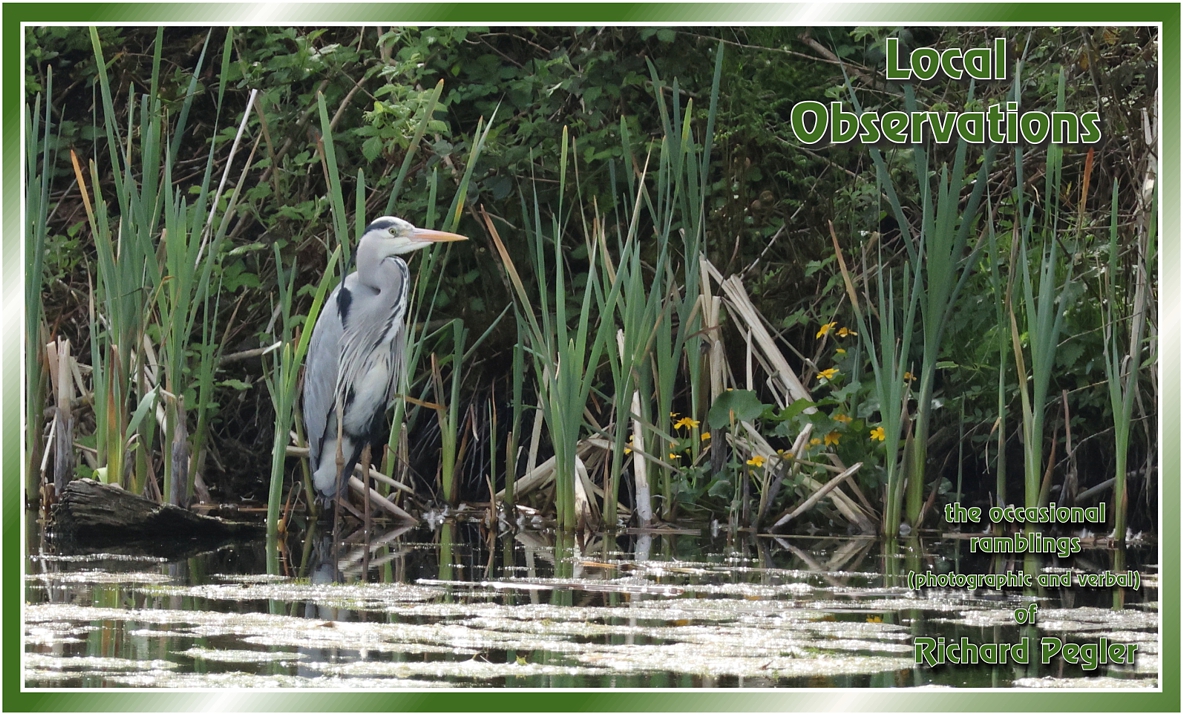
header image (while this post is current):- Fisher's Mill Pool, RSPB Middleton Lakes on 23rd February, 2023
With Lindsay's situation continuing to improve, we were both confident that I could safely leave her for more than the two or three hours that I'd limited myself to lately, and go a little further afield. It also meant that I was not having to spend so much time keeping the household afloat, and could start trying to catch up with projects around the house and garden that needed attending to. The result was that, although I did get out twice in the seven days, I spent little time observing what was happening in the garden.
Wednesday, 22nd February Garden
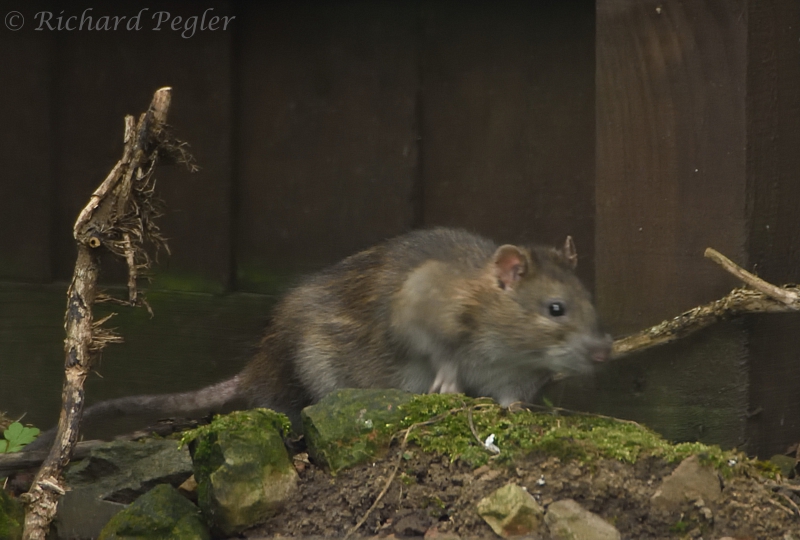
This was the last day that I had recorded a Redpoll in the garden - until today (3rd March). However, we also had an unwelcome visitor in the form of a Brown Rat. I had been rather lax in sweeping up spilled seed from the feeders and this was, no doubt, the result of my failure. I quickly swept up but, unfortunately the rat was seen again yesterday (2nd March).
 |
| Brown Rat (Rattus norvegicus) - garden on 22nd February, 2023 |
Thursday, 23rd February RSPB Middleton Lakes
In my last blog post, I mentioned that I'd met my old pal Mick Smith at Hicks Lodge that week. Mick, and his wife Pauline, had been extolling the virtues of Miiddleton Lakes Nature Reserve. I have never been to this reserve before, although it is less than 20 miles (30 km) from my home. The reserve is just south of Tamworth on the west side of the River Tame. I have, however, in the distant past (2011), been to Dosthill on the opposite side of the river to photograph Short-eared Owls.
For the first time since Lindsay's operation in esarly December, I made myself a picnic lunch and headed off for a short 'day out'. Middleton Lakes seemed like an obvious choice.
It was a relatively easy journey there and I parked in the RSPB car park, headed into the courtyard at nearby Middleton Hall to check what might be there for a future visit by Lindsay and to avail myself of the ablutions there (none on the RSPB reserve).
I'd armed myself with a map of the reserve that I'd downloaded from the internet and, having enjoyed a short introduction to the reserve by a volunteer at the reserves entrance, set off into the reserve.
 |
RSPB Middleton Lakes Map
|
I feel that I should point out that the signage in the reserve is not great and, without the map, I would almost certainly (1) got lost, and (2) missed a lot.
It is approximately 1 km from the car park entrance, along the Woodland Trail, to the first lake, and I had not travelled far along the trail before I was greeted by a Dunnock. A Dunnock may not be the most colourful of birds but I think the feathering of the side of the face is wonderful.
 |
Dunnock (Prunella modularis) - Woodland Trail, Middleton Lakes
|
A very short distance further on, there is a small pond on the left with feeders beside it. I stopped to survey the area just before I got to the feeders as there were youngsters busy watching the birds on the feeders and the rats on the ground. It was all very common fare, and I didn't attempt any photography there.
Further on, on the right, there is another area with views over some water and reed beds. Here there is also a set-up which is desctibed (if I remember correctly) as a 'bird kitchen', where people put out seed on an arrangement of tree stumps to attract the birds. I spent a little while here, but nothing of interest was seen.
It was quite a bit further on that I came to what is described as 'Pooh Stick Bridge'. I stayed here a while as Lesser Spotted Woodpecker was being seen here on a virtually daily basis, but usually early in the morning. However, the best that I could manage was a shot of a busy Nuthatch.
 |
Nuthatch (Sitta europaea) - Pooh Stick Bridge, Middleton Lakes
|
The trail crosses the Birmingham and Fazeley Canal at Fisher's Mill Bridge. Here, people had been leaving bird sees on the bridge parapet and this was attracting mainly Robins, and Great Tits, but some Reed Buntings were showing an interest and being quite bold.
 |
| Reed Bunting (Emberiza schoeniclus) (male) - Fisher's Mill Bridge, Middleton Lakes |
 |
| Reed Bunting (Emberiza schoeniclus) (female) - Fisher's Mill Bridge, Middleton Lakes |
It's only about 50 metres from Fisher's Mill Bridge to Fishers Mill Pool, at a point where I took the shot that is the header to this blog while this post is current. Here, although the birds were all distant, the noise being made by the gulls was tremendous!
I turned northwards here, seeing little of interest as I passed along the west side of Fisher's Mill Pool. I stopped at the West Scrape blind when I reached the area known as Jubilee Wetlands, but again saw little.
Part way along the west side of Jubilee Wetlands, a pair of Greylag Geese flew in and landed with a group of their congeners on the grass to the west of the trail. The second image, below, serves as a warning not to stand under flying geese!
 |
Greylag Goose (Anser anser) - by Jubilee Wetlands, Middleton Lakes
|
As I approached the northern end of Jubilee Wetlands, I noticed a large number of swans on the far side of Jubilee Wetlands North. Through my binoculars, I was surprised to see the furthest and largest group seemed to have very yellow bills. My immediate thought was Whooper Swan. A birder was coming from the opposite direction and I asked him if I was correct in my identification. He responded that he wasn't sure, but had been looking for Bewicks Swans. While we were busy talking, the swans took to the air and I grabbed my camera and took some shots as they flew past. I commented that I thought that it was the first time that I'd seen Whooper Swans in flight. Later, I was asked by persons on a few occasions if I'd seen anything interesting, and I'd replied that the most interesting thing for me had been the Whoopers. I was, therefore, highly disappointed and extremely embarrased when, on reviewing my shots when I got home, I found that these swans were only Mute Swans! How I'd managed to see yellow bills I don't know - it must have been a trick of the light. Anyhow, I did manage to get some acceptable shots of the Mute Swans.

 |
Mute Swan (Cygnus olor) - Jubilee Wetlands, Middleton Lakes
|
A little further on, I found a Coot in a small pool of water.
 |
Coot (Fulica Atra) - Jubilee Wetlands North, Middleton Lakes
|
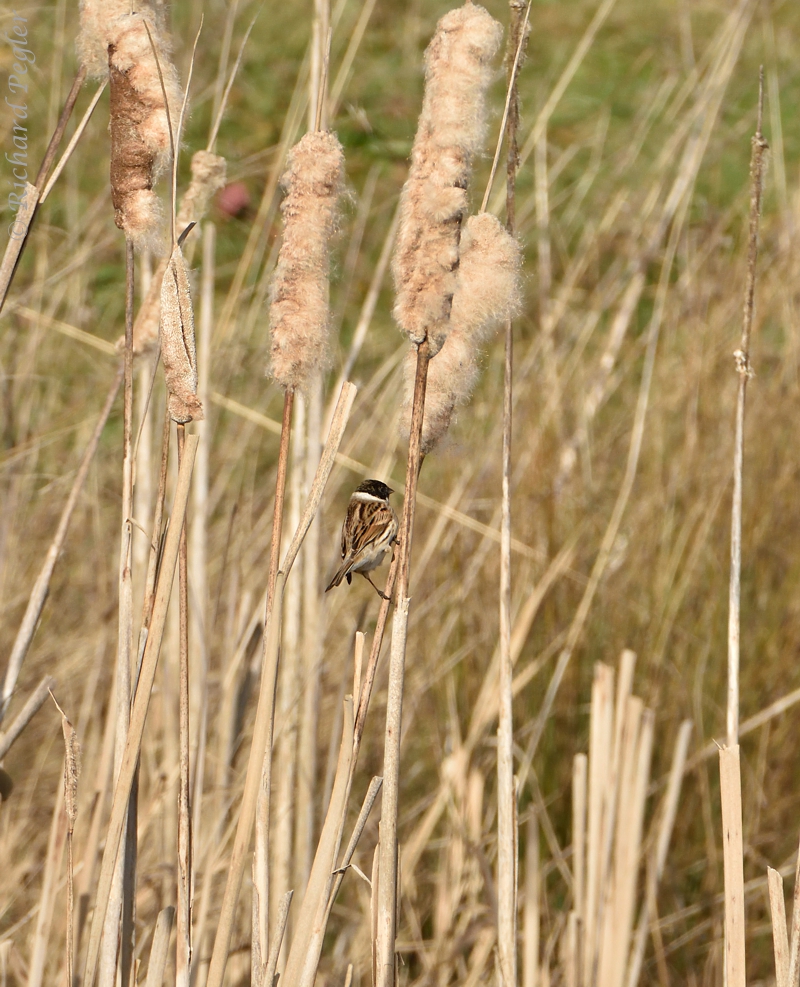
Near to the start of the track that leads to North Pool and The Lookout, I could not resist a shot of a Reed Bunting in its more natural environment.
 |
| Reed Bunting (Emberiza schoeniclus) (male) - near The Lookout, Middleton Lakes |
From the path to The Lookout, I photographed a nearby lone Great Crested Grebe.
 |
Great Crested Grebe (Podiceps cristatus) - near The Lookout, Middleton Lakes
|
I spent a while in The Lookout but, although there were many birds visible, they were all beyond the reach of my camera lens, and nothing out of the ordinary was spotted.
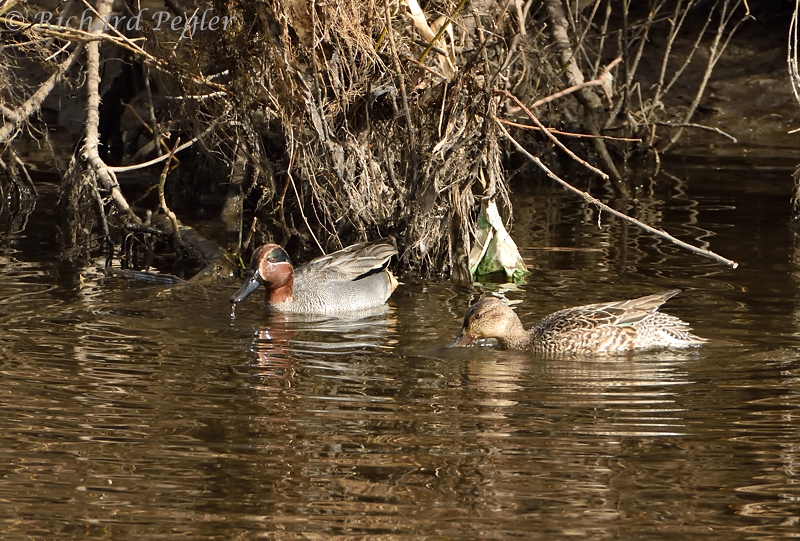
I made my return journey down the east side of the reserve, and the trail runs alongside the River Tame for most of its length. I did not bother photographing the Mute Swan in the river, but did try, rather unsuccessfully, to photograph some Teal which, surprisingly, didn't fly off as soon as I was in sight. I only managed to salvage one shot from here. Sadly, that shot features an item of detritus, not spotted at the time of taking it.
 |
Teal (Anas crecca) (male + female) -River Tame, Middleton Lakes
|
Reaching the eastern end of the seasonal trail that crosses between Fishers Mill New Reedbed and Jubilee Wetlands, I stopped at the junction, and just missed getting a shot of a Treecreeper.
Turning down the seasonal trail there was a Kestrel in the distance ahead of me. Sadly, I was shooting straight into the light, so I only got a very distant record shot, and can't tell for certain whether this was a male or female bird, but I suspect the latter.
 |
Kestrel (Falco tinnunculus) - from seasonal trail, Middleton Lakes
|
I went a short way down the seasonal trail and stopped at the East Scrape blind to see what was visible. There were several Shoveler in view, but not much else.
 |
Shoveler (Spatula clypeata) (male + female) - by East Scrape, Middleton Lakes
|
Wanting to see as much of the reserve as possible, I turned back, and then took the footbridge that crosses the River Tame to Dosthill Nature Reserve. I had a quick scan about from the top of the bridge and decided that Dosthill would have to wait until another day. Coming back off the bridge, I continued round the east and south sides of Fisher's Mill Pool, seeing absolutely nothing of interest.
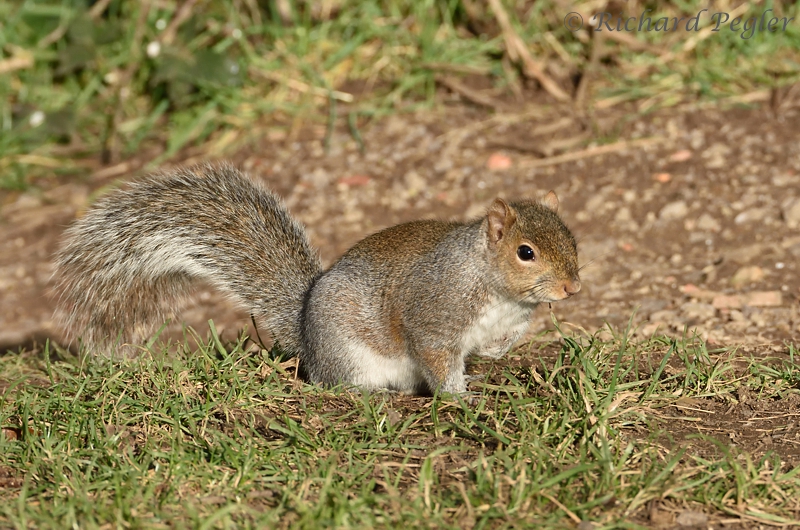
Back at Fisher's Mill Bridge, a squirrel was looking for a snack, and a Dunnock posed nicely in a nearby bush.
 |
| Grey Squirrel (Sciurus carolinensis) - Fisher's Mill Bridge, Middleton Lakes |
 |
| Dunnock (Prunella modularis) - Fisher's Mill Bridge, Middleton Lakes |
I stopped at the bird kitchen for a while, and spent a short while photographing a Blue Tit.
 |
Blue Tit (Cyanistes caeruleus) - the 'bird kitchen', Middleton Lakes
|
Opposite this area, there is a stream that runs beside the trail. Here, a Grey Wagtail flew past, and I failed to locate it again.
I got back to my car after just under four hours on the reserve. Although I had not seen or photographed anything outstanding, it had been a very enjoyable time. The reserve is full of promise, and I look forward to returning in the not too distant future, and taking things at a more relaxed pace. My thanks, again, to Mick and Pauline Smith for inspiring me to visit this place.
Friday, 24th February Garden
The numbers of birds visiting the garden have thinned out, almost certainly being put off by the frequent visits by the Sparrowhawk. I have, therefore, had limited opportunities for garden photography.
 |
Sparrowhawk (Accipiter nisus) - garden on 24th February, 2023
|
In our front garden, a pair of Goldfinch were canoodling in the top of our small Pink Pagoda Mountain Ash, staying stationary and just making facial contact for a least twenty minutes.
 |
Goldfinch (Carduelis carduelis) - garden on 24th February, 2023
|
Saturday, 25th February GardenAfter a long absence, the female Pied Wagtail made a brief return visit this day, but I only managed a rear-end view from the kitchen window.
 |
Pied Wagtail (Motacilla alba yarrellii) - garden on 25th February, 2023
|
To our delight, we are seeing Wren more frequently recently. Here's a shot of Wren in a fuchsia which, after many years, now seems to have been killed off by the extended cold spell earlier this winter.
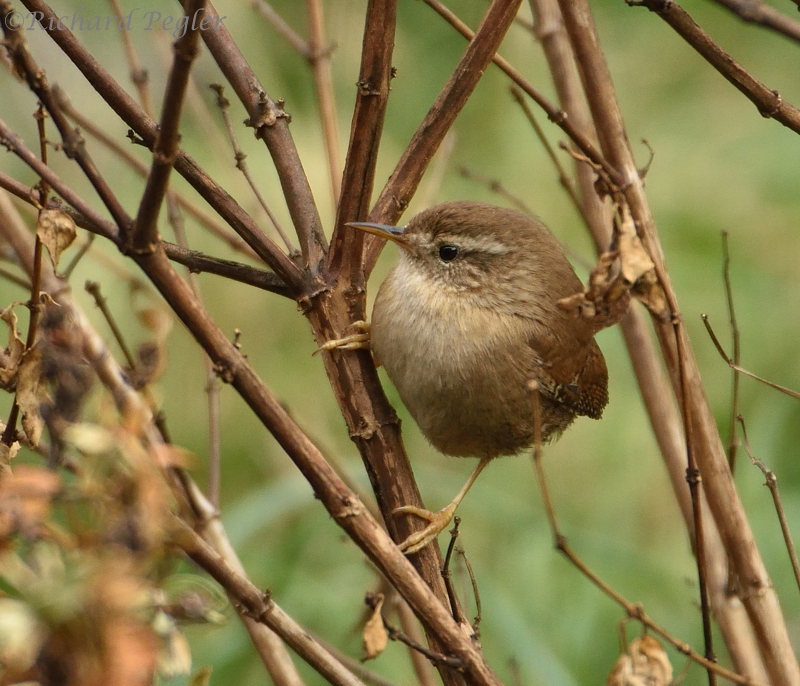 |
Wren (Troglodytes troglodytes) - garden on 25th February, 2023
|
Sunday, 26th February Kelham Bridge ; Normanton le HeathAn early afternoon visit to Kelham Bridge started off quite well as I was hearing the chatter of Fieldfare as I entered the site. I only managed photos of one bird and that was with difficulty as it was in a tree with another tree in front of it and I had difficulty in finding a gap to shoot through.
 |
Fieldfare (Turdus pilaris) - Kelham Bridge NR
|
Things then went rapidly down hill as, when I got nearer to the first hide, the tranquility of the day was shattered by the sound of unsilenced trail bikes. There were two of these machines which were on a circuit and passing at high speed within about 20 metres of the hide. Unsurprisingly there were no birds seen in the vicinity.
I didn't stay long, but moved on to the second hide. Here, it was much quieter, but there was little to see. Three pairs of Gadwall stayed distant, as did a lone Little Grebe, and the only other birds on the water were Mallards. However, the sun was shining, and a drake Mallard is a truly handsome duck - especially when in sunlight.
 |
Mallard (Anas platyrhynchos) (male) - Kelham Bridge NR
|
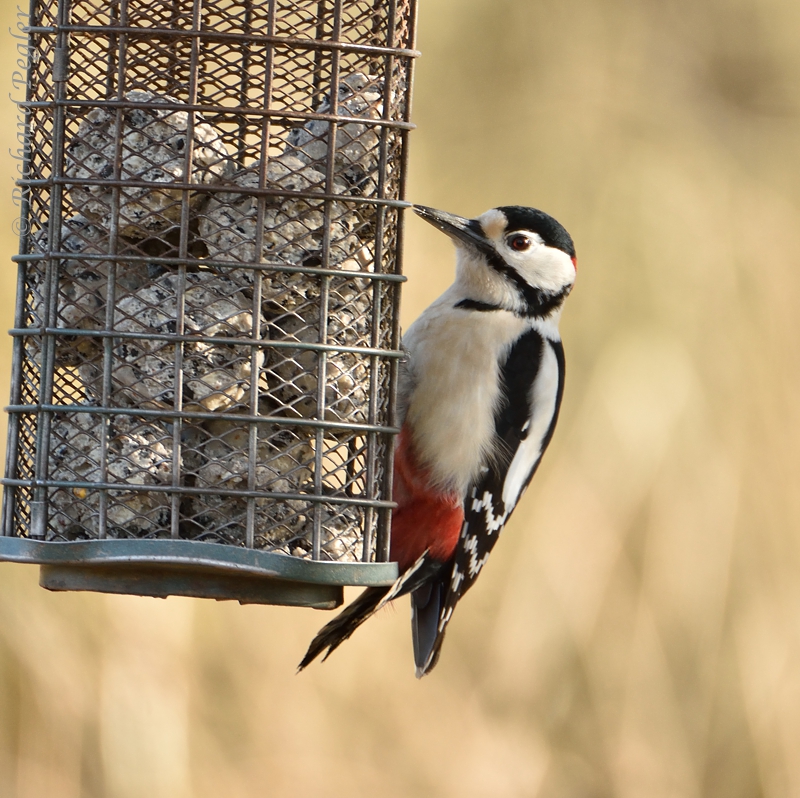
After about three quarters of an hour, I gave up and was pleased to find, on returning to the first hide, that the idiots on bikes had gone and peace had returned, as had a few birds. Contrary to my principles, all I have to offer from this stop is a shot of a woodpecker on a feeder - I felt I needed to add something to the account of this visit!
 |
Great Spotted Woodpecker (Dendrocopos major) (male) - Kelham Bridge NR
|
I chose to make a short diversion on my way home, taking in Redburrow Lane from Normanton le Heath. I was disappointed to see that it was likely that some poor child had lost it's favourite teddybear. I hope that it was reclaimed from its seat before the rain set in that night.
 |
Redburrow Lane, Normanton le Heath
|
I took a short walk along the lane when I got to the barn, and was enchanted by the song of a Song Thrush that was atop the derelict barn which used to be home to both Little Owl and Barn Owl before half the roof collapsed.
 |
Song Thrush (Turdus philomelos) - Redburrow Lane, Normanton le Heath
|
Tuesday, 28th February GardenThe weather on this last day of February, was pretty grim, with rain for most of the day. It did not, however, stop us having a rare visit from a female Reed Bunting. I managed to get a few (much manipulated) shots of it through the rain-spattered window on my study by holding the lens close to the glass.
 |
Reed Bunting (Emberiza schoeniclus) (female) -garden on 28th February, 2023
|
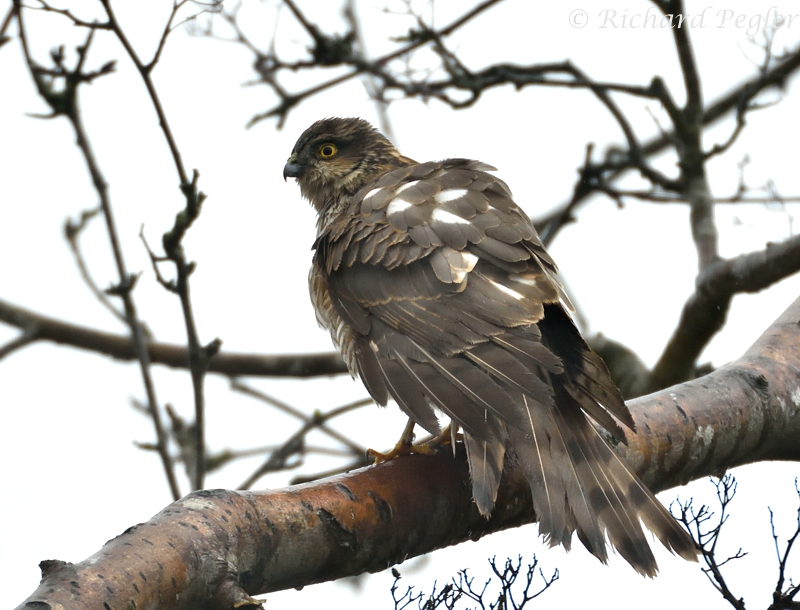
The Sparrowhawk was still visiting, and I got a number of shots, including this one of it having lost its composure, and looking slightly less manacing than usual.
 |
| Sparrowhawk (Accipiter nisus) - garden on 28th February, 2023 |
Thus ended February. March is now upon us and I will endeavour to produce another blog post in a week or so's time. In the meantime, please take good care of yourselves and Nature. Thank you for dropping by - - - Richard