Pages

Notes on Use of This Blog


1. I have a policy that I always reply to comments on my blog, even if it's just to say thank you.

2. Please don't submit comments that include your own web address. For obvious reasons, they will not be published.

3. I'm now on Twitter - @RichardPegler1
Showing posts with label Z UK Mammals. Show all posts

Sunday, 7 April 2024

Slow March Pt.1 - 1st to 15th March,2024

For reasons previously explained, I didn't get out much during March, and most of the excursions I did manage have been covered in previous posts. This will be an account of some of my other observations in the first half of the month.

Friday, 1st March          Garden

Much to our delight, the male Brambling was still visiting us on most days. I was pleased to get a shot of this bird in flight - albeit a rather poor one.
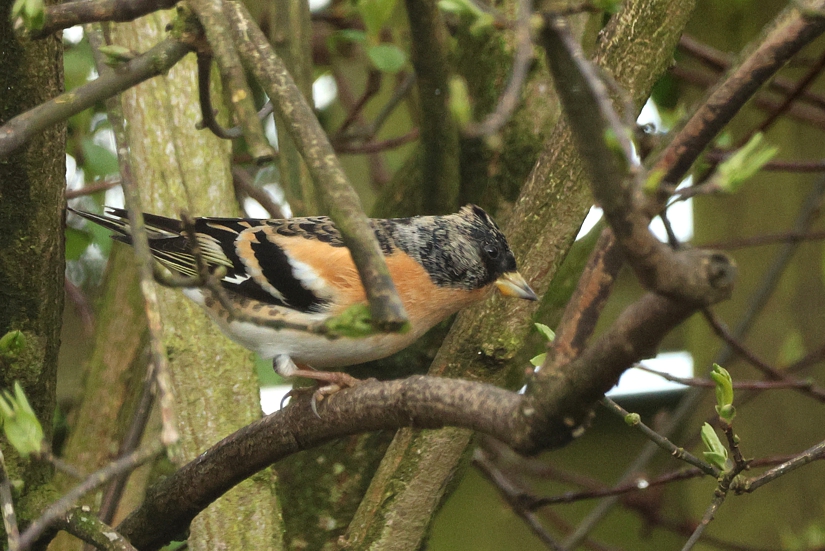


Brambling (Fringilla montifringilla) (male) - our garden

Saturday, 2nd March          Staunton Harold  :  Melbourne Pool

On 29th February, Lindsay and I had visited Melbourne. During that visit, we'd called in at a charity shop in the grounds of Melbourne Hall and Lindsay had spent a little while browsing through the books there. After we'd got back home again, she did some resaerch on a cookery book she'd seen there and come to the conclusion that she wished she had bought it. That day, I'd also taken a walk beside Melbourne Pool and thought I'd seen what might have been a Red-crested Pochard in the distance. This bird is rated locally as being 'uncommon, probably feral'. It is, nevertheless, a very attractive duck.
 
A Saturday is not a good day to visit Melbourne as it gets very busy, and car parking can be hard to find. It made sense, therefore, for me to visit Melbourne on my own this day, not having to worry about parking too far away from the shop for Lindsay to walk. It also meant that I could take more time out to walk round the pool.
 
Due to a long-term road closure and the official diversion route being a long one, I took a short cut through Staunton Harold deciding to stop there briefly to see if the Cattle Egret was still there. A swan greeted me as I arrived.

Mute Swan (Cygnus olor) - Staunton Harold
It took me a little while to find the egret, as it was tucked down in some reeds. Eventually it woke up and became more visible and, by moving further along the road, I got a better photo.
 
Cattle Egret (Bubulcus ibis) - Staunton Harold

Having returned to my car, I headed off to Melbourne and did manage to find a parking space quite close to Melbourne Hall. I hurried to the charity shop and was relieved to find the book that Lindsay wanted was still there. I quickly took it back to the car, and set off to Melbourne Pool with my camera.

I won't trouble you with most of the photos that I took, but this one, of a Black-headed Gull landing on the water, I thought was a bit unusual.

Black-headed Gull (Chroicocephalus ridibundus) - Melbourne Pool

From the road on the east side of the pool I could see a Red-crested Pochard in the far distance - this was with my lens at the full 400mm.
 
Red-crested Pochard (Netta rufina) (male) - Melbourne Pool

If the duck stayed in the same area, I would be able to photograph it from a well-used footpath that ran closer to its location, so I set off in that direction, taking another shot of Black-headed Gull as I did so.

Black-headed Gull (Chroicocephalus ridibundus) - Melbourne Pool

I got to a point where I could get some closer shots, but the bird was still at quite a distance.
 
Red-crested Pochard (Netta rufina) (male) - Melbourne Pool
I then stood behind the trunk of a tree, in the hope that the bird would come even closer - I suspect that this was to the amusement of the several passing dog-walkers. It did, eventually come a little closer, and I got some better shots, although far from perfect, before it drifted out into the centre of the pool. In the first image, below, it is enjoying a good scratch.
 
Red-crested Pochard (Netta rufina) (male) - Melbourne Pool

I returned home, happy to have seen my target, whilst earning a few brownie-points with Lindsay.

Sunday, 3rd March          Garden

The Hedgehogs came out of hibernation early this year, and we have had up to three different ones visit us in a night. On this occasion, there was a bit of an altercation between two hogs, as can be seen in the video below. The cat that appears is one of many that visit our garden (at least five), and I have named 'Ghost'.
 
Hedgehog (Erinaceus europaeus) - our garden
 
Monday, 4th March          Garden
 
A female Blackcap had now become a regular visitor, and was very fond of the 'flutter butter' that I make (blitzed peanuts in lard). She was back to this treat several times a day.

Blackcap (Sylvia atricapilla) (female) - our garden
Tuesday, 5th March          Garden

On this day, the male Brambling brought a female with him. Sadly, it seems that she was not impressed enough to return.

Brambling (Fringilla montifringilla) (female) - our garden

We were still getting frequent visits by three Carrion Crows. This is one of them on that day.

Carrion Crow (Corvus corone) - our garden
Sadly, Stock Dove has become a less frequent visitor, and when we do see one, it is usually a single bird.
 
Stock Dove (Columba oenas) - our garden
Friday, 8th March          Garden
 
Here is the Blackcap again on her favourite twig from which she launched herself into the 'flutter butter' feeder.
 
Blackcap (Sylvia atricapilla) (female) - our garden

Saturday, 9th March          Garden
 
A visit by Great Tit is not unusual in our garden, and they usually go for our sunflower hearts or flutter butter. However, I don't recall ever before seeing one probing in the moss on the wall, like a Wren often does. I missed the shot of the probing, but here is the bird.
 
Great Tit (Parus major) - our garden

Sadly, this next shot is my last one of the male Bullfinch that had been visiting our garden several times a day all winter. Three days later it was taken by a Sparrowhawk, dashing our hopes that, one day, he'd find a mate and bring her to visit.
 
Bullfinch (Pyrrhula pyrrhula) (male) - our garden

Tuesday, 12th March          Garden
 
It had been mainly male Siskins that had shown up in our garden, so the arrival of a female this day was a real pleasure. I only managed shots on a feeder, however.

Siskin (Spinus spinus) (female) - our garden

I was quite excited when a female Sparrowhawk landed on the trellis at the bottom of the garden as, usually, it is male Sparrowhawks that we see.

Sparrowhawk (Accipiter nisus) (female) - our garden

It did not stay long in that position, but shot off to the left round the back of our viburnum, reappearing a second or two later, landing on the ground in front of its previous position. I didn't spot anything in its talons, but could tell from its actions that it had got prey. I still couldn't spot the prey when it saw me and departed at speed. However, when I zoom in close to my photos of it on the ground I can just detect the red breast of a male Bullfinch in its talons, and the lack of subsequent sightings of our Bullfinch bears this out.
 
Sparrowhawk (Accipiter nisus) (female) - our garden

Wednesday, 13th March          Garden
 
This day was quite remarkable, in that we had a group of six Siskin visit - four males and two females. The best photo that I could manage, however, was of just three males on a feeder.

Siskin (Spinus spinus) (male) - our garden

Friday, 15th March          Garden

This day, a male Sparrowhawk stopped briefly in the Rowan outside my study.

Sparrowhawk (Accipiter nisus) (male) - our garden


I'll bring this account to a close now. With luck, Pt.2 will follow in about a week's time. In the meantime, please take good care of yourselves and Nature. Thank you for dropping by - - - Richard

Sunday, 31 March 2024

Calke Unbottled Again - 22nd March, 2024

Before I dive into the meat of this blog post, I'd just like to give an update on matters in the Pegler household. My regular readers will know that Lindsay has been going through a rough time this past eighteen months. This was due to a knee replacement that didn't go according to plan, leading to a drastic failure of her other knee which was compensating for the first one. We had to have her second knee replaced privately in February as it was looking like a two year waiting list for it to be done under our National Health Service. Couple this with a painfully arthritic hip which is also booked for a replacement, she has been through a lot. However, things are very much on the up, and her mobility and comfort are increasing day by day.

You may also have noticed that there has been the occasional reference by some of my followers to my own condition. I will explain.

Early in October, I sought medical advice on some problems I was having, which turned out to be sciatica. However, during that consultation, some of my symptoms, including weight loss, raised the possibility of me having cancer. This was obviously a great worry, particularly as I was concerned about the continuity of me being able to look after Lindsay in her state of disability. It took a month for me to be given an appointment for an x-ray to investigate the situation and the results were inconclusive. It was then decided that I needed an ultrasound scan. This resulted in nearly another month of delay for an appointment that I attended, only to be told that they couldn't do the scan because someone had forgotten to tell me that I had to fast for six hours beforehand. It was another six weeks before they could give me another appointment. When the scan came through, they showed a thickening of the liver and gallbladder and I was told that cancer could still not be ruled out.  I was then advised that I needed a CT scan. The appointment came through for 12th February. After the scan I was told that it would take two to three weeks for the results to come through. By this time I was getting considerably uncomfortable - both physically and mentally. When they did come through, I was relieved to be told that I probably did not have cancer, but that I had calcification of the gallbladder and gall stones too. I was given an appointment with a surgeon on 11th March who said that there was no sign of cancer, but that I needed to have my gallbladder removed. This was, of course, great news. The operation is now scheduled for late April and, if all goes to plan, should be via keyhole surgery, with me being discharged the same day. I am now quite relaxed mentally but, because the pain had greatly increased in the past four weeks and was interfering with my sleep and making me feel quite ill, am now on painkillers and anti-inflammatories.

Because of all of the above, my excursions out have all been quite short and to places requiring the minimum of physical exertion.

This blog post concerns one of those excursions where I did a reasonable amount of walking, but all on the flat. 

Friday, 22nd March          Staunton Harold  :  Calke Park

A fine weather afternoon was forecast, and I felt the need for some bird photography, with one or both of the hides at Calk Park being my chosen destination.

Due to a long-term road closure a long diversion was in place, but I managed to short-cut this by passing through the grounds of Staunton Harold. It occurred to me that, while I did so, I could call in to see if the Cattle Egret was still here. When I got to the location, I found that the sheep had all gone and there was no sign of the Cattle Egret, which had favoured the sheep pasture.

My route then took me to a corner from which it is possible to walk into Calke Park. A few hundred metres up the lane from the gate was where I once had a Little Owl site. My last sighting of an owl here was in July 2015 when I took Canadian friends Miriam and David there, and Miriam was the first to spot an owl. Sadly, on this day, I found that the tree that had been occupied by the owls had totally decayed to nothing. The nearby wet area which sometimes hosts Mandarin Duck was also devoid of any birds.

I returned to my car and drove round to the main entrance to Calke Park, parked in the Calke Explore car park, and trotted off to the nearby hide. As I approached the hide, I found my first hoverfly of the year, on the boardwalk - a Tapered Dronefly.

Tapered Dronefly (Eristalis pertinax) (male) - Calke Park
There were just two people (a couple) in the hide when I arrived and they turned out to be amiable companions. There were plenty of birds visible from the hide - mainly of common species. I was soon exercising my shutter finger.

Reed Bunting (Emberiza schoeniclus) (male) - Calke Park

I had not been in the hide long, when one of my companions drew my attention to a Water Rail that was approaching down the watercourse that passes near to the hide. I will now be giving you a bit of an overload of Water Rail images, as this is a species that I do not often get the opportunity to photograph, and this was probably my best ever views of a Water Rail.


Water Rail (Rallus aquaticus) - Calke Park

There is something magical and enchanting about the movement of a Water Rail, and so I was pleased to get some video from this session too.


Water Rail (Rallus aquaticus) - Calke Park
Eventually the Water Rail departed whence it came, and I settled in to photographing the other birds.

Robin put in a few appearances.

Robin (Erithacus rubecula) - Calke Park
I have a soft spot for Dunnocks. The markings on the face are beautiful, although they do not show so well in these images.


Dunnock (Prunella modularis) - Calke Park
Reed Bunting (male and female) made frequent visits. My personal preference in the beauty stakes is for the female.

Reed Bunting (Emberiza schoeniclus) (male) - Calke Park

Reed Bunting (Emberiza schoeniclus) (female) - Calke Park

Five species of tit were seen, but I failed to get shots of Coal Tit and Long-tailed Tit. 

Great Tit (Parus major) - Calke Park


Blue Tit (Cyanistes caeruleus) - Calke Park
I was most excited, however, to see that Marsh Tits were doing well here. This Red-listed species is considered, locally, to be an "uncommon resident breeder".


Marsh Tit (Poecile palustris) - Calke Park
It was approaching 4 p.m. and the low sun behind the hide caused a shadow to be cast in front of the hide that covered much of the area where photographs might be taken. It was now time to leave, but I did photograph one of the squirrels that was, from time to time, arriving and scattering the birds from the area.

Grey Squirrel (Sciurus carolinensis) - Calke Park

It had been a most enjoyable and rewarding afternoon out, and I came back feeling invigorated.


I believe that my next blog post will be a mop-up of some of my other March observations. In the meantime, please take good care of yourselves and Nature. Thank you for dropping by - - - Richard


Sunday, 10 March 2024

The last days of February, 2024

At times, at the end of February, it looked as if spring was on its way as, although it was officially recorded as the wettest February on record, temperatures were quite mild, occasionally reaching double figures. This is an account of some of my (mostly garden) observations during this period.

Thursday, 22nd February          Garden

I was away from home for much of the day as, in the early afternoon, I had to take Lindsay to hospital for a physiotherapy appointment following her knee operation. This was a quite hazardous journey as we were having torrential rain and encountered much flooding along the way. Fortunately, our car has a very generous ground-clearance and we were able to pass through the floods, but the journey took an hour and a quarter each way, instead of the usual 45 minutes.

I did manage some photos of birds in our garden in the morning before the rain started.

We are regularly getting three Carrion Crow visiting the garden. I think that these are a pair with an all-but-adult youngster, and this theory is strengthened by the fact that that, in recent days, two of the birds are trying to chase off the third, suggesting that they think that it's time the youngster left home and find its own way. Here is one of the birds.

Carrion Crow (Corvus corone) - our garden
Greenfinch is now vying with Goldfinch for the title of 'most numerous bird species in the Pegler garden'. On the previous day to this one, we had a record total of 14 Greenfinch, which exactly matched the Goldfinch total that day. However, Greenfinch rarely stop in a useful photographic position. This is one taken from my study window.

Greenfinch (Chloris chloris) (male) - our garden
Here's a Goldfinch from that day.

Goldfinch (Carduelis carduelis) - our garden
Friday, 23rd February          Garden

Fortunately, the rain stopped during the night, and the flooding had almost disappeared by the time I had to take Lindsay back to the hospital to have her sutures removed. As we arrived back home, we remarked on a fine patch of Crocus in our front garden.

Early Crocus (Crocus tommasinianus) - our garden
Sunday, 25th February          Garden

In the spirit of trying to pay a little more attention to the very common birds in our garden, I offer the Woodpigeon. This always strikes me as being one of the least intelligent of bird species that visit us. To watch a pair of them trying to banish each other from the feeding tray is nothing short of commical (note to self - must try to capture this on video!). 


Woodpigeon (Columba palumbus) - our garden
Monday, 26th February          Garden  :  Undisclosed Site  :  Garden

This was a quite remarkable day, because of my encounter with a Kingfisher and Barn Owl, as reported in my previous blog post.

The female Blackcap was with us again this day, and has now become a daily visitor once more.

Blackcap (Sylvia atricapilla) (female) - our garden

Sorry, but I can't resist going back to the Kingfisher from that day.

Kingfisher (Alcedo atthis) (male) - undisclosed site
That night, the trail cams caught a Hedgehog visiting one of our two Hedgehog feeding stations. Hedgehogs have been visiting to feed on warmer nights, since the first one of the year was seen on 2nd January!


Hedgehog (Erinaceus europaeus) - our garden

Tuesday, 27th February          Garden

Wren put in an appearance on this day, and this was taken from my study window, approximately 15 metres away.

Wren (Troglodytes troglodytes) - our garden
Wednesday, 28th February          Garden

We are still seeing a male Brambling in the garden on most days.

Brambling (Fringilla montifringilla) (male) - our garden
Thursday, 29th February          Melbourne Pool

On the last day of the month, it being a leap year, Lindsay decided that she wanted to try going out for a short walk. I took her to Melbourne (Derbyshire, not Australia!) where we had a quick visit to the charity shop in the hall courtyard before heading to the nearby Melbourne Pool. Lindsay didn't get very far before she needed to sit down on a convenient low wall, but it was significant progress. 

I continued along beside the pool for a little while, as I had my camera with me. There was little to photograph in the short time before I needed to return to Lindsay. Here are a couple of birds that I did photograph.

Black-headed Gull (Chroicocephalus ridibundus) - Melbourne Hall
Greylag Goose (Anser anser) - Melbourne Pool

Frustratingly, I thought that I could see a Red-crested Pochard in the far distance, but it would have added a good twenty minutes to half an hour to Lindsay's time on her own if I went to investigate, so I had to ignore it.

This brings me to the end of February, and this blog post. I'm hoping that my next blog post will feature a little more in the way of non-garden observations. In the meantime, please take good care of yourselves and Nature. Thank you for dropping by - - - Richard