Pages

Notes on Use of This Blog


1. I have a policy that I always reply to comments on my blog, even if it's just to say thank you.

2. Please don't submit comments that include your own web address. For obvious reasons, they will not be published.

3. I'm now on Twitter - @RichardPegler1
Showing posts with label Pintail. Show all posts

Sunday, 11 February 2024

The First Seven Days of February, 2024

This blog post is a relatively short one, covering just one visit out, and some garden observations.

Thursday, 1st February          Bluebell Arboretum, Smisby

The month got off to a bright start when I decided to make a visit to Bluebell Arboretum, Smisby, which is the first village you come to if you head directly north out of our home town of Ashby de la Zouch.

Bluebell Arboretum holds a sentimental attachment for me as it was the last place I visited with my mother before she died in 2004. Shortly after her death, I made a donation to the arboretum in her memory and, in return, I was offered a lifetime permit for Lindsay and I to visit the arboretum.

It had been a few years since I had last visited and, although the trees in the arboretum would be far from at their best, I thought that maybe I would find some interesting birds. I also felt the need for some quiet contemplation and was confident that the arboretum would be relatively devoid of people. This proved to be the case, but it was virtually devoid of birds too!

I resorted to photographing a bunch of Snowdrops.

Snowdrop (Galanthus nivalis) - Bluebell Arboretum
When I had last visited, my passion for dragonflies and damselflies had not yet developed. On this visit, I was pleased to note that there were small ponds which appeared to have very good potential for the Odonata. 

At one point a Robin came to introduce itself.

Robin (Erithacus rubecula) - Bluebell Wood
I did get a brief glimpse of a Moorhen disappearing into the undergrowth behind one of the ponds, but didn't manage any photos.

Having made a circuit of the arboretum, I found myself in need of the ablutions, so headed to the exit. Having done what needed to be done, I remembered that beyond the west end of the car park there was a lake and, in the past, it had been inhabited by a collection of ducks - clearly imported and pinioned. Out of curiosity, I started heading towards this when a voice called out "are you a tree man, or a birder" - it was the proprietor, Robert, and I stopped for a chat. He told me that, since his wife had died, he'd found that keeping the collection 'topped up' with birds had become difficult, and he'd allowed 'natural wastage' to occur. The only pinioned birds remaining were a pair of Pintail and a pair of Teal. 

I went to have a look, and found several ducks in the lake, including what were presumably the pinioned Pintail and Teal, but also included a few Shoveler and a pair of  Mandarin. Photography was difficult as there was a high chain-link fence in front of me, and other fencing intervening too in some areas.

Teal (Anas crecca) (male) - Bluebell Arboretum

Mandarin Duck (Aix galericulata) (male) - Bluebell Arboretum

I know that I have said this before, but I sometimes find myself surprised by how thin the heads of some species of duck are when viewed from the front - or, in this case, from the back!

Mandarin Duck (Aix galericulata) (female + male) - Bluebell Arboretum

Whereas the plumage of the male Mandarin is spectacular, I feel that the female Mandarin has a serene beauty.

To my mind, the drake Shoveler looked somewhat sinister as it swam away.

Shoveler (Spatula clypeata) (male) - Bluebell Arboretum
The drake Pintail is one of the most handsome of ducks.

Pintail (Anas acuta) (male) - Bluebell Arboretum
Pintail (Anas acuta) (female) - Bluebell Arboretum

I stopped to have another chat with Robert on my way back to the car and mentioned the Mandarins. Robert told me that he considered them a nuisance as he sometimes gets up to around fifty of them and they snaffle up any food that's put out before the other ducks can get to it. 

Bluebell Arboretum is now on my list of places to look for Odonata when the season comes around.

Friday, 2nd February          Garden

The visits by the female Blackcap are becoming less frequent, but we see her most days. She has a penchant for the blitzed peanut and lard mix that I make. Here she is, just about to pop into the jar (out of frame) containing that treat.

Blackcap (Sylvia atricapilla) (female) - our garden
We are starting to get a few more sightings of Long-tailed Tits, but they are not easy to photograph as they are never still.

Long-tailed Tit (Aegithalos caudatus) - our garden

Saturday, 3rd February          Garden

Greenfinches are continuing to pay frequent visits to the garden and, currently, their numbers are second only to that of Goldfinches, with up to six being seen at a time. I think that it was fellow blogger Sonjia (blog 'BREATHTAKING') who commented that the Greenfinches where she is in Portugal can be quite posessive and aggressive at the feeders, and I responded that this was not the case in our garden in my experience. I now find that I am having to reverse that statement as they are now exhibiting that sort of behaviour to their congeners as well as to other species. Here's one  that's on its own.

Greenfinch (Chloris chloris) (male) - our garden

Sunday, 4th February          Garden

We had been seeing a female Siskin on a daily basis for some time, and I had remarked to Lindsay that I wish she'd find a mate. On this day, she brought a male with her. I was unsure at first sighting as the crown was not as dark as males of the species that I'm used to seeing.

Siskin (Spinus spinus) (male) - our garden


Here are the two together on one of our feeders.

Siskin (Spinus spinus) (male + female) - our garden


Tuesday, 6th February          Garden

This was one of our better days for birds visiting the garden with 17 species being observed. However, only the male Siskin was photographed. I'm not too happy about showing photos of birds on feeders, but this is a somewhat clearer shot of the male of the species than others I have managed so far this winter.

Siskin (Spinus spinus) (male) - our garden

Wednesday, 7th February          Garden

I was away for most of the afternoon on a medical visit, but still managed to record 16 bird species putting a foot down in our garden, and took a few photos too.

Pied Wagtail (Motacilla alba yarrellii) (male) - our garden
Chaffinch (Fringilla coelebs) (female) - our garden

Siskin (Spinus spinus) (female) - our garden


This brings me to the end of this post. Busy times are ahead, so I may be away from Blogger for a while. In the meantime, please take good care of yourselves and Nature. Thank you for dropping by - - - Richard


Saturday, 2 December 2023

An Afternoon at Rutland Water - 24th November, 2023

Largely due to the situation at home, I have not been able to get to Rutland Water as much as I would have liked to this year. However, on this day, the weather was forecast to be sunny, if a little chilly, and the situation at home was relatively stable.

I managed to get away late morning and took my usual cross-country 'owling route' with no expectations of seeing an owl, and this turned out to be the case. It's makes me sad to reflect on past travels on this route when, occasionally, the out and back journey would result in Little Owl sightings just reaching double figures, over the 17 Little Owl nest sites that I passed. Virtually every one of these sites has decayed to the point that they are no longer habitable. 

By one of my old sites, however, I was lucky enough to spot two distant Red Kites, one of which came a little closer to the point that I had stopped at.

Red Kite (Milvus milvus) - Skeg Hill

I pulled into my usual picnic spot for a late lunch. This is a location where at one time, while sitting in my car, I could monitor three of those Little Owl sites.

Nothing more of interest was seen before I arrived at Rutland Water - again, this route used to yield good sightings of farmland birds, and I have noted a worrying decline in this aspect too.

Having parked in the Visitor Centre car park at the Egleton side of Rutland Water, I checked in by Tree Sparrow Hide to sort out my camera settings, just finding a Blue Tit as a subject.

Blue Tit (Cyanistes caeruleus) - from Tree Sparrow Hide
I had made up my mind, as my daylight time was going to be limited and the best prospects were towards the far end of the trail to the north, I would make my way directly to the northern end of the reserve and work my way back.

As I ascended the ramp to Plover Hide, which overlooks Lagoon 4, I was closely observed by some sheep. Here's one of them.

Hebridean Sheep (Ovis aries) - by Plover Hide
I had Plover Hide to myself, and found plenty to entertain me although most was rather distant, and the direction of the sun was unfavourable.

Most impressive from this location was a line of a few hundred Golden Plover, interspersed with a few Lapwing. The first image, below, shows a part of the line with the lens at 400mm.The second image is a heavily cropped image of a smaller section of the same group.

Golden Plover (Pluvialis apricaria) - from Plover Hide
Much closer, and on the edge of an island opposite the hide, were some Wigeon which were resting, and a male came drifting by.

Wigeon (Mareca penelope) - from Plover Hide

Wigeon (Mareca penelope) (male) - from Plover Hide

Unfortunately distant, I spotted a pair of Pintail. I'd have loved to get a closer shot of the handsome male of the species.

Northern Pintail (Anas acuta) (male + female) - from Plover Hide
A Lapwing was slowly moving around on the island in front of the hide.

Lapwing (Vanellus vanellus) -from Plover Hide
A drake Shoveler drifted into view.

Shoveler (Spatula clypeata) (male) - from Plover Hide
I now felt that it was time to move on. Bittern Hide was next on the list. By the access track to the hide I found a few Shaggy Ink-cap fungi.

Shaggy Ink-cap (Coprinus comatus) - near Bittern Hide
There were no birds visible in front of Bittern Hide (which overlooks Lagoon 3), where I found myself alone once more, and I was on the verge of giving up when a smallish bird of prey flashed by and headed into some distant trees. By the time I found it in the viewfinder and took a few shots, it was far too distant to ID. As it had come from the direction of Shoveler Hide (which also overlooks Lagoon 3, but with a much broader outlook), I hurried there to see if anyone had spotted it and could ID it for me. I was immediately told it was a Peregrine. Here's the best that I could muster - not good enough for an ID shot, but what is visible fits Peregrine.
 
Peregrine Falcon (Falco peregrinus) - from Bittern Hide
I spent a while in Shoveler Hide, which was almost full with people, as there were birds to be seen, although nothing of great note, and most being beyond the useful range of my lens or sitting on unattractive artificial structures. Here are a few birds that I did photograph.

Shelduck (Tadorna tadorna) (male) - from Shoveler Hide

Cormorant (Phalacrocorax carbo) - from Shoveler Hide

Gadwall (Mareca strepera) (male) - from Shoveler Hide
Keen to see more of the reserve before dusk, I called in at the empty Buzzard Hide (also overlooking Lagoon 3, but with a very narrow field of view) and found little in view except a close-by Cormorant.

Cormorant (Phalacrocorax carbo) - from Buzzard Hide
I decided not to spend time here, and popped over to Smew Hide (Lagoon 2), only to find the view was directly into the bright low sun, and seeing what was out there was virtually impossible, so left again without hesitation.

At Crake Hide, which gives views onto the narrow north-west end of Lagoon 4, I found one other person in attendance. There were good views of Cormorants on the far bank opposite the hide and a Great White Egret a little further away on the far bank. 

Cormorant (Phalacrocorax carbo) - from Crake Hide

Great White Egret (Ardea alba) - from Crake Hide
At one point, the egret flew and joined the Cormorants.

Cormorant (Phalacrocorax carbo) and Great White Egret (Ardea alba) - from Crake Hide


I spent some very pleasant time chatting with my companion, but when a third person arrived it was my cue to depart as there were still other hides I wished to visit before I departed.

My visit to Sandpiper Hide on Lagoon 4 was a very quick one as everything was very distant, and the light was failing fast. Nothing was photographed from here.

It was now time to start making my way back to the car park, calliing in at three hides as I did so.

I cannot remember whether it was at Osprey Hide or Grebe Hide that I photographed this Moorhen.

Moorhen (Gallinula chloropus) - Rutland Water, Egleton side
The last hide visited before returning to my car was Redshank Hide. The main item of interest here was a Great White Egret.

Great White Egret (Ardea alba) - from Redshank Hide
My final shots were of a gull that flew past. I am not sure what the ID of this gull was, and neither ObsIdentify nor Merlin can help with its ID. Germán, in Spain, has now advised that this is a juvenile Great Black-backed Gull, which ties in with one of the suggestions from ObsIdentify.

probable Great Black-backed Gull (Larus marinus) (juvenile) - from Redshank Hide
Having got back to the car, I had a short errand to run in Hambleton before heading home, by a faster route, rather than the countrified one, as darkness rolled in. 

It had been a highly enjoyable afternoon out, even though nothing particularly exciting had been seen.


If all goes according to plan, my next post will cover the second half of November, which included four short trips out, as well as some garden observations.

In the meantime, please take good care of yourselves and Nature. Thank you for dropping by - - - Richard


Wednesday, 18 April 2018

Another Scilly Sojourn (Pt.2) - 16th to 19th March, 2018

This is the second part of my report on our visit to the Isles of Scilly in March. The first part can be found here.

Friday 16th March         Peninnis Head - Higher Moors - by Porthellick House - Porthcressa

After breakfast, I set off on the path up to Buzza Hill and then along the track called King Edward's Road to Peninnis Head. There are some pleasant views from King Edward's Road (possibly named because the mud is probably deep enough in places to plant potatoes!).

view to The Garrison from King Edward's Road
Before I got to the head, by the windmill ruin, I noticed a crow on a dry stone wall that was pulling at something. At the distance I was at, I couldn't tell whether this was animal or vegetable, but I suspect the former.

Carrion Crow  (Corvus corone) - near Peninnis Head
Just before the gate that leads on to Peninnis Head I noticed a male Stonechat on the other side of the field. Drystone walls on the Scillies tend to be a bit more makeshift and heavyweight than the refined structures found elsewhere in England!

Stonechat (Saxicola rubicola) (male) - Peninnis Head
Passing through the 'gate' onto Peninnis Head, I found that I could get closer views of the Stonechat.


Stonechat (Saxicola rubicola) (male) - Peninnis Head
Suddenly a female appeared, somewhat closer than the male.


Stonechat (Saxicola rubicola) (female) - Peninnis Head
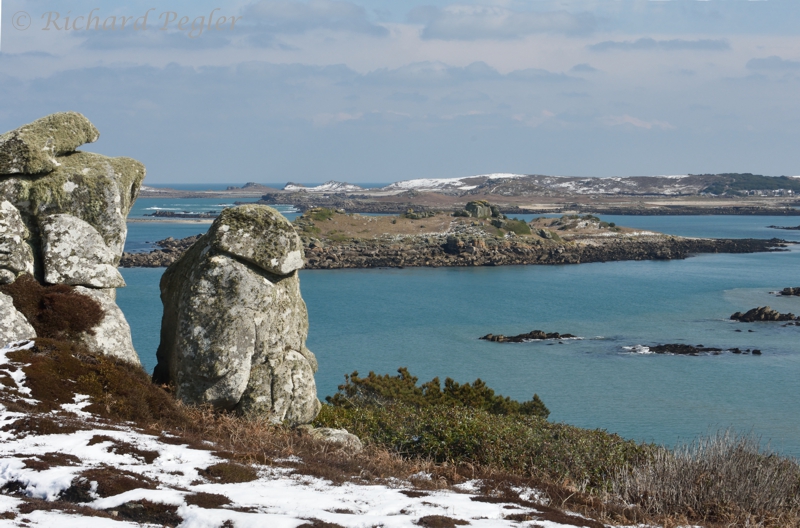
One of the great attractions of Peninnis Head are the wonderful rock formations. The first image shows what I believe to be Pulpit Rock, the second includes Tooth Rock, and I suspect the third also has a name but I am unaware of it!


Rocks - Peninnis Head
There being little but the Stonechats around, I headed along the path on the west side of the head, back towards base, taking a few shots of the scenery as I did so.

view from Peninnis
view to Porthcressa from near Peninnis Farm
The girls had made other plans for lunch and so, arriving back at base before mid-day, I had a quick snack and, feeling lazy, phoned Toots Taxis  to take me to the entrance to Higher Moors, near Porth Hellick House. I arrived at 12.15, and arranged for the taxi to pick me up again at 14.15.


I'd been told a Short-eared Owl had been being seen from the path to Holy Vale from this point. Never having taken this path before, I was totally unaware of the terrain it traversed. Almost immediately after taking this path, I found myself picking my way through densely spaced tree trunks in a very wet area. I persevered for a while, but could see no sign of the trees thinning out to give an area suited to a Short-eared Owl, so turned back and crossed the road to take the track which leads to the bird hides overlooking Porthhellick Pool.

I found the first hide full of Wildlife Trust workers on their lunch break. They were there to replace the boardwalk with an excellent recycled plastic version and were making a splendid job of it! I left them to it and headed to the next hide.

There were relatively few birds visible, and little to photograph, but there were a couple of 'oddball' birds which I found rather interesting. The first was what I suspect to be a melanistic Mallard drake, rather than a hybrid, as it had all the characteristics of a normal drake other than the colour, although there was a very small hint of green in the head plumage. The lower female in the first image is also a little puzzling.


possible melanistic Mallard (Anas platyrhynchos) (male) - Porthhellick Pool
The other mystery, was a small duck with almost entirely black plumage which had a brilliant green sheen when the sun caught it at an angle. I'm assuming that this was either an escapee from a collection or a domestic duck of some sort.


mystery duck - Porthhellick Pool
The only other thing I photographed from the second hide was a nicely presented Moorhen.

Moorhen (Gallinula chloropus) - Porthhellick Pool
I took a stroll further along the path, to the bay, but didn't find anything of interest. I did, however, stop to photograph a caterpillar (which Bob Dawson subsequently kindly identified to me as a Ruby Tiger) and a bee of an unidentified species although I think it could be Buff-tailed Bumblebee (Bombus terrestris), on my return journey.

Ruby Tiger (Phragmatobia fuliginosa) (larva) - by Porthhellick Pool
bee species - by Porthhellick Pool
I returned to the first hide, and spent some time trying to photograph a Greenshank which remained distant. The results were greatly inferior to any images of this species taken in the previous few days so will not appear here. I did, however, get a few shots of a heron on the far side of the pool.

Grey Heron (Ardea cinerea) - Porthhellick Pool
It was fast approaching the time when I had to make my way back to the road, to rendezvous with my booked taxi, when a couple of gentlemen came into the hide and asked what was about. They then said that they'd just seen a Short-eared Owl from the road! They explained very clearly where they'd seen it and I beat a hasty retreat. 

It didn't take too long to locate the owl, but it was two fields away and too far away, and too hidden by branches to get a photo.  I took a quick decision and entered the near field, leaving plenty of distance between me and the owl, and took some shots.

Short-eared Owl (Asio flammeus) - by Porth Hellick House
Due to intervening branches, I was getting soft focus and not a good view. However, by maintaining my distance of around 100 metres (measured on Google Earth) but moving up the hill, I was able to get a better line of sight.

Short-eared Owl (Asio flammeus) - by Porth Hellick House
Having grabbed the shots, it was time to head back to the road. I was delighted at having achieved my first owl sighting on the Isles of Scilly.

For the rest of the afternoon, I spent time with the birds at Porthcressa.

Iceland Gull (Larus glaucoides) - Porthcressa


Turnstone (Arenaria interpres) - Porthcressa

Greenshank (Tringa nebularia) - Porthcressa
Pied Wagtail (Motacilla alba ssp. yarrellii) (male) - Porthcressa
That night we returned to the Atlantic for a most enjoyable dinner.

Saturday 17th March                     Porthcressa

The weather had deteriorated somewhat, with a threat of rain and cold winds. I took the decision to stay close to base. Things started looking up, however, when, first thing after breakfast, I spotted a Mediterranean Gull out in the bay. Summer plumage for this species was a first for me and it stayed all day.


Mediterranean Gull (Ichthyaetus melanocephalus) (2nd summer) - Porthcressa
I'd not been seeing as many Song Thrushes on the Scillies as on my previous visits, but I did manage some shots this day. The first was taken in the garden of our base.


Song Thrush (Turdus philomelos) - Porthcressa
A Shag was out in the bay, whilst a Cormorant decided to be more obliging by coming ashore.

Shag (Phalacrocorax aristotelis) - Porthcressa
Cormorant (Phalacrocorax carbo) - Porthcressa
The Chiffchaff put in another appearance and the Rock Pipits were ever-present.

Chiffchaff (Phylloscopus collybita) - Porthcressa
Rock Pipit (Anthus petrosus) - Porthcressa
However, I found myself spending a significant amount of time with the Black Redstarts


Black Redstart (Phoenicurus ochruros) (female) - Porthcressa
That evening, I noticed that the Snowy Owl had been seen again that day - this time on Tresco. Furthermore, a boat (the Sea King) was scheduled to take a trip to Tresco, departing at 10h15. The slightly worrying situation was that snow was forecast to fall that night, and again in the morning.

That night we dined in.

Sunday 18th March                 Porthcressa - Tresco - Porthcressa

We awoke to a light covering of snow - things didn't look too bad! However, I found that the boat would be calling at Near Carn on Tresco as it would be low water at that time. This would add another 3 miles (5 km) to my walk up onto North End - a walk that the last part of which would be uphill over relatively rugged ground.

When I went out at 06h30, it didn't look too bad, but it soon started snowing heavily - this was taken at 06h49. 

Snowing! - Porthcressa
By 07h40 the snow had stopped and all looked rather beautiful.


Scilly Snow - Porthcressa
I now had a dilemma on my hands. I only had lightweight walking shoes with me as the weight limit on flights to the Scillies is very low - I was going to get wet feet in the snow! I was also not sure that I was up to the challenge of what, to me, would be an arduous walk. Bob Dawson emailed me to alert me to the owl and inform me that there was a boat to Tresco, and both my wife and daughter were very encouraging, so I decided to go for it, on the basis that if it turned out to be too much I could turn back and await the return boat at 15h15. It helped to know that there would be an open pub and café on Tresco.

I headed down to the harbour at an appropriate time and noted Sea King in the bay with its two-man crew on board. They were busy clearing snow in the open boat. After a while, they brought it round to the quayside - the snow was still piled up on the lower part of the windshield.

Sea King - St. Mary's Pool
When we came to board, we found the boat was full of snow, and the seats cold and wet, so I stood for the first part of the journey. It was a pleasant crossing to Tresco, and Tresco looked most inviting as we approached Carn Near Quay.

Carn Near, Tresco
On the way up the road which leads from the jetty to the Abbey Garden I got into conversation with a gentleman who looked as if he too might be going to look for the Snowy Owl. As it happened, he was a teacher on St. Mary's and here to do some research for a forthcoming school visit to some of the ancient monuments on the island, but was quite keen to tie the visit in with an attempt to find the Snowy Owl. I was quite happy to follow the lead of this gentleman (Nigel Bray) and it was agreed that we would walk together.

We took a slightly circuitous route, initially heading east and then doubling back alongside the north side of Great Pool, stopping off at the hides en route. It was good to see Sand Martin had arrived. We then made our way round New Grimsby before cutting up towards Townshill, and then towards Beacon Hill. Emerging onto higher ground, we had good views of King Charles' Castle.

King Charles' Castle, Tresco
We continued up to the castle, keeping our eyes peeled as we did so. Nigel had to take notes and photos of the information boards at the castle, and I searched the immediate surrounds. There were views down to Cromwell's Castle to the south-west.

Cromwell's Castle, Tresco - Bryher beyond
We then set off north to Gun Hill where there were some great views.

Men-a-vaur and Round Island from Gun Hill, Tresco
While I was busy admiring the scenery, Nigel spotted Wheatear and Black Redstart. Nigel seemed more interested in the Black Redstart, but the Wheatear was the treat for me.


Wheatear (Oenanthe oenanthe) (male) - Gun Hill, Tresco
We headed eastward and were still having no luck finding the owl. Nigel needed to resume his other mission for the day, and so we said our goodbyes and Nigel set off downhill. I started photographing the wonderful scenery, and Nigel had not gone more than about 100 metres before he called out. I turned to see the unmistakable shape of a Snowy Owl fly across in front of him and settle on the ground. I took a safety shot before going to join Nigel.

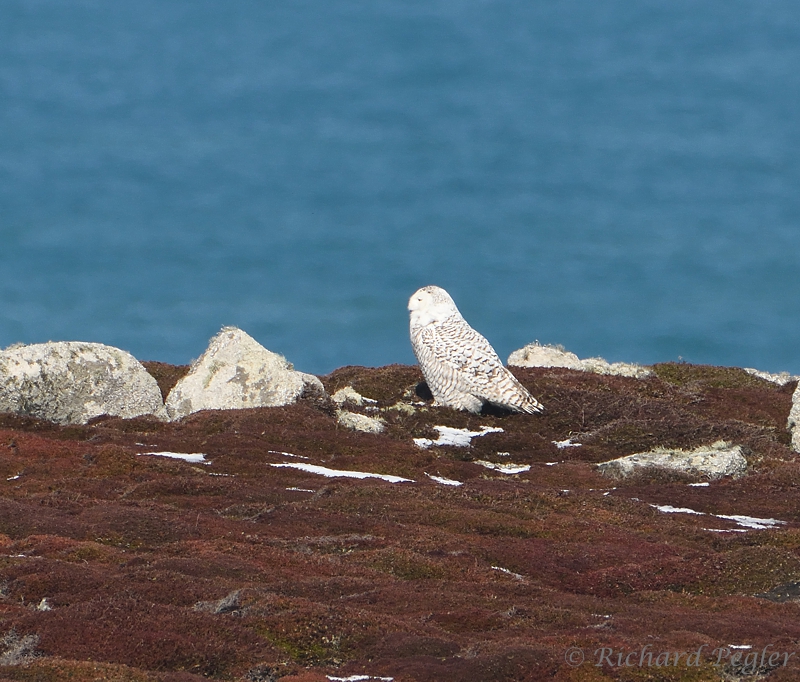
Snowy Owl (Bubo scandiacus) (1st winter female) - Tregarthen Hill, Tresco
As I slowly approached Nigel, the owl flew off and settled at a considerable distance. Sadly our view was directly into the sun, and photography was difficult.

Snowy Owl (Bubo scandiacus) (1st winter female) - Tregarthen Hill, Tresco
We had a quick chat, and I advocated fieldcraft which I have successfully applied to photographing other owls, the main factors of which are:  (1) try and avoid eye contact with the owl, and hold the camera to your face before turning towards the owl; (2) never walk  directly towards the owl, but take a loosely spiralling path, or zig-zag path, which lets it think that you will walk past it at a distance (in the circumstances, the spiral was appropriate); (3) move quietly, slowly and steadily. In the event, this worked beautifully and we were able to walk past the owl and get some shots with better light. Here's a sequence that covers the event.


Snowy Owl (Bubo scandiacus) (1st winter female) - Tregarthen Hill, Tresco
It was a version of that last shot which earned me Birdguides 'Photo Of The Week'. We'd had our fill, and were ready to walk away when the bird lazily took to the air and flew eastwards up onto the top of a ridge - it was time to depart the area.


Snowy Owl (Bubo scandiacus) (1st winter female) - Tregarthen Hill, Tresco
Nigel went hurrying off to the south west while I made my way south. My target was to have a light lunch in the Ruin Beach Café on the eastern side of Tresco. On the way I took some more shots of the scenery.
 
view towards Northwethel and St. Helen's

Gimble Porth and Middle Carn, Tresco
I didn't quite find the route I intended but ended back near Townshill, so took Back Lane to Norrard and the Ruin Beach Café . Here I had an excellent smoked salmon and cream cheese ciabatta with salad and crisps. The only downside to the visit was that the price for this programmed into the till was £1 dearer than the price printed on the menu, This was, of course, rectified without quibble, but I hope that they have sorted it out now!

I took a stroll back to New Grimsby and then back to the hide on Great Pool nearest to civilisation. There was little to see, but it was good to sit down and relax. As I left the hide I took a distant shot of a drake Pintail.

Pintail (Anas acuta) (male) - with Mallard - Great Pool, Tresco
When the time came, I made my way to the New Grimsby quayside, stopping to photograph the huge snowman that was starting to suffer from the thaw that had well and truly set in, and which someone had admirably set a Lifeboat collection box beside.

Snowman - New Grimsby, Tresco
It quickly got rather cold on our run back to St. Mary's. Nigel reported that he'd been back up onto North End later in the day and the owl was still on the same ridge.

Back at base I went to the sea wall to have a last look at the Porthcressa birds. A Mediterranean Gull was still there.

Mediterranean Gull (Ichthyaetus melanocephalus) - Porthcressa
Wren (Troglodytes troglodytes) - Porthcressa
Black Redstart (Phoenicurus ochruros) (female) - Porthcressa
That night we had a hearty meal at The Scillonian club. It had been a fabulous day and an exciting ending to our stay on the Isles of Scilly.


Monday 19th March            the journey home

After breakfast and packing, the minibus came at 09h10 to take us to the airport. We arrived at the check-in desk to be informed that no flights were able to reach St. Mary's because of snow and ice on the mainland. Passengers for the two or three flights before ours were all waiting in the 'lounge' (for want of a better term) in cold draughty conditions. The staff were, however, hopeful that things would get moving soon. 

Two or three people decided that they'd already missed their prime reason for going to the mainland and were either reallocated to a flight the next day or (possibly) given a refund. People on an earlier flight than ours were given refreshment vouchers for the café after two hours delay. Eventually it was announced that a plane was on its way from the mainland. We must have been very lucky as the three of us were called to check-in to be on the first flight out - I don't think any of the others waiting were so lucky!

We were just under the two hours late when we took off for Lands End. There was no wait for baggage and we were in our car within five minutes of landing.

In spite of major road closures through snow earlier in the day, all roads were clear by the time we reached them, and it was an uneventful drive home.

Conclusion

For me it was by far the most exciting of my visits to the Isles of Scilly, and the girls had a great time too. The weather was, technically, the worst we have experienced there, but the results for me were probably enhanced by the weather (definitely in one case!). Whilst, most of the time, I went off on my own, the girls had a great time together and the arrangements worked extremely well. I am, therefore, very grateful that friends Lynne and Roger gave up this week and we were able to take advantage of the vacancy.

I would like to thank the management of Beeches for an excellent stay at their property. My grateful thanks also go out to the wildlife/bird enthusiasts that I met there - Bob Dawson, Ren Hathway, Nigel Bray, and the gentleman that showed me round Shipman Head, Bryher (sorry, I didn't note your name, but please get in touch if you read this) - you were all key to the enheightened enjoyment of my stay.

I must make mention of a very special little girl on Bryher - Martha Eggins of Hillside Farm! This wonderful young lady has designed the most delightful fridge magnets which she sells in aid of the Isles of Scilly Wildlife Trust (she raised £380 for them in 2017!). Sadly, I became aware of this the day after I visited Bryher. I was, therefore, extremely grateful to receive a fridge magnet from Martha in the post to my home (together with a wonderful card that she'd written herself) in return for a donation. If you get the opportunity, please buy one of Martha's fridge magnets - and give generously!

The week gave me what will probably remain the lifetime highlight of my bird photography - Snowy Owl - in snow - on The Scillies - WOW, WOW, WOW!!! More on that subject here

Thank you for dropping by. Possibly more snow, but closer to home, will feature in my next blog post.