Pages

Notes on Use of This Blog


1. I have a policy that I always reply to comments on my blog, even if it's just to say thank you.

2. Please don't submit comments that include your own web address. For obvious reasons, they will not be published.

3. I'm now on Twitter - @RichardPegler1
Showing posts with label Stonechat. Show all posts

Wednesday, 25 October 2023

Isles of Scilly, 2023 Pt.3 - 27th & 28th September, 2023

This third instalment of my account covers another two days of our recent holiday on the Isles of Scilly. It is a little shorter than my two previous postings, but if I had added a third day it would have been excessively long.

If you missed Pt.1 or Pt.2, you can find them by going to the bottom of this post and then clicking on 'Older Post'. 

Wednesday, 27th September

This day had been forecast for a few days as being one of awful weather due to Storm Agnes, with an official Severe Weather Warning for much of the UK,  including the Isles of Scilly.  The main factor was high winds, but heavy rain was in the mix too.

We woke to fairly strong winds with light rain. However, the wind soon picked up, and the rain became torrential. Some birding folks ventured out in the foul weather and some interesting birds were sighted, but I stayed at base, mainly because I couldn't contemplate going out without my camera, and my camera isn't waterproof. I did take some photos of the Humming-bird Hawk-moth which was now in the conservatory.

Humming-bird Hawk-moth (Macroglossum stellatarum) - from the house - Littleporth
After lunch it started brightening up, although it was still very windy, and so I took the buggy to Old Town and went into Lower Moors.  To my delight, the hide was empty apart from two other people who arrived at the same time as me. The juvenile Pectoral Sandpiper that had relocated from Higher Moors,  presumably to be in a more sheltered location, was immediately spotted and showed well.

Pectoral Sandpiper (Calidris melanotos) - Lower Moors

I spent a while here but it started getting crowded in the hide, so I departed, heading for Carreg Dhu Garden as this beautiful garden is in a sheltered long-disused quarry and often used by sheltering small birds, such as Firecrest. I found butterflies and two Humming-bird Hawk-moths, but no birds to photograph. 

Humming-bird Hawk-moth (Macroglossum stellatarum) -Carreg Dhu Garden
I next moved on to Higher Moors and, on entering Sussex Hide, found the unprecedented sight of  eleven Greenshank together. I have only ever seen single Greenshank.

Greenshank (Tringa nebularia) - Porthellick Pool
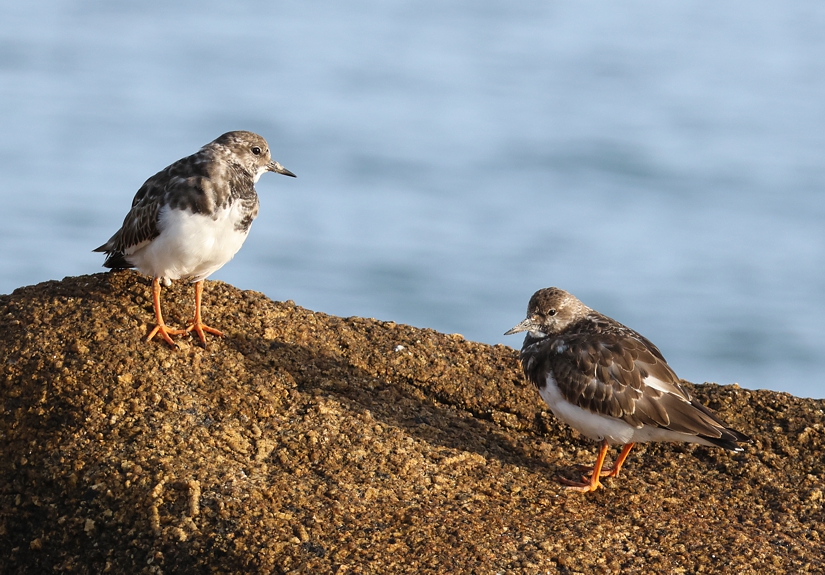
Little else was happening here, so I moved on to Seaward Hide, where only Mallards were visible. I sat out a heavy shower of rain then went along to Porthellick beach. Here there were lots of House Sparrows and three Turnstone.

Turnstone (Arenaria interpres) - Porthellick Beach
What was more interesting to me, however, was the several stranded 'jellyfish'. These varied considerably in size from maybe 3 cm to 15 cm across. Some seemed to be absolutely crystal-clear, but a couple seen had a circular ring of a pinkish colour. I did not know what species these were, but an image I posted of the second one was was subsequently identified by the excellent 'Scilly Wildlife News' WhatsApp group as Crystal Jelly. This very attractive and bioluminescent animal is not an actual jellyfish but classed as a hydrozoan. It is, I believe, quite a rarity in UK but there were numerous sightings being reported in the south-west of UK at this time. According to an on-line article, "The species is typically found off the west coast of North America, identified from the Bering Sea to southern California. It’s particularly common in Puget Sound, an inlet of the Pacific Ocean along the northwestern coast of Washington." I must say that I find this hard to believe!

Crystal Jelly (Aequorea victoria) - Porthellick Beach
I dropped back into the hides on Porthhellick Pool. At Sussex Hide, the Greenshank were still there, but put up by an arriving Grey Heron. This seemed to have prey, which looked rather like a small rodent, in its bill. I couldn't see clearly as this shot was of it at the seaward end of the pool.

Grey Heron (Ardea cinerea) with prey - Porthellick Pool
The Greenshank soon settled back again and seemed quite relaxed.

Greenshank (Tringa nebularia) - Porthellick Pool
Other than these, the only other notable sightings were a pair of Snipe in the distance, kindly pointed out by Julian Branscome, a member of the superb Isles of Scilly Wildlife Trust.

It was now time to head back to base.

Apart from a shopping trip to the Co-op, the evening was spent relaxing and writing up notes.

I'd been expecting the day to be a total washout,  but it was far from that.

Thursday, 28th September

The weather forecast indicated that a relatively dull morning would develop into a rather wet afternoon.  The girls decided that they'd like another attempt at collecting sea-glass on Treasure Beach (Porth Minick),  so I got Melanie to drop me off at the entrance to Higher Moors. The plan was that I'd see what was going on at Porthellick Pool and Beach, and then walk over Sallakee Down, past the airport turning circle, and meet them at Treasure Beach.

I saw absolutely nothing of interest until just before the airport turning circle, where I got some shots of a female Stonechat.

Stonechat (Saxicola rubicola) (female) - by Airport Turning Circle
Between the airport turning circle and Porth Minick, I spotted a Kestrel. My previous sighting of a Kestrel on the Isles of Scilly was on 14th March, 2020 when some photos I took turned out to be the confirming photos for Lesser Kestrel - a 'mega' that had previously been reported as a 'very interesting looking Kestrel on Porthellick Down' with a request for photos.

I had no such luck this time!

Common Kestrel (Falco tinnunculus) (female)
I arrived at Treasure Beach before the girls had departed from base, so had a brief look around. All I found of interest was something that looked like a tiered lump of jelly, but again was subsequently identified by the 'Scilly Wildlife News' WhatsApp group as being a Beadlet Anemone. It seems that it would have been a real treat to see this animal in shallow water with its tentacles open.

Beadlet Anemone (Actinia equina) - Porth Minick
As the girls had not appeared, I made a quick visit to Lower Moors, but saw nothing of any interest. I then hurried back to Porth Minick and found the girls had already got there. I spent a little while with them, but was concerned that I was going to get caught out by the forecast heavy rain, there being only room for the four girls on the buggy, so I set off to return to base.

I stopped briefly for a comfort stop by Old Town Cafe, and noticed that the forecast had moderated, with the rain now coming in later. I changed my plan and took the path round Old Town Bay towards Carn Lêh, getting some shots of a large and wonderful Hornet Hoverfly which, unusually, settled.

Hornet Hoverfly (Volucella zonaria) (female) - near Carn Lêh
I went up onto Peninnis, seeing little of interest. 

As I descended the west Peninnis path a Grey Heron passed by, but the shots were binned. I was surprised to see some 'wild swimmers' who seemed to be launching themselves from what appeared to be a relatively inaccessible location, not far from Peninnis Head. 

Wild Swimmers - Peninnis
By the allotments I stopped by some Ivy where there were many Ivy Bees.

Ivy Bee (Colletes hederae) - by Porthcressa Allotments
After a late lunch, we all went out to Carn Vean Cafe where we sat outside and enjoyed tea and cake. I was happy to be reunited with their fabulously succulent 'Jaffa Cake'. Because of the forecast rain, I'd left my now normal (non-waterproof) camera set up back at base and taken my old Nikon D7200 body with an old Tamron 28-300 lens (my only back-up equipment these days) with me. I found myself struggling to remember how to use this kit, but did manage some photos of the House Sparrows that wanted us to share our cakes with them. One even had the cheek to read the menu.


House Sparrow (Passer domesticus) - Carn Vean Cafe
While we waited for Melanie to return with the buggy (it needed two trips to transport five of us in a four-seater) I took Lindsay part-way down the path from Carn Vean Cafe to show her the views over to Toll's Island and the Eastern Isles. Toll's Island can be accessed on foot at low tide, but the tide was in on this occasion.

View to Toll's Island from Carn Vean
View to the Eastern Isles from Carn Vean
We got back to base just in time to avoid the rain.

The evening was spent, as usual, catching up with notes, making plans, etc.


My next blog post, if all goes according to plan, will feature the next day of our stay, and will be a little different. 

In the meantime, pleased take good care of yourselves and Nature. Thank you for dropping by - - - Richard

Thursday, 19 October 2023

Isles of Scilly, 2023 Pt.2 - 26th September, 2023

I had, originally, intended to have this second instalment of my account cover another two days of our recent holiday on the Isles of Scilly. I then realised that just this one day would result in a blog post that was more than long enough - sorry folks! 

If you missed Pt.1, you can find it by going to the bottom of this post and then clicking on 'Older Post'.

Tuesday, 26th September

In spite of having had a poor night's sleep, I was up relatively early for us - 07.00. I then had a relaxed breakfast, after which, my first job of the day was to go and pick up the buggy that we'd hired for six days from the excellent Scilly Carts, taking Melanie along with me.
 
As there were five of us, I'd booked the hire of a six-seater cart. We trotted off to Scilly Carts, arriving soon after opening time and, after filling in the necessary forms, were headed back to base. I'd been concerned that the abrupt transition from level road and pavement to a steeply sloped drive might be a problem due to the long wheelbase of the low-slung six-seater. On arrival, we carefully tried puting the cart on the drive and found that we only had about 2 cm clearance with just me in the cart. With five of us in, I suspect that it would have grounded. A quick call to Scilly Carts and we were headed back to exchange the cart for a four-seater. This did, of course, mean that our options for travel were slightly limited. This is the cart that we ended up with.

The forecast for the day was for warm, but rather breezy, weather with sunny spells - and this is what it turned out to be.
 
Having missed out on seeing a Wryneck the previous afternoon, I was  determined to have another try. I set off, on foot, along Porthcressa seafront, dipping into Becky's Scilly Cakes  to choose my cake that the girls would pick up later.

I then headed towards the path that runs on the west side of Peninnis to Peninnis Head. As I passed the allotments, I stopped by a large patch of ivy to photograph some of the many Ivy Bees that were enjoying it. Ivy Bees have become very common on the Isles of Scilly.
 
Ivy Bee (Colletes hedera) - Porthcressa Allotments

A couple of Red Admirals were also in attendance.
 
Red Admiral (Vanessa atalanta) - Porthcressa Allotments

I continued along the Peninnis West Path, seeing a few Small Copper butterflies as I went.
 
Small Copper (Lycaena phlaeas) - Peninnis West Path

Before reaching the head, I saw a couple of pipits on a drystone wall. My ID skills are sadly lacking when it comes to pipits, but I reckon the most likely candidate is Meadow Pipit, which is very common in this area.
 
probable Meadow Pipit (Anthus pratensis) - Peninnis

I spent half an hour on Peninnis head at the spot where the Wrynecks had been seen the previous day. No Wryneck was seen, but I did get some shots of a Wheatear - a species that never fails to excite me.
 
Wheatear (Oenanthe oenanthe) (female) - Peninnis
There had been a stiff westerly breeze along the west side of Peninnis and on the head, so I set off down the east side towards Old Town. As I neared the point where the path levels off and passes through the drystone wall, I put up a bird that I'd not noticed, which flew and dropped down into the ground vegetation. It then flew out again and landed on the drystone wall at a distance. My usual modus operandi is to take the photos first and then check for ID.  Through my binoculars, I was not sure of its identity, but when I zoomed in on my photos I found I'd photographed a Wryneck! These are very heavily cropped images.
 
Wryneck (Jynx torquilla) - Peninnis East Path
As I approached Old Town Church I spotted a Speckled Wood butterfly that looked a bit unusual. The Speckled Woods on the Isles of Scilly are a different sub-species to those found on the mainland. The main distinguishing feature is that where the mainland sub-species tircis have pale cream markings, the sub-species insula on the Scillies have markings that are more orange. This particular specimen had much smaller markings than usual. 
 
Speckled Wood (Pararge aegeria insula) - near Old Town
I continued through Old Town Churchyard, seeing nothing of interest, and walked down the road to Old Town and turned off to Lower Moors.

At the ISBG hide at Lower Moors, there were two Snipe. Again, just distant shots were obtained. I didn't get any shots of the Migrant Hawkers that were sticking to the far side of the pool.
 
Snipe (Gallinago gallinago) - Lower Moors

On the approach to the hide, on the railings as I left, were two Common Darter dragonflies. Here's one of them.

Common Darter (Sympetrum striolatum) (male) - Lower Moors
Just along from the ISBG hide I also photographed a Speckled Wood  butterfly.  This was, in appearance, much as I would expect this species to be. I think that you will agree that it looks rather different to the one shown earlier.

Speckled Wood (Pararge aegeria insula) - near Old Town
I carried on to Rosehill Garden, hoping to find more dragonflies, but only found another Common Darter.

Continuing to Porthloo,  I found a few birds on the beach, including some Pied Wagtails, but only photographed a Rock Pipit. 
 
Rock Pipit (Anthus petrosus) - Porthloo
 It was now time to get back to base and fix myself a very late lunch. 

That afternoon, Melanie drove me out to the entrance to Higher Moors where I had frustratingly distant views of a juvenile Pectoral Sandpiper that blended in so well with the background that I couldn't find it in my viewfinder. I took a few shots with the camera pointing in roughly the right direction and found that I'd actually managed to include the bird in just one of the shots. Here is a very heavily cropped image, from which you can problably understand the difficulty I had.
 
Pectoral Sandpiper (Calidris melanotos) - Porthellick Pool
After about half an hour I lost the bird and gave up as I'd tentatively arranged to meet the girls at Porth Minick beach where they were going to collect sea-glass.

I took the path that goes over Salakee Down, seeing little as I did so. My timing was such that, as I approached the airport runway turning circle,  the sirens started and I had to wait for a plane to taxi up to the circle and turn before taking off.
 
Continuing on my way on the south side  of Salakee Down, the only bird photographed was a Meadow Pipit.

Meadow Pipit (Anthus pratensis) -Salakee Down
From the path to Porth Minick, there are views over to Peninnis. I rather liked this view of the nearer rocky coast.

View from Salakee Down
As Porth Minick came into view, I couldn't see the girls there. I was only a few hundred metres from the beach when I got a message to say that they'd turned back because there was little beach showing as the tide was well-in (a spring tide), and were heading for base. I went onto what was left of the beach and found  two Turnstone there. I sat on a rock and waited patiently and soon one of them came close and allowed some relatively intimate photos.
 
Turnstone (Arenaria interpres) - Porth Minick

A Rock Pipit was similarly obliging.
 
Rock Pipit (Anthus petrosus) - Porth Minick

Whilst on the beach, a Coastguard helicopter passed overhead. I tend to be curious about such aircraft, and looked up details of this one from its registration. I was sorry to learn that it had been involved in a fatal accident on 4th March, 2022. When landing at Derriford Hospital, Plymouth, the downdraught had blown over an 87 year old woman on a nearby footpath, who sustained a serious head injury. It also injured another woman in her 80s who was exiting her car in a nearby car park, when the downdraught caused the car door to slam on her, breaking her pelvis.
 
Coastguard Sikorsky S-92A - G-MCGY - over Porth Minick
The approach to Old Town from Porth Minick is lined with Amaryllis Belladonna, as are so many places on the islands. I couldn't resist a photo of a flower that, to me, epitomises the flora of the Isles of Scilly. 
 
Amaryllis belladonna - Old Town
A Glossy Ibis had been reported at Lower Moors, but was nowhere to be seen when I got there. I didn't stay long, but took the coastal path past Old Town church to Carn Lêh, where some climbers were busy.
 
Climber on Carn Lêh
On a rock in Carn Lêh Cove there were two Shags and a Herring Gull.
 
Shag (Phalacrocorax aristotelis) + Herring Gull (Larus argentatus)  - Carn Lêh Cove

I then followed the path up onto Peninnis in the hope of a better sighting of Wryneck, but it didn't happen. It was good to see both male and female Stonechat as I was beginning to be concerned that I was not seeing this species on Peninnis - a usually reliable area for this species.

Stonechat (Saxicola rubicola) (female) - Peninnis

Stonechat (Saxicola rubicola) (male) - Peninnis
I also took some shots of Dunnock and Meadow Pipit.
 
Dunnock (Prunella modularis) - Peninnis

Meadow Pipit (Anthus pratensis) - Peninnis

I walked down King Edward's Road and by Peninnis Farm thought, momentarily, that I'd found a Stock Dove, until it ran towards me, flashing its leg bands! It was a racing pigeon looking to be fed. As I write this, on 18th October, this bird was spotted on 17th October in Porth Mellon. It seems it was supposed to be flying from North Wales to Belfast but got lost on the way, and has decided that it likes the Isles of Scilly - and who can blame it!

Racing Pigeon - Peninnis Farm
Almost back at base, I went onto Littleporth beach to photograph a pair of Turnstone. 
 
Turnstone (Arenaria interpres) - Littleporth
It had been a record breaking day for me with my fitness tracker recording 24,087 steps (11.92 miles / 17.58 km). I am rather happy with this achievement as much of it was up-hill and down-dale and over uneven or rough terrain.

That night we were requested to batten down the hatches as winds of up to 55 mph (89 kph) were forecast for the following day, accompanied by heavy rain.
 
My bird ID skills are far from well honed and are, I believe, weakening (age and deteriorating eyesight) . If you disagree with any of my IDs, please let me know - I will be most grateful!


I suspect that my next blog post in, as usual, about a week's time will just cover the next two days of our stay on the Isles of Scilly. In the meantime, please take care of yourselves and Nature.

Thank you for dropping by - - - Richard