Pages

Notes on Use of This Blog


1. I have a policy that I always reply to comments on my blog, even if it's just to say thank you.

2. Please don't submit comments that include your own web address. For obvious reasons, they will not be published.

3. I'm now on Twitter - @RichardPegler1
Showing posts with label Grebe Great Crested. Show all posts

Sunday, 24 March 2024

🎵 "Avocetta, Gentille Avocetta" 🎵 - 7th March, 2024

On this day, prompted by a report of a sighting of Avocet on the dam at Thornton Reservoir, which is about 12 miles (19 km) from our home, and it being forecast for dry, if a little misty, weather, that is where I decided to go after lunch.

I arrived at the main car park to find two birders present, including 'Mr Thornton Reservoir' Andy Smith. The water close to the car park contained a number of birds and I photographed a Great Crested Grebe before looking for the Avocet.

Great Crested Grebe (Podiceps cristatus) - Thornton Reservoir
The Avocet was against the dam, and very distant, but was kindly pointed out to me and shown to me through a 'scope. I did take some record shots, one of which (very heavily cropped and enhanced to reduce the effect of the mist) is shown below.

Avocet (Recurvirostra avosetta) - Thornton Reservoir
I had another objective for this visit, and that was to get some exercise. The path round the reservoir is 2.5 miles (4.0 km) in length and I was decided to take this in an anti-clockwise direction. Before setting off, I took a few shots of Black-headed Gull.

Black-headed Gull (Chroicocephalus ridibundus) - Thornton Reservoir
From the car park, we'd observed a photographer leaning over the wall directly opposite the Avocet. I was not at all comfortable with that, but I did want a better shot, so I continued past until I got to the control block well past the bird, and took my shots from there. The one below is still heavily cropped, but better shows the bird.

Avocet (Recurvirostra avosetta) - Thornton Reservoir
The first half of my circum-perambulation was very uneventful, with only a Mallard being photographed. They might be our most common duck, but there's no denying that the drake is a very handsome bird

Mallard (Anas platyrhynchos) (male) - Thornton Reservoir
At the half-way mark, I found that someone had placed some seed on a post and fence. This was attracting birds from the adjacent woodland.

Nuthatch (Sitta europaea) - Thornton Reservoir

Great Tit (Parus major) Thornton Reservoir

Continuing my circuit, before reaching the car park, I took a few more photos.

Moorhen (Gallinula chloropus) - Thornton Reservoir

Mute Swan (Cygnus olor) - Thornton Reservoir
On arrival back at the car park I found a gentleman who was just finishing putting food out for the waterfowl. This had attracted a whole bunch of ducks, geese, and gulls. I didn't take much notice, wanting to check on whether the Avocet was still showing. It was and, yet again, a photographer was leaning over the wall directly adjacent to the bird.

I was about to go to my car and head home when I noticed a Mandarin was amongst the throng of birds attracted to the deployed food. How did I manage to miss it until then?!

Mandarin Duck (Aix galericulata) (male) - Thornton Reservoir

Thus ended my visit and this blog post which is somewhat shorter than my usual offering.

Until the next time, please take good care of yourselves and Nature. Thank you for dropping by - - - Richard


Sunday, 12 November 2023

The First Half of October, 2023

Having returned from our visit to the Isles of Scilly on 3rd October, I found myself with nearly two and a half thousand photos to process. This took about three weeks to complete, and limited my time out in the field. I did, however, manage three short excursions, but also found myself distracted by birds in the garden while at my desk, working on the photos. Here are some of my observations from the first half of October.

Thursday, 5th October          Garden

Stock Dove was absent for a few weeks, but is now being seen on an almost daily basis. Occasionally we get two of them.

Stock Dove (Columba oenas) - Garden
Carrion Crow has become a frequent visitor to the garden, and also we sometimes get two together. I think that face radiates intelligence.

Carrion Crow (Covus corone) - Garden

Woodpigeons are also frequent visitors - it's a rare day that we don't see one in the garden - but we rarely see youngsters, such as this one.

Woodpigeon (Columba palumbus) (immature) - Garden
Sunday, 8th October          Garden
 
Our over-the-back neighbour has a box hung on the dividing fence which he fills with peanuts in their shells. These seem to be exclusively attractive to the local squirrels which take great delight in burying them in our garden, although sometimes they will stop and enjoy the contents - as this one did, sitting on the wall of our mini-pond, which I photographed from my study window.
 
Grey Squirrel (Sciurus carolinensis) - Garden

Monday, 9th October          Saltersford Valley Country Park
 
Lookking for a dragonfly fix on a fine weather day, I headed to my favourite local dragonfly location - Saltersford Valley.

I started off by spending time on the boardwalk, which is usually the best location for finding dragonflies. There were several Common Darters here, mostly landing on the boardwalk , which is not very photogenic. Occasionally, however, one would perch on some vegetaion.

Common Darter (Sympetrum striolatum) (male) - Saltersford Valley CP

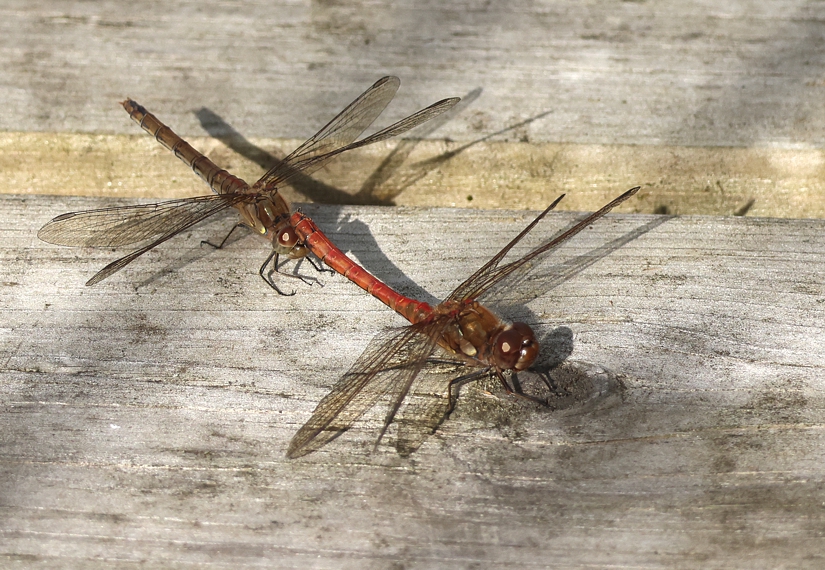
At one point, a pair of Common Darter appeared in tandem, but I was only able to photograph them on the boardwalk.

Common Darter (Sympetrum striolatum) (male+female in tandem) - Saltersford Valley CP
I spent quite a long while trying to photograph one of the two Migrant Hawker dragonflies that were patrolling round the boardwalk. I failed to get any flight shots and if they landed it was always away from the boardwalk and partly obscured by the Reedmace. This was, unfortunately, my best shot.
 
Migrant Hawker (Aeshna mixta) (male) - Saltersford Valley CP

I seemed to be getting nowhere fast, so decided to take a walk round the site.
 
A Western Honey Bee looked rather fine on wild Angelica.
 
Western Honey Bee (Apis mellifera) - Saltersford Valley CP

I found a few more Common Darter which, to my advantage, didn't have a boardwalk that they could settle on. 


Common Darter (Sympetrum striolatum) (male) - Saltersford Valley CP

The bright red berries of Guelder-rose stood out like a beacon.

Guelder-rose (Viburnum opulus) - Saltersford Valley CP
A return to the boardwalk gave me an unobstructed view of a perched Migrant Hawker, but at a distance and at an awkward angle for photography.
 
Migrant Hawker (Aeshna mixta) (male) - Saltersford Valley CP

I came away, concious that, apart from the tandem Common Darters, I'd only seen male dragonflies. This however, is not an unusual situation, as males have a tendency to patrol near water, while females tend to come to water to primarily mate or oviposit.
 
I had hoped to find Willow Emerald Damselfly here, as I had not yet positively seen one this season, but I failed. 

Tuesday, 10th October          Thortit Lake Area

I'd had an eye injection in the morning, after which I was supposed to take it easy for 48 hours, and not drive for at least four hours. However, at around 16.00, the effect of the dilation drops had worn off, my eye was not feeling too uncomfortable, and so I decided on a gentle visit to my nearest dragon site, Thortit Lake, to try once more for Willow Emerald.

Having parked my car, as I entered the site, I found five Common Darter roosting on the gate. I was a little surprised to see that these were all females.


Common Darter (Sympetrum striolatum) (female) - near Thortit Lake


As I approached the lake, a Red Admiral kept landing on the path ahead of me and then flying ahead as I got nearer.

Red Admiral (Vanessa atalanta) - Thortit Lake
As I approached the water's edge, a pair of Mute Swan with four youngsters in tow came towards me, obviously expecting to be fed. They soon realised that I would not oblige, and turned away again. My shots including the youngsters were not good, but here's one of one of the adults.
 
Mute Swan (Cygnus olor) (male) - Thortit Lake

I saw two or three Migrant Hawker dragonflies, but not in a position to be photographed. A Coot went swimming by as I was about to head back to base, mindful of the fact that I was supposed to be taking it easy.

Coot (Fulica atra) - Thortit Lake

As I neared the exit gate, I saw that some of the female Common Darters were still on the gate.

Wednesday, 11th October          Garden

Another shot of one of the Stock Doves that visited that day, taken through the glass of my study window.
 
Stock Dove (Columba oenas) - Garden

Thursday, 12th October          Garden

We had been seeing very little of Wren over the past couple of months, and so were absolutely delighted when one showed up this day - not the best of shots, taken from the conservatory, through the double-glazing at an angle.

Wren (Troglodytes troglodytes)  - Garden

Saturday, 14th October          Garden

It has been a quite good year for Comma butterflies. This one visited us this day and sunned itself on Lindsay's nook in the garden.

Comma (Polygonia c-album) - Garden

Sunday, 15th October          Calke Park : Garden

Against my better judgement - it was a fine weather Sunday during the schools half-term holiday -  I set out for a visit to Calke Park. I found myself in a queue for the entrance booths when I was about 500 metres from them, and would have turned back if the road had not been 'one-way'. 

I first headed for Calke Explore, where there is a hide overlooking a bird feeding station. The car park was full, but I managed to squeeze our small Smart car into a gap in the overflow car park.
 
I fully expected to find the bird hide full of unruly children but, to my surprise, there were just four people in there (it has capacity for six) and they left as I arrived (I didn't think I looked that threatening!). 
 
I stayed for about half an hour, but not much was going on and the branches used as photographic props had all been removed, so I photographed very little.
 
The rats were plentiful and very busy seeking food.

Brown Rat (Rattus norvegicus) - Calke Park
The few photos I did take didn't turn out too well and probably the best of a bad bunch was this of a very common, but nonetheless delightful, bird - a Blue Tit.
 
Blue Tit (Cyanistes caeruleus) - Calke Park

With little going on here, I decided to try the other hide on the estate. This is by the main car park near the house. As the house came into sight, I was surprised to see that the overflow car park was full of cars, and a second (unofficial?) overflow car park was in operation. This was, by far, the busiest that I have ever seen Calke Park. Amazingly, however, I managed to find myself a vacant spot in the main car park within a few metres of the hide.
 
I also found that, with just two people in the hide when I got there, I had room to sit in comfort. There was more going on from this hide, although nothing very exciting was seen. The birds were zooming in to the feeders which were suspended on a tensioned wire that went from one side of the clearing to the other. The best photographic opportunities were when the birds approached but were still in the neighbouring trees. Here are a few of the shots that I took.

Nuthhatch (Sitta europaea) - Calke Park

Greenfinch (Carduelis chloris) (female) - Calke Park

Common Pheasant (Phasianus colchicus) (male) - Calke Park

Goldfinch (Carduelis carduelis) - Calke Park

Greenfinch (Carduelis chloris) (male) - Calke Park

Nuthhatch (Sitta europaea) - Calke Park

Mallard (Anas platyrhynchos) (male) - Calke Park

The arrival to the hide of a group of people acted as a signal for me to depart. I stopped for a while just outside the hide to view the deer in the Deer Park.
 
My attention was drawn to a young Fallow Deer that was bounding across the grass at a good speed.

Fallow Deer (Dama dama) - Calke Park

The reason for its haste soon became apparent!

Fallow Deer (Dama dama) - Calke Park

Over on the far side of this area there was a Fallow Deer with what I can only suggest, by the antlers, was a young male Red Deer.

Red Deer (Cervus elaphus) and Fallow Deer (Dama dama) - Calke Park
I then drove round to what is known as The Round Car Park and walked down to the south-west arm of Staunton Harold Reservoir and then headed westward to reach the weir that is the inflow from Calke Park. This is the view eastward from near that location. On my previous visit, the water in the reservoir was so depleted that, with wellington boots on, it would have been possible to walk across the reservoir on a right to left trajectory that approximates to that thin dark line behind the brighter blue strip.

Staunton Harold Reservoir
From near the inflow, on the far side of the water, I spotted a Heron that was looking for its afternoon tea.

Grey Heron (Ardea cinerea) - Staunton Harol Reservoir

As I headed back, a Little Egret arrived, landing in the trees on the far side of the water.

Little Egret (Egretta garzetta) - Staunton Harold Reservoir

An immature Great Crested Grebe was closer as I went along the boardwalk section of the path.

Great Crested Grebe (Podiceps cristatus) - Staunton Harold Reservoir
I arrived back home in time to witness the Sparrowhawk making a nuisance of itself once more. This immature male has been visiting on a 'several times a day' basis, but its hit-rate is relatively low. The visits are, however, frequent enough that many of the other birds have got wise and are staying away from our garden.

Sparrowhawk (Accipiter nisus) (immature male) - our garden


As it stands at the moment, my next post will cover the second half of October, and be somewhat shorter than this one as I did not manage to get out with my camera during that period.

In the meantime, please take good care of yourselves and Nature. Thank you for dropping by - - - Richard
 

Thursday, 13 July 2023

Anglian Adventures, Day 3 - 16th June, 2023

Herewith my account of the third day of my break in Norfolk. If you missed the previous two days, you can find them here:-  https://peglerbirding.blogspot.com/2023/06/anglian-adventures-day-1-14th-june-2023.html, and here:- https://peglerbirding.blogspot.com/2023/07/anglian-adventures-day-2-15th-june-2023.html

Friday, 16th June                    Strumpshaw Fen

It had been my intention to have an early start this day, and make a pre-breakfast visit to Strumpshaw Fen to see if I could find a Barn Owl to photograph. I was then going to come back to my room for breakfast and follow it up with a gentle day somewhere.

I'd set the alarm on my phone to wake me at 05.00, so was horrified to wake in the morning and find that it was already 08.15. I never sleep through an alarm, but what I'd done was select the time OK, but neglected to press 'save', so it hadn't activated.

I had my usual breakfast of cereal and dried fruit before leaving for Strumpshaw Fen, arriving at about 09.30. Having paid the entrance fee, I set off towards the Meadow Trail to see if I could have any better luck with Norfolk Hawkers in flight.

There was a bit of activity in the channel that runs beside the trail and I photographed a Four-spotted Chaser that was nicely posed.

Four-spotted Chaser (Sympetrum quadrimaculatum) (male) - Strumpshaw Fen
A fellow with a camera pointed out something that he was not sure of the identity of - it was a dragonfly exuvia. I subsequently found out that it was that of a Norfolk Hawker.

Norfolk Hawker (Aeshna isoceles) (exuvia) - Strumpshaw Fen
I suddenly noticed a Barn Owl in the far distance. It was between 400 and 500 metres away, and I took some record shots before rushing, via the trail alongside the River Yare, to my favourite spot for watching them, beyond the Pump House. 

Barn Owl (Tito alba) - Strumpshaw Fen

On the way, I stopped briefly to try and photograph a pair of birds that seemed to be having a squabble. I only got some poor shots of just one of them and I think it is just a common Meadow Pipit - please let me know if you think I'm wrong.

Meadow Pipit ? (Anthus pratensis) - Strumpshaw Fen
I had not had any further sightings of the Barn Owl after leaving my original position, and spent an hour and a half at what should have been an ideal spot, patiently waiting for one to appear again. Even the dragonflies were playing hard to get at this point, but I did find one obliging Norfolk Hawker before I decided to give it up as a bad job.

Norfolk Hawker (Aeshna isoceles) (male) - Strumpshaw Fen
It was time to head back to the Visitor Centre via the Woodland Walk to see if I could find some butterflies. I had been hoping to find White Admiral and Silver-washed Fritillary, but it seems that it was too early in the season for these. The best that I could find was another Brimstone!

Brimstone (Gonepteryx rhamni) (male) - Strumpshaw Fen

From the Visitor Centre, I crossed over the railway line to the car park and spent a little time resting my legs and enjoying another picnic lunch. I then set off down Tinker's Lane, seeing nothing of interest as I went, and crossed the railway line again at the far end to head back into the reserve. Just inside the reserve were a few orchids, of which species I do not know.

Orchid sp. - Strumpshaw Fen

Further on, I was pleased to find a few damselflies, including a Variable Damselfly in an area that I'd seen my first ever, a few years ago.

Variable Damselfly (Coenagrion pulchellum) (female) - Strumpshaw Fen

Azure Damselfly (Coenagrion puella)(female) - Strumpshaw Fen

Halfway along Lackford Run, I stopped to try and photgraph a distant Marsh Harrier. A month ago, I would not have stood a chance, but I'm now getting a little more used to the camera, although I still have a fair way to go!

Marsh Harrier (Circus aeruginosus) (male) - Strumpshaw Fen

Beside the River Yare, I took photos of a colourful hoverfly and another Brimstone, before reaching Tower Hide. I can't ID the hoverfly beyond genus.

hoverfly (Parhelophilus sp.) - Strumpshaw Fen
Brimstone (Gonepteryx rhamni) (male) - Strumpshaw Fen

I found Tower Hide to be almost full of people but did manage to find a space. Once again, there seemed to be little happening in front of the hide but, way over to the left, there was some Marsh Harrier action. Again, this was a little too distant for pleasing photography.


Marsh Harrier (Circus aeruginosus) (female) - Strumpshaw Fen

The harriers disappeared and I continued my travels alongside the Yare. 

Moorhen (Gallinula chloropus) - Strumpshaw Fen

Red Admiral (Vanessa atalanta) - Strumpshaw Fen
At one point, I found a person taking photos at a gap in the landward belt of trees. He pointed out that a grebe was out on the water with a chick riding on its back. 

Great Crested Grebe (Podiceps cristatus) (adult with chick) - Strumpshaw Fen
The chick eventually hopped of the adult's back and I was interested to note that it had regained its buoyancy.

Great Crested Grebe (Podiceps cristatus) (adult with chick) - Strumpshaw Fen
The two of us left the area and were chatting as we went. Turning left down the trail that leads to the Visitor Centre, I almost immediately said "stop!" to my companion. On the trail, way ahead of us, was a Brown Hare, and it was heading our way.

Brown Hare (Lepus europaeus) - Strumpshaw Fen
We stood stock-still, taking photos, as it came forward, stopped a while came forward again, stopped again, and then came forward until it can't have been much more than four metres from us.

Brown Hare (Lepus europaeus) - Strumpshaw Fen

Remarkably, it stopped there long enough for me to set my camera to take some video - note the sound of a Blackcap in the background. 

You might find it interesting to see that video in slow-motion.

My companion and I then continued to the Meadow Trail and spent some time there photographing dragonflies and damselflies. I also managed to collect that exuvia which features in the second image in this blog post, and it is now in my small collection of exuviae.
 
A large part of Meadow Trail was closed off, due to the presence of longhorn cattle, including a bull.

Longhorn cattle - Strumpshaw Fen
Common Blue Damselfly (Enallagma cyathigerum) (male) - Strumpshaw Fen
Four-spotted Chaser (Sympetrum quadrimaculatum) (male) - Strumpshaw Fen
Norfolk Hawker (Aeshna isoceles) (male) - Strumpshaw Fen
Scarce Chaser (Libellula fulva) (male) - Strumpshaw Fen

Black-tailed Skimmer (Orthetrum cancellatum) (female) - Strumpshaw Fen

It seemed to have reached ovipositing time, as several species were observed in this activity at around 17.00.

Azure Damselfly (Coenagrion puella)(male+female ovipositing) - Strumpshaw Fen
Norfolk Hawker (Aeshna isoceles) (female ovipositing) - Strumpshaw Fen
Hairy Dragonfly (Brachytron pratense) (female ovipositing) - Strumpshaw Fen

I'll supplement that last image with a bit of video:-
 
I had been on site for getting on for eight hours and was getting to the end of my stamina. My walking distance was not far short of the previous day's record. It was time to leave Strumpshaw Fen, head a short way down the road to 'The Scottish Restaurant' for some speedy refreshment, and then return to the Travelodge. 
 
When planning this trip, it had been my intention to spend the following day at somewhere fairly local and then head home after hiving some lunch. However, a couple of days before my departure from home, I received a message to say thay I'd got a place on a visit to a dragonfly hot-spot in Northamptonshire on 17th. As this is a place that is not open to the public, I was keen to go. It did, however, mean I had to make a relatively early start in order to travel the 125 miles (201 km) and arrive at 10.00. This meant that I, once again, turned in relatively early.

Although I felt that, for some reason that I cannot fathom, there were far fewer dragonflies and damselflies around on this day, it had been another highly enjoyable time.

If all goes according to plan, I'll be publishing my next post in about a week's time. In the meantime, please take good care of yourselves and Nature.

Thank you for dropping by - - - Richard