I'll open by saying that I have still not managed to resolve the problem with the comment facility on my blog. I used to have comments in 'embedded' mode. However, something went wrong and any attempt at comment by anyone resulted a link to that person's profile, rather than a comment form. I suspect that, somehow, the blog 'theme' has been corrupted. Until I solve this issue I have had to swith comments to 'pop-up window' mode, which means that comments can't be 'threaded', so my response to any comment will not appear as a 'reply' and may be after someone else's comment! Please bear with me on this !
Here is the second (and last) part of my report on our family visit to the Isles of Scilly in March this year. You can find the first part here:- https://peglerbirding.blogspot.com/2022/04/scilly-sojourn-march-2022-pt1-6th-to.html.
Friday, 11th March Littleporth ; Pelistry ; Toll's Hill ; Porth Hellick ; Lower Moors
We had a fine start to the day after a wet night, with the temperature at 10°c (feels like 7°)
and wind speed 20 to 26 mph.
After breakfast, I took a stroll along Littleporth beach, and
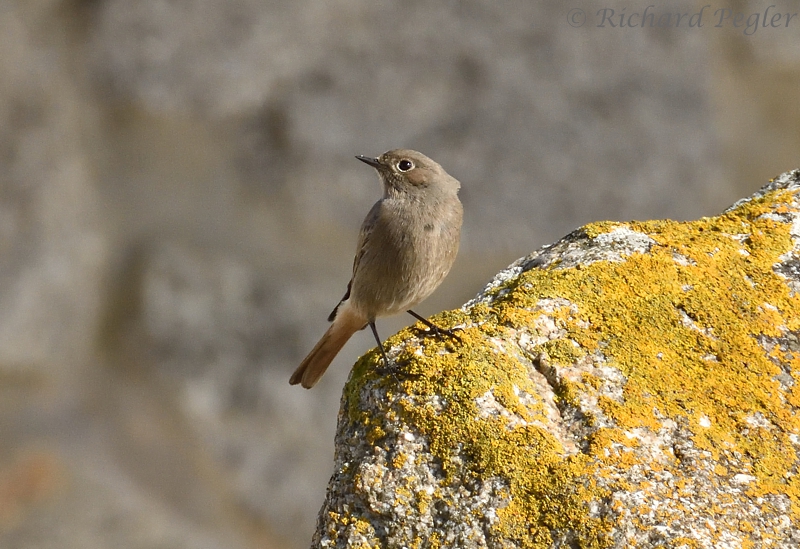
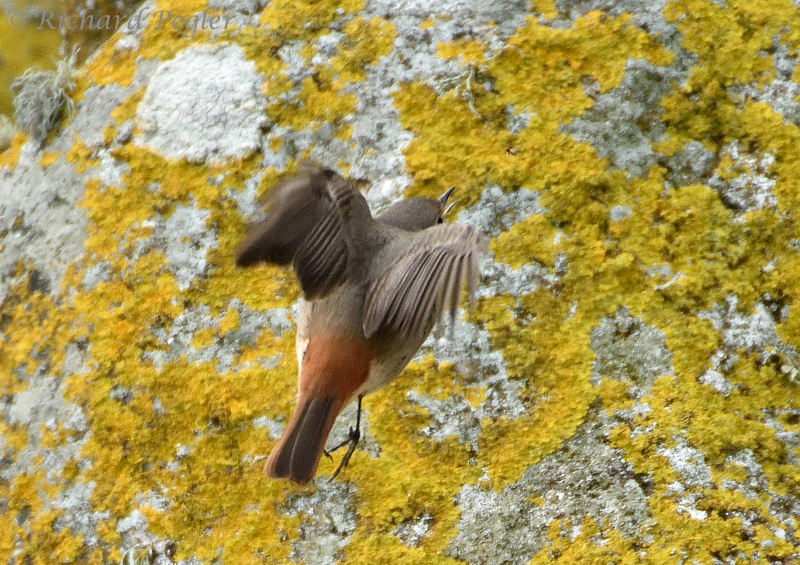
spent time sitting amongst the rocks trying to photograph the Black Redstarts. I was partly successful, but was also pleased to get photos of other birds, including a Grey Wagtail, and a Siberian Chiffchaff. As you can see, the Chiffchaff was ringed, but I've had no feedback from the partial detail that was visible on my photos.
 |
| Black Redstart (Phoenicurus ochruros) - Littleporth |
 |
| Grey Wagtail (Motacilla cinerea) - Littleporth |
 |
| Siberian Chiffchaff (Phylloscopus collybita tristis) - Littleporth |
 |
| Greenshank (Tringa nebularia) - Littleporth |
 |
Wren (Troglodytes troglodytes) - Littleporth
|
I then went off to fulfill the daily cake order at Becky's Scilly Cakes!
After getting back to base, I had an early lunch, and set off in the buggy to Pellistry, where I parked the buggy and walked up Green
Lane, turning right at the end to take the path towards Tregear's Porth. As I approached the seaward end of the path, I was surprised to see a Red-legged Partridge run round the corner in
front of me. I spent some time trying to find it, but didn't succeed. The header that is current with this blog post depicts the view from the t-junction at the seaward end of the path. There are many rabbits on the Isles of Scilly, and this is one of them, seen from that point.
 |
Rabbit (Oryctolagus cuniculus) - near Tregear's Porth
|
At the junction, I turned right towards Toll's Hill. I have found the Toll's Hill area to be a relatively reliable location for Stonechat. On this occasion, I found two, with a male being totally uncooperative and one that I first took to be female, but now think it might be a 1st winter male, being only marginally better!
 |
| Stonechat (Saxicola rubicola) (1st winter male?) - Toll's Hill |
 |
View from Toll's Hill - Toll's Island just showing on right
|
I then walked down onto the beach by Toll's Island, seeing nothing of interest and so I took the direct path back up to Pellistry and rejoined the
buggy.
There had been reports of Purple Sandpiper in Porth Hellick bay and, as I
had never seen Purple Sandpiper before, this is where I went.
On my arrival at the entrance to Higher Moors, some kind birders told me where the four sandpipers were.
However, I found them in a different, and closer, place. Unfortunately all four
spent most of their time asleep. It was good to get a 'lifer' - I have tried for Purple Sandpiper on many an occasion!
 |
Purple Sandpiper (Calidris maritima) - Porth Hellick
|
After watching for a while, I headed into Higher Moors to see what might be on Porthhellick Pool. A male Garganey was being regularly seen there, although elusive. After a while, all I'd photographed was a passing Moorhen, so I decided to move on.
 |
Moorhen (Gallinula chloropus) - Porthhellick Pool
|
As I left the hide, I bumped into one of the local birders, who had also been given the same location information for the sandpipers that I had been given, but had missed seeing them at their new location. We went back to the beach and they were still there. Soon we were joined by others who'd also been looking in the wrong place. We stood there chatting for a while hoping that the birds would wake up and do something interesting. The tide went out and they were still there.
 |
| Purple Sandpiper (Calidris maritima) - Porth Hellick |
Eventually, they were flushed from the rock by a Great Black-backed Gull and disappeared round the headland.
After this, some of us returned to Seaward Hide overlooking Porthhellick Pool and thought we saw the Garganey departing from the far corner, and agreed it to be a
'probable'.
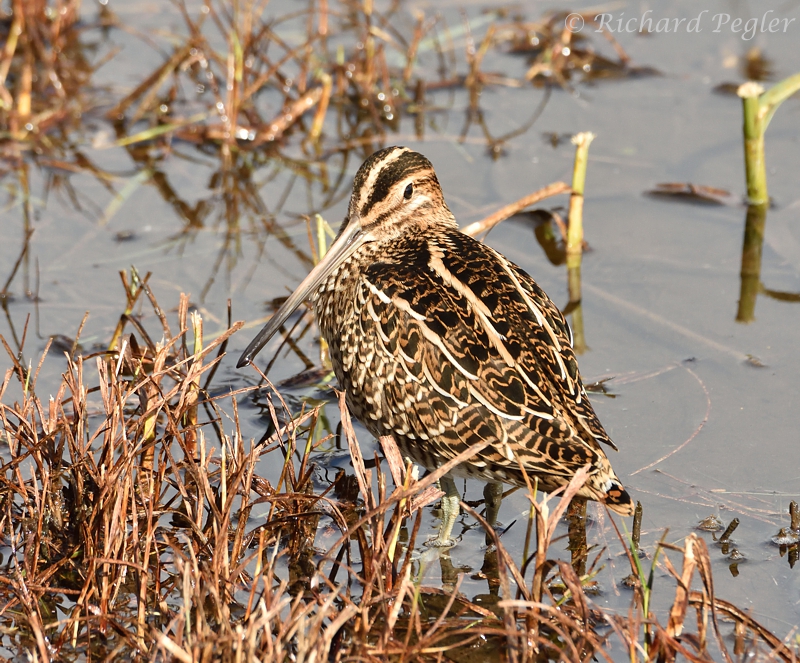
My next stop was at Lower Moors to try for better shots of the Jack Snipe. I
found the bird once more, when it started bobbing between a pair of Gadwall, but it stayed even more concealed on this occasion.
 |
| Jack Snipe (Lymnocryptes minimus) - Lower Moors |
 |
Gadwall (Mareca strepera) (female + male) - Lower Moors
|
It
was now time to head back to base. I got back to find that Lindsay and Melanie had headed to the beach to find
sea slate for a project, but had failed and were on their way back because
Lindsay found that her knee would not allow her to walk on the sand with any
degree of safety. I took the two tubs from them that they'd intended to collect the stuff in and managed to fill both tubs in about ten minutes as the sea slate was more plentiful than I have ever
seen before.
My next job was to do the requested shopping at the Coop, and this proved
to be a quick and easy task.
After all this, our evening meal was a little late, and the rest of my
evening was spent catching up with my notes, and logging my photos. It had been a splendid day!
Saturday, 12th March Littleporth ; Lower Moors ; Porthloo ; Hugh Town
The weather forecast for the day came with a yellow warning
for strong winds, and these would be accompanied by heavy rain. We had another
'washout day' in prospect.
 |
Local Weather Forecast on Saturday 12th March at 07.53
|
Shortly after 09.00 I set off for Becky's Scilly Cakes to
collect our doughnut order. The wind was already gaining strength and few birds
were seen en route. On Saturdays, Becky makes the best doughnuts on the planet,
and we ate these on my return while they were still warm. Whilst there, I also
bought our cake requirements for later in the day and for Sunday also as Becky's
is closed on Sundays.
After a doughnut, I went to sit on the bench that is in a
corner on top of the sea wall just a few metres along from our base. Photography
was virtually impossible due to the gusting wind, but a few birds were seen.
Eventually the effect of the wind and cold got through to me and it was time to
move. I did, however, manage some shots of Turnstone at the base of the sea wall
by jamming my camera against the railings to steady myself and the shots.
 |
Turnstone (Arenaria interpres) - Littleporth
|
By now the wind had got so strong that I was getting sand
blasted, even though on a wall about 3 metres above the beach. It was time to
give up.
Some shopping was needed from the Co-op and so I volunteered.
By the time that I returned it had started raining heavily.
The first part of the afternoon was spent sitting in the
lounge doing admin things. It then brightened up a bit at around 15.30 so I took
the buggy to Old Town and headed into Lower Moors once more as it was somewhere
that I could sit out of the wind and rain. My timing was perfect from a weather
point of view as there was a short deluge soon after my arrival.
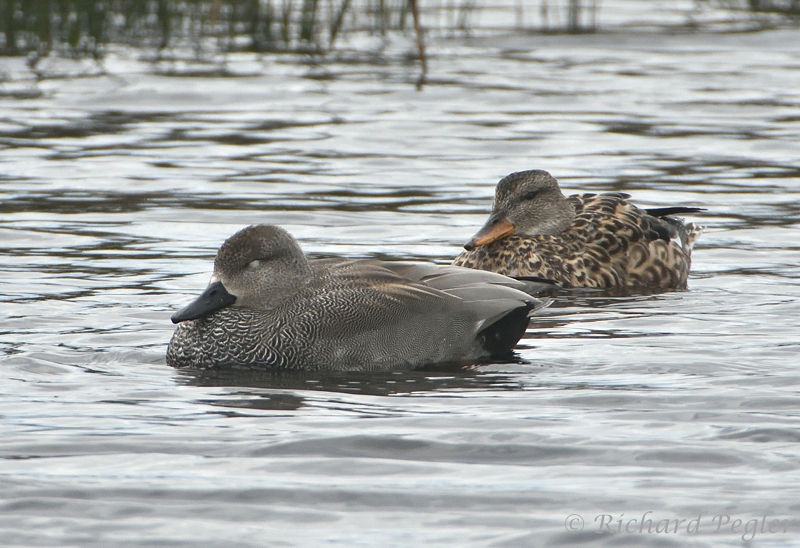
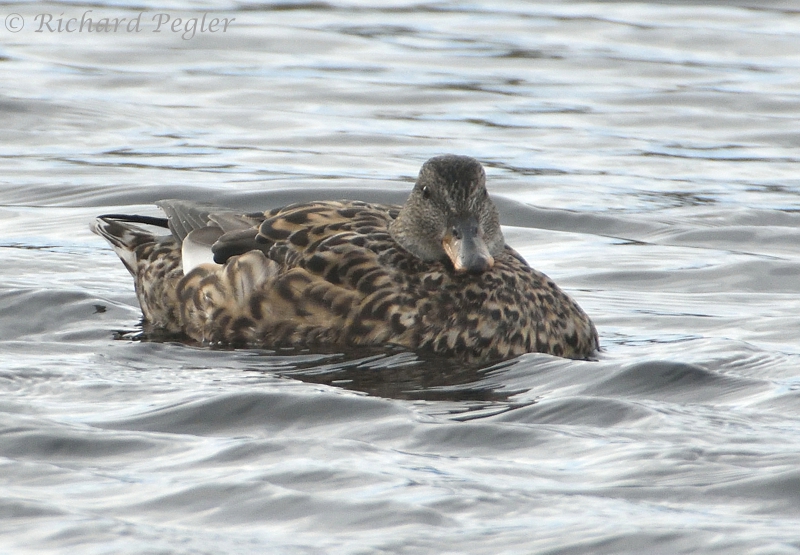
I stayed for about three quarters of an hour and the only
birds seen were three Gadwall and a Mallard.
 |
| Gadwall (Mareca strepera) (male + female) - Lower Moors |
 |
| Gadwall (Mareca strepera) (female) - Lower Moors |
 |
| Gadwall (Mareca strepera) (male) - Lower Moors |
 |
Mallard (Anas platyrhynchos) (male) - Lower Moors
|
It started raining as I left the hide and I was rather wet by
the time I reached Old Town. Having visited the public loos, I stayed in the
doorway until the rain passed. I then crossed the road to the buggy.
My next stop was at Porthloo where I parked the buggy before heading for the beach. I realise that I keep mentioning the buggy, but have not shown you this useful means of transport.
 |
The 4-seater buggy we hired from Scilly Carts - Porthloo on 12th March
|
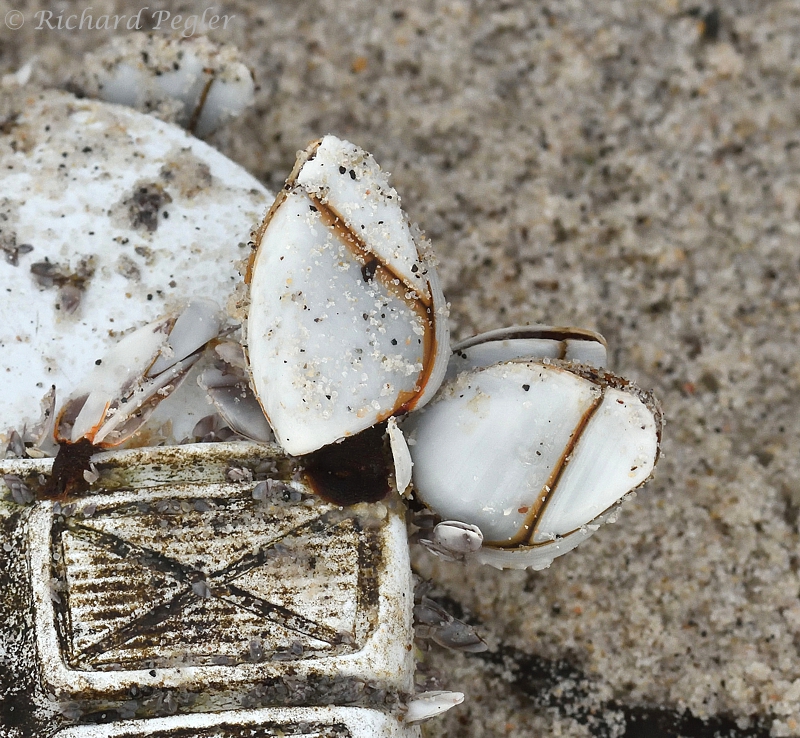
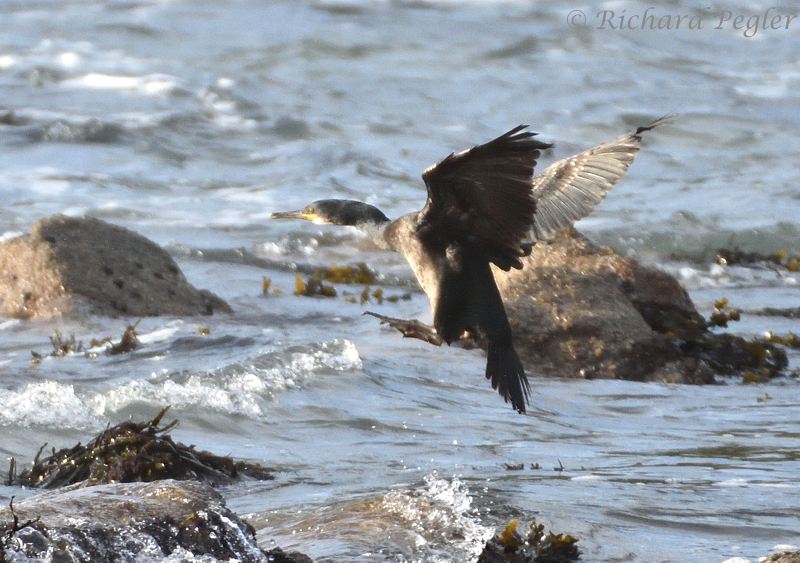
On the beach, I photographed some Oystercatchers and a couple of Shags, attempted to photograph a Black Redstart, and found some Goose
Barnacles attached to the plastic sole from a shoe! I'd seen pictures of Goose Barnacles before, and was looking forward to maybe seeing them in the flesh one day. I wish that I'd found them on something more appealing than a bit of plastic rubbish!
 |
| Oystercatcher (Haematopus ostralegus) - Porthloo |
 |
| Shag (Phalacrocorax aristotelis) - Porthloo |
 |
Goose Barnacles (Lepas anatifera) - Porthloo
|
My last stop was at Town Beach, Hugh Town, where there was a
large group of Turnstone, some of which were bathing. I also collected some sea
glass and pottery sherds for Lindsay, getting back to base just before
18.00.
 |
Turnstone (Arenaria interpres) - Hugh Town
|
A view from the bottom of the garden that evening, shows that the weather and sea were far from settled!
 |
Looking towards Peninnis from Littleporth
|
Sunday, 13th March Porthcressa ; Peninnis ; Porth Minick
Somehow I managed to fail to write notes for this day, other than to record the forecasted local temperature ( 10°c with a 'feels like' of 6°) and wind speed of 17-25 mph. I also noted that it was sunny for much of the day and there was a gentle breeze.
As we were going to have a relatively early start, followed by me having a long drive the following day, I decided that I ought to have a gentle day on this day.
Before breakfast, I spent time on Littleporth and Porthcressa beaches. On Porthcressa Beach, the Turnstones were true to character and very confiding as they searched for food.
 |
Turnstone (Arenaria interpres) - Porthcressa
|
At the western end of Littleporth, a Shag launched itself from a rock and landed in an area where the water looked worryingly shallow.
 |
| Shag (Phalacrocorax aristotelis) - Littleporth |
The Rock Pipits were around, as usual, and one of them (in the first image) has found a tasty snack which, I am reliably informed, was a Sea Slater (related to Woodlouse).
 |
Rock Pipit (Anthus petrosus) - Littleporth
|
I found another stranded Portuguese Man O'War on the beach.
 |
Portuguese Man O'War (Physalia physalis) - Littleporth
|
I also managed to photograph what I initially thought were a pair of Siberian Chiffchaff, although I am far from sure about that. Both were ringed, and what little I could see of the marking on one ring led me to believe it was probably the same bird depicted above. However, correspondence received today from the official recorder on thge Scillies casts doubt on this ID. I will, therefor, just not them as being 'Chiffchaff'
 |
| Chiffchaff (Phylloscopus collybita) - Littleporth |
I was on duty after breakfast in case nocturnal Georgie surfaced while Lindsay and Melanie went shopping, but returned to Littleporth beach late morning.
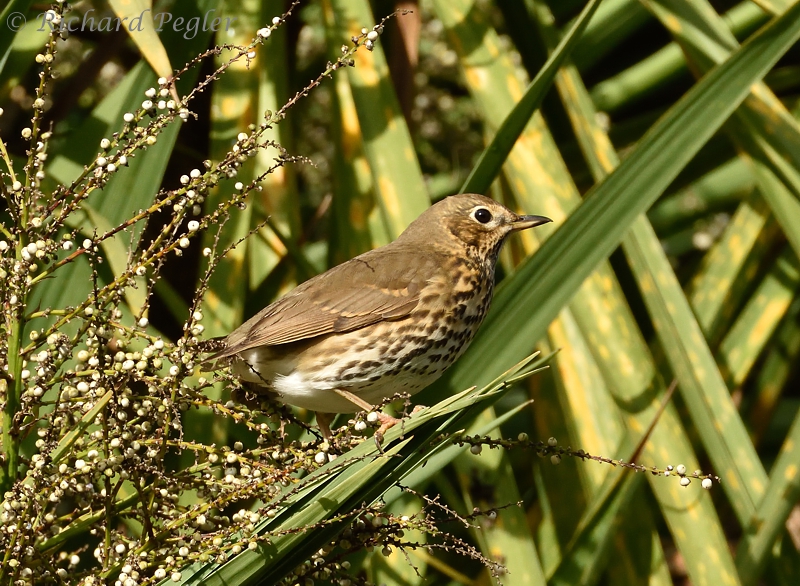
A Song Thrush on the path at the end of our garden was quite obliging.
 |
Song Thrush (Turdus philomelos) - Littleporth
|
I took a few shots of Black Redstart. The second image is a poor photo, but I include it as it shows the extent of the red rump.
 |
| Black Redstart (Phoenicurus ochruros) - Littleporth |
The warmer calm weather brought out the early hoverflies. As the eyes do not appear to meet in this one, I believe it to be a female.
 |
hoverfly (Eristalis pertinax) (female) - Littleporth
|
I also found a few more Portuguese Man O'War, one of which was quite tiny without 'tentacles'. This is one of the larger ones, but still rather small. However, you can see that those 'tentacles' are quite long.
 |
| Portuguese Man O'War (Physalia physalis) - Littleporth |
After lunch I headed off to Peninnis, leaving the girls with the buggy in case Georgie woke up and wanted a trip out.
I saw little on the way there, but was pleased to connect with a feew Stonechats once on Peninnis Head.
 |
| Stonechat (Saxicola rubicola) (female) -Peninnis |
 |
| Stonechat (Saxicola rubicola) (male) -Peninnis |
The sea was still being quite lively at times.
 |
View from Peninnis
|
I had just started heading towards the west side of Peninnis, to take the coastal path back to Porthcressa when I got, a call from Lindsay to say that Georgie had woken earlier and wanted to go to Treasure Beach (Porth Minick) and they were on their way. I decided to join then and, by the time I got to the east side of Peninnis Head I could just see them getting out of the buggy by Old Town Cafe. I hurried on and although I had three times the distance to cover, some of it over rough terrain, I arrived at Porth Minick soon after them.
I helped with the gathering of sea glass, and also noted that there were many Portuguese Man O'War here too, but all were somewhat smaller than most of the ones that I'd found at Littleporth earlier.
We did not spend long here as I needed to drop the girls back at base, and return the buggy to Scilly Carts by 17h00. In the event, I was earlier than required.
Most of that evening was spenty getting things in order so that we could make an early departure the next day.
Monday, 14th March Littleporth ; St Marys Airport ; Land's End Airport ; Ashby de la Zouch
The alarm was set for 05h30 to give us time to have breakfast, tidy round the property, and pack, ready to be picked up by Paulger's Transport at 09h10, for our 10h10 flight to Land's End Airport.
Frustratingly, the weather for the day was forecast to be by far the best since we left home over a week previously!
I was ready in good time, so paid a last visit to the seat above the beach at the western end of Littleporth. The birds were in good voice, with a Song Thrush living up to its name high up on a nearby roof, and a Wren out-doing it in volume down on the rocks below me.
 |
| Song Thrush (Turdus philomelos) - Littleporth |
 |
Wren (Troglodytes troglodytes) - Littleporth
|
Paulger's threw us into disarray by arriving twenty minutes early. At the airport we had a difficult half hour when Georgie decided that she could not possibly fly because she'd been allocated a seat which meant people other than family would be around her. Sadly, total avoidance of unfamiliar people is part of her condition. Thanks to the efforts of the Skybus team, a solution that was acceptable to Georgie was found, and after a 15 minute flight we landed safely in Cornwall without any further problems.
We were soon on our way home and, unlike on our outward journey, found diesel in Penzance without difficulty. A picnic lunch was purchased at the fuel station, and we arrived home at around five o'clock in the afternoon.
It had been a very enjoyable break, in spite of some of the worst weather we have experienced on the Isles of Scilly and an avian scene that caused birders to repeatedly remark that "there's not much about".
The real highlight for me was, undoubtedly, seeing the Purple Sandpipers.
We are all very much looking forward to our return in September.
In about a week's time I'll probably be doing a post on sightings very much closer to home. In the meantime, please take good care of yourselves and Nature - - - Richard