Firstly, my apologies for my absence from Bloggerland for a while - I have recently returned from a break on the fabulous Isles of Scilly. A blog post (or two) on that subject will follow this one, when I have had time to process the over three thousand frames I shot with my camera whilst away!
This post covers the two weeks before our departure for the Scillies and will almost certainly represent the end of summer in these parts. WARNING - this is also a rather long post!
Monday, 14th September
Nothing of significant note in the garden, although I did photograph a common, but nonetheless spectacular, Garden Spider.
 |
Garden Spider (Araneus diadematus) - garden on 14th September, 2020
|
That afternoon I decided it was time to make my first visit to Rutland Water since the start of the Covid pandemic. As I approached my old Little Owl site No.42, where I had not seen an owl for a very long time, I noticed a suspicious shape poking out from behind the roof of the building. I nearly ignored it but, at the last moment, decided to park the car and walk back along the road to a place where I could check with the binoculars - there it was, a Little Owl!
 |
Little Owl (Athene noctua) - my Site No.42
|
My reasons for wanting to visit Rutland Water were twofold - I felt that it was about time I photographed some birds, other than those in my garden, but I also wanted to check on the dragonfly scene there. On arrival, I went to the gate by one of the ponds not open to the public and had a sighting of a male Southern Hawker which very briefly landed in a tree before a strong gust of wind sent it on its way again, and I only managed a rather poor shot.
 |
Southern Hawker (Aeshna cyanea) (male) - Rutland Water, Egleton Reserve
|
I then took the trails towards the north of the site, and observed several Common Darters. Strangely, every one seen was a female!
 |
Common Darter (Sympetrum striolatum) (female) - Rutland Water, Egleton Reserve
|
A Comma butterfly was exhibiting the reason for its names (both common and scientific).
 |
Comma (Polygonia c-album) - Rutland Water, Egleton Reserve
|
Along the edge of Sharples Meadow I was hoping to find a number of Migrant Hawkers as this has been a good spot for them in the past, but I just found one, and not in the best of positions.
 |
Migrant Hawker (Aeshna mixta) (male) - Rutland Water, Egleton Reserve
|
I was more than a little nervous about entering hides at Rutland Water, as these can get quite busy at times, and the car park had been virtually full. I did, however, risk popping my head into Crake Hide which overlooks the northern end of South Arm III. There was no one there but, disappointingly, the vegetation in front of the hide had grown so tall that it was difficult to see much. The only bird I photographed was an incoming Grey Heron.
 |
Grey Heron (Ardea cinerea) - Rutland Water, Egleton Reserve
|
After half an hour or so, I had to give up and beat a hasty retreat as I was scheduled to visit our daughter on the way home. It had been an interesting session, but not as good as I had been hoping for.
Tuesday, 15th September
The garden highlight of the day was a male Migrant Hawker (Aeshna mixta), which briefly settled on a branch in our Rowan and departed as I went for my camera.
Wednesday, 16th September
Two garden highlights on this day, the first being a female Southern Hawker dragonfly which passed through without stopping, and the second being a rare visit by a Chiffchaff.
 |
Chiffchaff (Phylloscopus collybita) - garden on 16th September, 2020
|
It was also good to see Coal Tit, as these have been very thin on the ground for a couple of years.
 |
Coal Tit (Periparus ater) - garden on 16th September, 2020
|
Thursday, 17th SeptemberThere was real excitement this day as we had a visit from a Humming-bird Hawk-moth (Macroglossum stellatarum). This was only the second I have seen in the garden and only, I think, the fifth that I have ever seen anywhere! I was just raising my camera to it when it departed, never to be seen again.
The day was not lost, however, as I managed to get some shots of the Hornet mimic hoverfly, Volucella zonaria - the largest British hoverfly and a garden 'first'.
 |
hoverfly (Volucella zonaria) - garden on 17th September, 2020
|
Friday, 18th SeptemberIt continued to be a good garden week when we had a visit by a pair of Nuthatch. Sadly, I only got a shot of one of them - which is better than I did with the Southern Hawker which also visited this day and avoided the camera!
 |
Nuthatch (Sitta europaea) - garden on 18th September, 2020
|
Lindsay and I went out for a picnic lunch that day, and enjoyed the company of a Little Owl at my site No.34, although it was difficult to spot it in deep shadow. I have had to do some image manipulation to get it visible in the images below. This was the first time in two years that I have seen an owl in this tree.
 |
| Little Owl (Athene noctua) - my Site No.34 |
After lunch, we headed off towards Burrough Hill, but had not gone far before Lindsay alerted me to three small birds in the hedgerow. I was delighted to see Whinchat, and managed to get some shots of one of them.
 |
Whinchat (Saxicola rubetra) (female) - near Burrough on the Hill
|
I had passed by the entrance to Burrough Hill Country Park, the site of a huge Iron-age hill fort, but had never visited. As this was a sunny day, even if a bit windy, we decided to investigate. The wildlife was a bit thin on the ground, probably due to the wind, but the views were wonderful - some of the best in the county, in my opinion! |
| part of Burrough Hill Iron-age hill fort |
 |
View from Burrough Hill Iron-age hill fort
|
Our homeward route took us past my old Little Owl site No.41 where it must be at least two years since I last saw an owl after the nest tree collapsed just above where John Truman and I had installed a nest box a couple of years or more before, after a previous catastrophe to the nest tree. I was just about to raise my binoculars to investigate a dark 'splodge' on top of the nest box when Lindsay exclaimed 'there's an owl!'
 |
Little Owl (Athene noctua) - my Site No.41
|
Sadly, looking at the entrance hole, it does not look as if this box is being used, other than as a perch.
It is also sad to reflect that here I was on a Friday, getting excited about seeing my third Little Owl in a week. A few years ago I'd have been disappointed if I had made this same journey in one afternoon and only seen three Little Owls.
Saturday, 19th September
Little of note this day, other than an unphotographed visit by a Southern Hawker dragonfly - this time a male.
The young Goldfinches are nearly all in the process of getting their adult plumage now, and this one hasn't long to go before it 'comes of age'. In the meantime, it looks rather scruffy!
 |
Goldfinch (Carduelis carduelis) - garden on 19th September, 2020
|
Lindsay and I are both fond of Grey Squirrels, although they are a controversial subject. However, at this time of year, they can be a bit of a nuisance as they like to bury hazelnuts from our tree all over the garden, including in the lawn. This year I reckon that I have had to dig up well over a couple of hundred saplings from their unrecovered hoardings.
 |
Grey Squirrel (Sciurus carolinensis) - garden on 19th September, 2020
|
Sunday, 20th September
I'd very recently read an article about German Wasps (Vespula germanica) in UK, saying that they were very similar to our Common Wasp, although a little larger and more aggressive, which probably explains why the only time I have ever been stung by a wasp was at Peenemunde in Germany - not the worst thing to have occurred at that location! The article explained that the easiest ID point was markings on the face, so I set out to photograph a wasp face.
 |
Common Wasp (Vespula vulgaris) - garden on 30th September, 2020
|
Monday, 21st September
While out trying to find a male Migrant Hawker seen in the garden, I happened on some ladybirds. I confess to having been almost totally ignorant of the lifecycle of ladybirds so was, initially a little confused by what I saw. Having returned home this week and studied my photos, I now have a better understanding, and am concerned to find that these were Harlequin Ladybird - an alien species which predates other ladybirds, and poses a threat to our native species. I have now re-checked the location and all have disappeared except for empty larval shells.
 |
Harlequin Ladybird (Harmonia axyridis var. succinea) (nymph) - garden on 21st September, 2020
|
 |
| Harlequin Ladybird (Harmonia axyridis var. succinea) (pupa) - garden on 21st September, 2020 |
 |
| Harlequin Ladybird (Harmonia axyridis var. succinea) (emergence) - garden on 21st September, 2020 |
 |
| Harlequin Ladybird (Harmonia axyridis var. succinea) (adult) - garden on 21st September, 2020 |
I also photographed some hoverflies that day. The first I am relatively confident is an Eristalis species but cannot be identified specifically without more details.
 |
hoverfly (Eristalis sp.) - garden on 22nd September, 2020
|
The second, I believe, was Syrphus ribesii, but I'm happy to be corrected !
 |
hoverfly (Syrphus ribesii) - garden on 22nd September, 2020
|
Tuesday, 22nd September
Seeing a window of reasonable weather, and probably my last opportunity before our forthcoming visit to the Scillies, I paid a short visit to Saltersford Valley to check on the dragonfly scene.
On my way to the boardwalk I stopped to photograph a Speckled Wood butterfly.
 |
Speckled Wood (Pararge aegeria) - Saltersford Valley
|
From the boardwalk, I only managed to spot a male Common Darter.
 |
Common Darter (Sympetrum striolatum) (male) - Saltersford Valley
|
Seeing little, I left the boardwalk and made an anticlockwise circuit of the site. One of the juvenile Coots was trying out its wings for size. It looked rather amusing to me, particularly when it turned its back.
 |
Coot (Fulica atra) (juvenile) - Saltersford Valley
|
Other than this, my circular perambulation yielded nothing of interest and I returned to the boardwalk. Here I found two female Common Darters.
 |
| Common Darter (Sympetrum striolatum) (female) - Saltersford Valley |
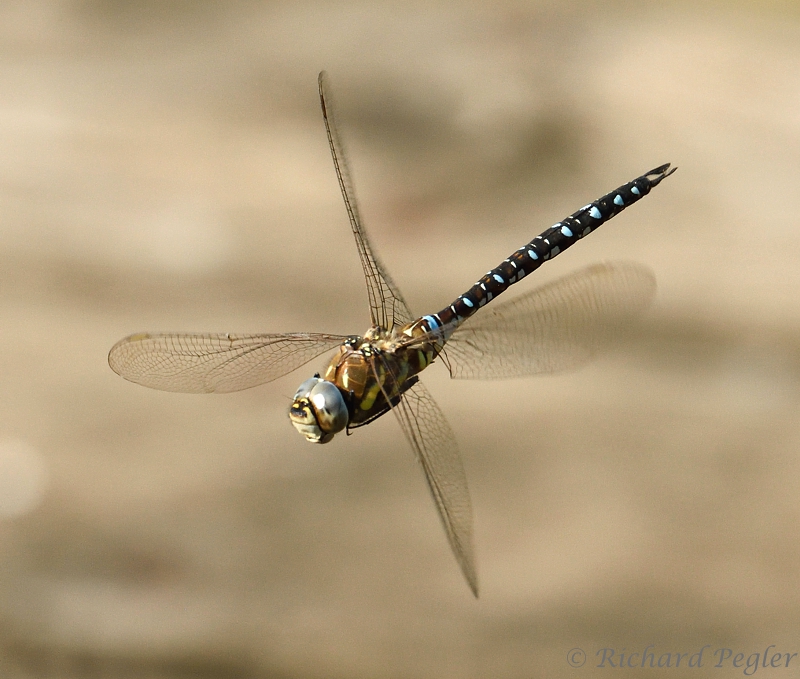
The real bonus came, however, when a male Migrant Hawker arrived and I was able to get some perched shots, and some better flight shots than I have achieved of this species this year.
 |
Migrant Hawker (Aeshna mixta) (male) - Saltersford Valley
|
This brings me to the end of this post as observations for the rest of the week were less because I was busy preparing for our visit to the Scillies.
I will now start to work my way through all those frames shot in the Scillies - I may be gone some time!
This virus thing seems to be getting a lot worse again (unless you're a fan of Donald Trump), so take great care, avoid the idiots, and stay safe. Best wishes - - - Richard