Pages

Notes on Use of This Blog


1. I have a policy that I always reply to comments on my blog, even if it's just to say thank you.

2. Please don't submit comments that include your own web address. For obvious reasons, they will not be published.

3. I'm now on Twitter - @RichardPegler1
Showing posts with label Flycatcher Spotted. Show all posts

Sunday, 8 November 2020

Scilly Sojourns - September/October, 2020 - Pt.3

This is the third, and final, part of my report on our excellent stay on the Isles of Scilly this autumn. You can find Pt.1 here:- http://peglerbirding.blogspot.com/2020/10/scilly-sojourns-septemberoctober-2020.html, and Pt.2 here:- http://peglerbirding.blogspot.com/2020/11/scilly-sojourns-septemberoctober-2020.html

It had been a mixed start to our stay weather-wise, which even led to our arrival being delayed by a day. Sadly, the poor weather was to continue up to the time of our departure. Here is an account of our last days of the break.

Saturday, 3rd October

The forecast was for continuing very windy weather, but with some sunny spells. Scillonian III was not sailing that day, due to the weather, neither was the Gry Maritha which brings supplies from the mainland to the islands, but flights were back in action. 

My plan was to start with visiting some inland locations before taking a coastal path and braving the high winds. 

As I set off, I was delighted to see a Wheatear on the beach below our base. I was seeing more Wheatear on the beaches than I was inland during this visit! 


Wheatear (Oenanthe oenanthe) - Littleporth
I then made my way up Buzza Hill, turning left at the top to gain the Old Town road. As I reached the entrance to the road to Carn Gwaval, I noticed a group of three people looking intently into a field. They kindly informed me that they had been looking at a Spotted Flycatcher. It soon re-appeared and I was quite surprised to see it catch a Red Admiral butterfly which it took to a tree on the far side of the field.

Spotted Flycatcher (Muscicapa striata) - Carn Gwaval
After a while, it came a little closer and I got a better shot.
 
Spotted Flycatcher (Muscicapa striata) - Carn Gwaval
There had been a Jack Snipe reported visible from the screen beside the ISBG hide on Lower Moors, so I thought that I'd take a look. As I arrived, a gentleman who was coming away said that it was just about visible just to the right of the rock opposite the screen. 'Just about visible' was an accurate description but I did manage a few record shots. On examining my shots, however, I am fairly well convinced that this was a Common Snipe rather than a Jack Snipe as the bird appears to have a pale stripe along the top of its crown, and no dark line above the eye. I do not know whether this bird had been mis-identified or I was looking at a different bird, but it was exactly in the place as described!

Snipe (Gallinago gallinago) - Lower Moors
I set off back to Old Town and took the road that heads round the eastern side of Old Town Bay and then the path round Porth Minick, stopping at the eastern end to photograph a Speckled Wood butterfly, before heading up to Church Point where, on the edge of the airport runway turning circle, I found another Wheatear - this one wan't on a beach! It seemed to be feeding well and has a caterpillar in the second image.

Wheatear (Oenanthe oenanthe) - Airport Turning Circle

A Goldcrest on the loop trail at Higher Moors managed to avoid my camera and I passed through without spotting anything else of interest.

Beside the road opposite the northern entrance to Higher Moors, I found another Speckled Wood ssp. insula to photograph. I had never noticed how, under certain lighting conditions, this species shows a blue-greenish colour in the wings - parhaps it is a feature of the subspecies?


Speckled Wood (Pararge aegeria, ssp. insula) - by entrance to Higher Moors
From here, I set off for Old Town, noticing a Grey Heron on the far side of a field by the airport turn.  My initial thought was that it was a long way from water, but I see that it was probably only around 200 metres from the water in Lower Moors. It's a pity that that fence wire was there!

Grey Heron (Ardea cinerea) - near Airport turn

I called in at Lower Moors once more, and the Snipe was still there in the same place, but had moved its head. My record shots do nothing to convince me that it was anything but a Common Snipe.

Snipe (Gallinago gallinago) - Lower Moors

I had been out walking for a few hours by now, and was getting tired and hungry so it was time to head back to base.

In the field before the road to the Medical Centre, there were Rabbits. I photographed one before realising that it was in an extremely poor state through Myxomatosis, so I will not present an upsetting image of it here.

I took the Buzza Tower route back to base, stopping by the end of Littleporth beach to photograph a Chiffchaff.

Chiffchaff (Phylloscopus collybita) - Littleporth
I didn't feel up to doing much more that day, having been out in a strong wind, carrying camera gear, and without a sit-down for just over four hours. However, I did pop out onto the sea wall path at Littleporth for half an hour later that afternoon, when the tide was in. 

It was good to see the Porthcressa Three cruising past.

the Porthcressa Three - Littleporth
I also took more shots of Rock Pipit, and was surprised at how vertiginous a rock face the Rock Pipit can cling to.

Rock Pipit (Anthus petrosus) - Littleporth

Sunday, 4th October

This was to be our last full day on the Scillies, with us taking a flight back to the mainland the following morning. The morning was forecast to be very windy with showers, with the afternoon being cloudy but extremely windy. Transport between the islands and the mainland does not operate on Sundays, but even if it did, it would not be operating this Sunday!

It had just been published that various trails on St Mary's were now open. These trails are a feature of the migration season when landowners give permission for birders to follow set routes, clearly marked out by the Isles of Scilly Bird Group, across their land. I had never experienced these routes before, so resolved to try one, and also to visit the Standing Stones field which was also open under the same arrangements.

In the morning, I stayed close to base, just spending time along the path at the bottom of the garden. The Stonechats were busy at the western end of the beach. Yes, we've managed to get all this way on this blog post without a Stonechat until now!

Stonechat (Saxicola rubicola) (female) - Littleporth
Stonechat (Saxicola rubicola) (male) - Littleporth
I took a shot of a gull without paying much attention to it, and now find that I am uncertain of its identity. My feeling is that it's a Black-headed Gull, and that the light conditions are stopping the black 'ear-smudge' from showing. The long red legs and the bill colouration seem to indicate this. The head and bill seem very slim and elegant, however, but I am not used to looking at Black-headed Gull at this sort of angle. Please correct me if I am wrong.

Black-headed Gull (Chroicocephalus ridibundus) - Littleporth
Oystercatchers were at the waterline.


Oystercatcher (Haematopus ostralegus) - Littleporth

I had only had a couple of very distant sightings of seals during this stay but, on this occasion, one did come a little closer to enable me to identify it.

Grey Seal (Halichoerus grypus) - Littleporth

A Grey Heron put in an appearance.
 
Grey Heron (Ardea cinerea) - Littleporth
At mid-day I went back to base to get myself an early light lunch and then set off in the afternoon with waterproof equipment in case of rain.

I set off up Buzza Hill and then turned towards Old Town, stopping at Carn Gwaval Lane to see if the Spotted Flycatcher was still there - it was, but it was not very cooperative before it flew over the road and down towards the School.

Spotted Flycatcher (Muscicapa striata) - Carn Gwaval
A quick look from the screen at ISBG hide on Lower Moors showed nothing of interest, so I turned round and wandered over Standing Stones Field to the gate by the school playing fields. By the gate I spotted a tiny bird flitting around in a rather dense tree, and felt sure that I had found another Goldcrest. It then suddenly showed and flew off, distinctly showing the head markings of a Firecrest! I tried for some time to relocate the bird but failed.

I returned to Old Town Bay, where I found a Pied Wagtail.

Pied Wagtail (Motacilla alba ssp. yarrellii) - Old Town Bay
I had a quick look at Porth Minnick in extremely windy conditions and was not surprised to see nothing. I then returned to Old Town Bay and took the path in front of the church towards Carn Léh. From by Carn Léh, the Peninnis Trail starts and takes a twisting route up the hillside through cattle fields to a point on King Edward's Road on Peninnis. The trail yielded absolutely nothing of interest, but it was very windy on the trail.

I then decided to go onto Peninnis Head, but this turned out to be an uncomfortable experience in the gale. I did, however, take a shot of a sheltering Meadow Pipit.

Meadow Pipit (Anthus pratensis) - Peninnis
It started to rain again, which was rather unpleasant on Peninnis and I headed for home, taking the King Edwards Road - Buzza Hill route rather than the exposed western Peninnis path. 

My last photos of the holiday were, appropriately, of Stonechat, back at Littleporth!

Stonechat (Saxicola rubicola) (female) - Littleporth

Stonechat (Saxicola rubicola) (male) - Littleporth
The rest of the day was spent sorting out ready for our departure the following morning.
 
Monday, 5th October
 
We were booked on the 10h10 flight to Land's End, which meant a relatively early start so that we could have breakfast, and dismantle bedding, etc. in line with the request of the property owners. It was good to know that they too were being extremely cautious about exposure to the Covid virus. Paulger's Transport came to pick us up at 09h10 and we arrived at the airport in good time and found ourselves in a queue to check in at a desk that was unmanned.
 
When the check-in opened, it was a speedy and painless process, but Lindsay and I were a little disappointed at being given boarding tickets for seats Nos. 16 and 17. On this 17-seat plane, seats 15,16,and 17 are in a back row of three seats and it meant, so we thought, that one of us would have someone sat right beside us. When called to the briefing room, we were pleasantly surprised to find that there were only six passengers on the plane and the nearest person to us was two rows away on the opposite side of the plane!
 
We took off on time and had a pleasant flight back to the mainland. Baggage was soon reclaimed and we were back in our car and on our way home. The journey was uneventful and relatively pleasant, with comfort stops made en-route. Home was reached by 16h30.
 
Weather-wise, it had probably been our worst stay on the Scillies, and the birding hadn't been brilliant compared to previous visits either - again through weather conditions affecting the birds and limiting my own excursions to see them. However, Lindsay and I both agreed that it was probably our most enjoyable stay there as it was a much-needed change from the relative drudgery of the year since our visit there in March this year, just days before lock-down.
 
I'd set out with just four prime wildlife objectives for the visit, and am more than happy that I achieved three of them - I just failed on Wryneck. Three out of four ain't bad (as someone once said) and it's always good to be left with something that needs to be achieved in the future!
 
My thanks to all concerned for a great stay, with particular mention for Jenny Hicks, the Isles of Scilly Bird Group, the Isles of Scilly Wildlife Trust, Hugh Town Co-op and Becky's Scilly Cakes! We are booked to return twice next year, and hope that we will be able to take up those bookings - time will tell! 
 
 
My next post will be a catch up on things back at home since my last post on local matters up to 27th September. I suspect that it will be a thin one, as not much has been observed wildlife-wise since then, due to other activiteies and poor weather.
 
We are now in full lockdown once more, and only permitted out locally in order to take exercise or go shopping. We do not intend to do much of the latter!
 
Until the next time, take great care and stay safe, but make the most of any wildlife opportunities that come your way.


Monday, 16 September 2019

Heather Lake - on 8th September, 2019

Having had a successful (health-wise) trip out with my camera three days earlier, I found myself tempted to visit Heather Lake to see what the dragonfly situation was there. This would involve less walking than my previous trip out, but did not give the option to sit down if I felt the need to take a rest. The morning did not disappoint!

There were still a few damselflies around, but only Common Blues were noted.

Common Blue Damselfly (Enallagma cyathigerum) (male) - Heather Lake
I did not pay much attention to the damselflies as my interest was drawn more to the several dragonflies that were visible. I did, however, take some shots of a lone duck on the lake, not being sure whether it was a Tufted Duck or a (somewhat rarer) Scaup. My photo and description even had the local experts scratching their heads for a while before coming to the conclusion that it was just a 'Tufty'.

Tufted Duck (Aythya fuligula) (female) - Heather Lake
I spent a rather long time trying to photograph Migrant Hawkers. Photographing dragonflies in flight can be a rather strenuous exercise, particularly on the chest and arm muscles, and I did not feel up to it on this occasion, so I waited for them to settle before moving in. Only males were seen on this occasion. I'm not sure what the hawker in the 2nd image, below, is doing but it was busy whirring its wings whilst settled - perhaps trying to generate some warmth?


Migrant Hawker (Aeshna mixta) (male) - Heather Lake
There were plenty of Common Darters around, and several were busy ovipositing in tandem. For the ovipositing ones I did try some 'flight shots' as it is somewhat easier to wave a camera around when it is pointing in a generally downward direction.


Common Darter (Sympetrum striolatum) (male) - Heather Lake
Common Darter (Sympetrum striolatum) (male + female, in cop) - Heather Lake
Common Darter (Sympetrum striolatum) (male + female, ovipositing in tandem) - Heather Lake
I've often heard it said that Brown Hawker are extremely difficult to photograph, with their unpredictable flight, and their reluctance to settle. I can, to some extent, understand this view, particularly in respect of their unpredictable flight. However, I have, with patience, managed the occasional shot of a settled Brown Hawker, although catching females ovipositing is more frequent. I was, therefore, somewhat delighted to photograph at least three Brown Hawkers (all male) on this day. It might have been more, but you can clearly detect three different specimens by looking at wing damage (last two images are probably of the same individual).


Brown Hawker (Aeshna grandis) (male) - Heather Lake
For a short while, I was distracted by the juvenile Little Grebes on the lake. 

Little Grebe (Tachybaptus ruficollis) (juvenile) - Heather Lake
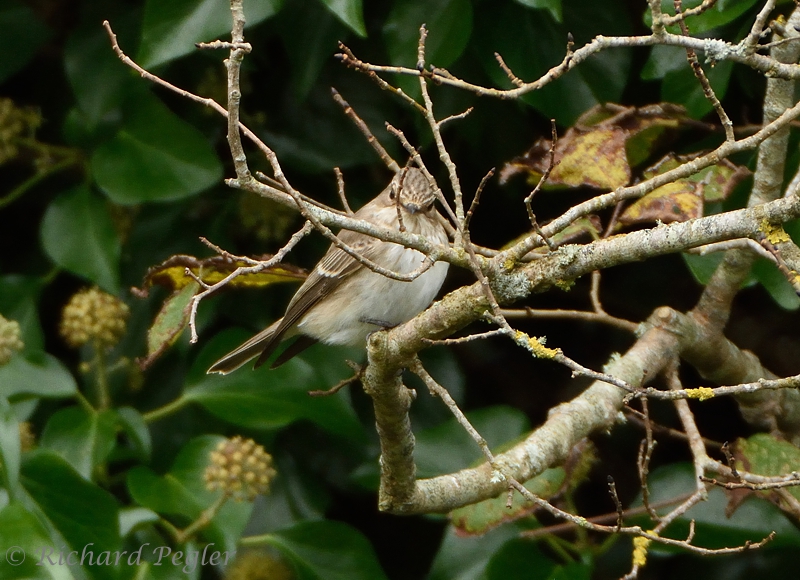
My greatest delight was, however, seeing Spotted Flycatcher. I'm not a 'lister', but I can't remember seeing one of these before in the county, and I certainly hadn't photographed one in the county. I believed, at the time, that there were probably two, although I didn't see them together at any one time. Having looked at the two images below, however, my suspicions are strengthened!


Spotted Flycatcher (Muscicapa striata) - Heather Lake
I'd now been on my feet for two and a half hours with a heavy camera and been contorting myself into awkward poses in order to take photos. I was starting to feel I'd overdone it and so headed back towards my car, it not helping that I put a foot into an unseen hole under the grass as I did so and twisted my back as I stumbled! It took a couple of days to recover, but I'm delighted that I made the visit.

Thank you for dropping by. I suspect that my next blog post will largely feature the dragons, once more, but I feel that an owl is in the offing!


Wednesday, 3 July 2019

Hebridean Adventure, 2019 - Pt.1 - 23rd to 28th May, 2019

Last year, Lindsay and I had a fabulous holiday on the island of North Uist - one of the Outer Hebrides group of islands. It was our first-ever visit to the Outer Hebrides and, on that occasion, we had virtually wall-to-wall sunshine and no wind. Accommodation, food, scenery, and birds were all wonderful. We had no hesitation in booking for a second visit at the same time this year, but were under no illusions that we'd be so lucky again with the weather. Indeed, before we set off, we were already seeing that the weather forecast was not good. Here's how the first part of our stay unfolded.

Thursday, 23rd May                Ashby de la Zouch (home) to Stirling (Scotland)

Neither of us are that keen on long-distance motorway driving, preferring where possible to travel by more scenic routes even though it takes longer. On that basis, we don't like driving more than about 300 miles (500 km) in a day - I get to do all the driving on these occasions! Instead of taking the M6, M74, M73, and M80 to Stirling, we had a short run up the M1, and M18 to the A1, and then took the Edinburgh City Bypass and M9 to Stirling.

It was raining hard when we set off, and we broke our journey on the A1 to have lunch at our favourite location in Boston Spa - the Deli-Café. Fortunately the rain stopped just before we got there. Here we had an excellent lunch at a very reasonable price, before a quick trawl round the charity shops and then continuing on our way.

It rained on and off all the way to Stirling, where we checked in at the Travelodge at Sterling Services on the M80 near the city. Dining options there are Burger King and Costa Coffee, so we opted for a picnic gleaned from the shelves of the M&S Food shop, and then had a relaxing evening and early night.

Friday, 24th May               Stirling to Kyleakin (Isle of Skye)

We woke to find the services area inundated with soldiers, but they were just stopping for breakfast before departing in three coaches. I went over to M&S, to get some fruit for our breakfast.

Lindsay was keen to visit the Scottish Antiques and Art Centre at Doune which was just 20 minutes down the road and didn't open until 10h00, so we didn't have an early start. We arrived before they opened and had to wait until exactly 10h00 before entering. We spent a full hour looking round the vast area of the centre, and came away empty-handed. It's not that we didn't see anything to take our fancy, it's just that we either didn't have the space to put it, or we couldn't afford it!

It was then that I realised Lindsay's real reason for wanting to visit - the Café Circa on the premises offers fabulous cakes, so we settled in for tea and cake (superb!).

It was a relatively fine day and, again, we opted for the scenic route rather than the fastest route, which would have included a large section of the notorious A9 road. 

We found a very pleasant place for lunch which was the Artisan Café near Tyndrum and which is located in the old Strathfillan Church. 

Fort William can get very congested with traffic at times, but we had no problems, and were over the Skye Bridge and at our B&B, MacKinnon Lodge, just outside Kyleakin by 16h00. 

Our first impressions were that this was a grand place, but was in need of a little TLC. Our room was up an extremely narrow and steep set of stairs with a 180° turn in them, and getting the cases up there was difficult! However, the view from the large window in the room was pleasant. 

As we'd arrived, I'd noticed a spectacular-looking beetle in the grass. However, my cameras were both packed away in the back of the car. After taking everything upstairs, I went back out to see if I could find the beetle, but had no luck. I did, however, take a walk round the extensive grounds, not finding much until I approached the woodland which backed onto an inlet of Loch Alsh. Here there was a noisy heronry, but I couldn't get any photos through the dense trees. I did, however, at one point find a distant Spotted Flycatcher.

Spotted Flycatcher (Muscicapa striata) - Kyleakin
The midges were building up and so I soon returned to our room.

That night, we walked into Kyleakin and enjoyed a splendid seafood dinner at the Kings Arms Hotel.

Saturday, 25th May            Kyleakin to North Uist, via Uig

Breakfast was offered within a relatively tight time band, and we decided to go towards the start of the proceedings. This entailed walking down the drive to the main house, where we found a very pleasant dining room.

I am not someone who enjoys a cooked breakfast, and usually just opt for a bowl of cornflakes (sometimes Weetabix) and some fruit, washed down with a pot of tea. Bizarrely, the only cereals they had available were either sugar-coated, or those with very robust grains. I found myself having scrambled eggs with smoked salmon - very enjoyable but with unwanted after effects later in the morning.

Whilst at breakfast the threatened rain arrived in the form of 'mizzle', and the midges were out in force as we returned to the room. However, on the way, I noticed that a Spotted Flycatcher was in a group of small trees near to the drive. I rushed in to get my camera and spent some time trying to photograph it. I got some shots of it in bad light and partially obscured by a branch.

Spotted Flycatcher (Muscicapa striata) - Kyleakin
It then moved to a twig much closer to me and in better light. It was only when I came to look at the photos later that I found out that the 'twig' was a thick cable with a cable-tie on it! Part way through this session I noticed that I'd bee so preoccupied with the flycatcher that I'd not noticed that I was covered in midges. I must have had a couple of hundred on my hands and face. I was to regret this for half of the following week!

It was raining as I packed the luggage into the car, and I found a moth on the property wall during this. It's a species that I don't think I have seen before and I hope I have the correct ID.

Syndemis muscula - Kyleakin
We had a fixed, but not tight, schedule this day as we had to be at the ferry terminal at Uig for check-in before 13h45. The most direct route was a journey of only 48 miles (77km) with a theoretical duration of 66 minutes. We used this opportunity to take a devious route and visit bits of Skye we'd not seen before. In spite of the continual rain, this proved to be a good move.

We had a stop at the Bog Myrtle café and bookshop is Struan. The cake was wonderful, but the book prices were prohibitive - more for a second-hand book than one would have paid for a new one. 

A stop at the Croft Studio, Dunvegan, was an absolute delight. As we approached the door, I was very taken by a painting in the window of a Kingfisher. We each came away with prints by the artist, Pamela Budge, plus a couple of greetings cards - mine based on artwork by the same artist.

It was still chucking it down with rain as we left, and I spotted my first Hooded Crow of the trip on a fence post on the far side of the road.

Hooded Crow (Corvus cornix) - Dunvegan
We arrived at the CalMac ferry terminal at Uig in good time and decided to have lunch at the Bakur Bar there. This turned out to be somewhat less than satisfactory - the waitress didn't seem to have any knowledge about the menu or the drinks available. Furthermore the aroma coming off the mussels that a few people were eating seemed to me to be akin to that of sewage. I only managed half my meal, which was rather unpleasant.

It had still been raining torrentially while we were in the bar but, fortunately, by the time we had boarded the ferry, it had eased off a lot, and we were able to find an outside area that was under cover, and stayed relatively dry. I stayed outside for the whole of the 1hour 45 minute crossing, but Lindsay spent time inside drinking coffee. There were quite a few birds seen, but nothing wildly exciting. Here are a few of them:-

Kittiwake (Rissa tridactyla) - The Little Minch (Outer Hebrides)
Small mixed groups of Razorbills and Guillemots were seen.

Razorbills (Alca torda) and Guillemots (Uria aalge) - The Little Minch
Razorbill (Alca torda) - The Little Minch
Guillemot (Uria aalge) - The Little Minch

Gannet (Morus bassanus) - The Little Minch

Puffin (Fratercula arctica) - The Little Minch

Black Guillemot (Sepphus grylle) - The Little Minch
It was not far from the ferry terminal at Lochmaddy to our accommodation, which was a fabulously converted 'blackhouse'. Here we unpacked the car, sat and had a cup of tea whilst writing a shopping list, and then set off for the Co-op shop some 6 miles (10km) away. We'd not brought any food with us and everywhere would be closed the next day, which was a Sunday, so shopping was essential.

The rain had diminished to a drizzle after our shopping and so we visited a local beach. There was no one there (I'm not surprised!) and the only bird seen within reasonable distance was a solitary Dunlin.

After this, we headed for the legendary Committee Road - famous for Short-eared Owls and Hen Harriers. Although the rain was now intermittent, visibility was not good and we only saw Meadow Pipits and Stonechats.

Stonechat (Saxicola rubicola) (male) - Committee Road, North Uist
Stonechat (Saxicola rubicola) (juvenile) - Committee Road, North Uist
The rest of the evening was spent unpacking and relaxing after a simple meal.

Sunday, 26th May       Petersport and Griminis - via the Committee Road

We woke up to a relatively dismal day, weather-wise. Little did we know that the temperatures would struggle to reach 10°c each day we were here and, coupled with some stiff breezes, this did not make for comfortable conditions.

After breakfast I took a turn round the outside of the property and had some pleasant surprises. Adding Wheatear and Snipe to the garden list plus hearing Corncrake in a piece of ground on the property purposely left to encourage them was a foretaste of what was to come!

Wheatear (Oenanthe oenanthe) (male) - Garden, near Clachan Sands
Snipe (Gallinago gallinago) - Garden, near Clachan Sands
I also found a rather dark, and damp, Knot Grass moth on the house wall.

Knot Grass (Acronicta rumicis) - house wall, Clachan Sands
As the weather forecast was not that good, we expected to be spending much of our time in the car. We set off that morning with two objectives in mind. The first was go to the island of Benbecula to look at the other property owned by the same person as that we were staying in, to see if it would be an alternative for next year, and the second was to spend some time at Loch Mor, by Griminis and also on Benbecula.

Our chosen route was, of course, via the Committee Road, but near Solas we stopped for the first of several fairly close encounters with Redshank.

Redshank (Tringa totanus) - near Solas
At the north end of the Committee Road, in drizzle, I stopped to take the first of many Meadow Pipit photos - a common bird, especially in the Uists!

Meadow Pipit (Anthus pratensis) - Committee Road
We didn't see much else until we got near to the south end of the Committee Road, when Lindsay's eagle eyes spotted - an eagle! It was, unfortunately, already drifting away from us.


White-tailed Eagle (Haliaeetus albicilla) - from the Committee Road
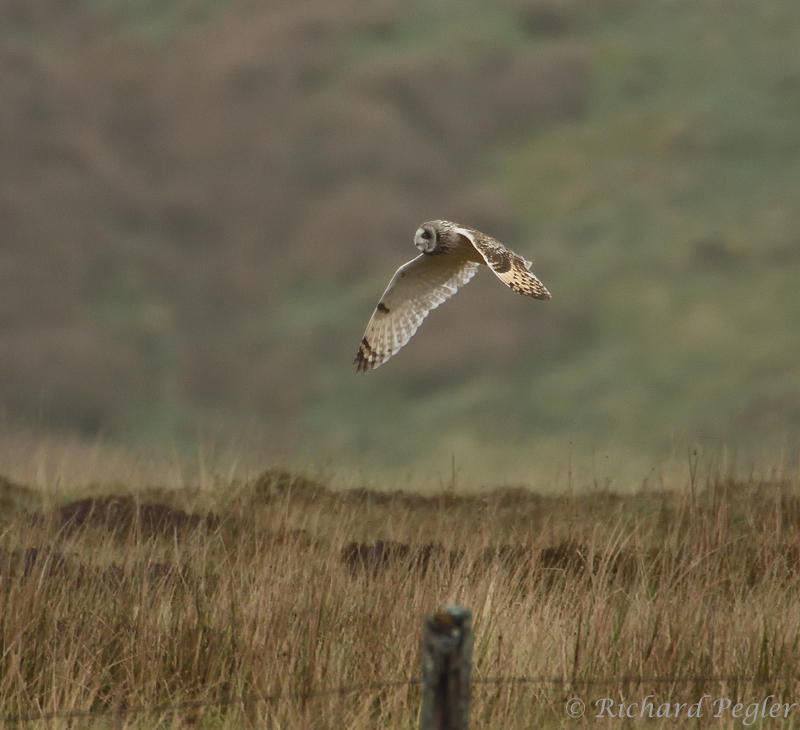
At the end of the Committee Road, we continued south and Lindsay's skills came into play again as we passed Carinish Village Hall  - she'd spotted a distant Short-eared Owl! Fortunately there was a long passing place on the single track road, so we were able to stop a while. 

Short-eared Owl (Asio flammeus) - near Carinish Village Hall
We continued on to Benbecula and found the property that we were looking for. To my mind the location looked fabulous, but Lindsay felt that it was a probably a little too remote for her comfort - especially if I went wandering off on my own!

We then headed to Loch Mor and parked at a convenient place beside the road, where we could watch from the comfort of the car (yep, it was raining), and not risk disturbing the birds. A relatively close Lapwing, looking rather soggy, gave me something to check camera settings with.

Lapwing (Vanellus vanellus) - Loch Mor, Benbecula
We didn't have to wait too long before I spotted our target species - Red-necked Phalarope - about to disappear into some distant vegetation. I suspect that I'd missed it fly in.

Red-necked Phalarope (Phalaropus lobatus) (female) - Loch Mor
I then realised that the occasional small birds that I was seeing flying in and out of the area were Red-necked Phalarope. They seemed to be spending more time flying than swimming - something I'd not seen on my previous visit in 2018. I did catch this very distant one in the air - you can detect how murky the conditions were!

Red-necked Phalarope (Phalaropus lobatus) (female) - Loch Mor
Partly due to the weather limiting the photographic opportunities, but also due to a need to head to Baile Mhaniach to avail ourselves of 'the facilities' there, we didn't stop for long after our late picnic lunch at Loch Mor. We did, however, have a brief stop when Lindsay spotted some birds on the coast near Aird. It was delightful to see a Shelduck with six chicks, four of which are visible in the next image.

Shelduck (Tadorna tadorna) (with chicks) - near Aird, Benbecula
Eider (Somateria mollissima) (male) - near Aird
We took our time heading homeward after our comfort stop, taking the Committee Road once more. As we got near to the north end of the road we spotted a Short-eared Owl on a distant fence. This gave me some slightly better photo opportunities than the one seen in the morning.


Short-eared Owl (Asio flammeus) -from the Committee Road
As we travelled the A865 near Cnoc Mhic Eoghainn, Lindsay spotted another owl, and we were in a place where we could stop. The owl stayed distant and was quite active, although it did stop for a while on a fence. It also kept disappearing behind a rise in the land. Eventually, however, it dropped to the ground, as in the fourth image below.


Short-eared Owl (Asio flammeus) - near Cnoc Mhic Eoghainn
I'd thought that we were possibly seeing two different owls, and suddenly this was confirmed when a second owl (a male) dropped in at exactly the same place as the first, as can be seen in the next image (there's 11 seconds between the above image and the below image).

Short-eared Owl (Asio flammeus) - near Cnoc Mhic Eoghainn
They then proceeded to mate - the first time (and probably the last) I've ever seen SEOs mating - I just wish I'd had a better vantage point.

Short-eared Owls (Asio flammeus) (mating) - near Cnoc Mhic Eoghainn
Afterwards, they went their separate ways, and the female perched on a rock in a somewhat better position than she'd been in up until then.

Short-eared Owl (Asio flammeus) (female) - near Cnoc Mhic Eoghainn
I'd had a fair crack of the whip with the birds, and it was now time to indulge Lindsay, who loves a stroll on the beach. As the weather was now greatly improved, although far from sunny, we made our way to Clachan Sands, which was the nearest beach to our base. It was desperately crowded, as you can see below!

Clachan Sands, North Uist
The road to the beach passes through grassland, and by a cemetery, and so some birds were seen

Lapwing (Vanellus vanellus) - near Clachan Sands
Common Gull (Larus canus) - near Clachan Sands
As we'd had a late lunch, we had a late (for us) evening meal, so I had time beforehand to have a stroll round the property. I was delighted to add Twite to the garden list, and photographed a few passing birds.


Twite (Linaria flavirostris) - garden, near Clachan Sands
Greylag Geese (Anser anser) - from garden, near Clachan Sands
Redshank (Tringa totanus) - from garden, near Clachan Sands
Our first full day in the Outer Hebrides had given us some decent sightings even if the weather had not been so good. However, the photography had suffered somewhat.

Monday, 27th May               Grimsay, Baleshare, and Balranald

Today was designated a 'Lindsay day', with a greater focus on spending time at the coast. The weather forecast was somewhat better, although still cold and windy. It was also our first opportunity for shopping  after the closures on the Sunday.

I took a before-breakfast stroll up the lane from the property and spotted a distant Hooded Crow. Strangely, I don't think I saw one in the Outer Hebrides in 2018.

Hooded Crow (Corvus cornix) - near Clachan Sands
Close to the cottage, a Redshank graced the top of a post - as they do!

Redshank (Tringa totanus) - near Clachan Sands
An Oystercatcher flew in, seemingly oblivious to my presence!


Oystercatcher (Haematopus ostralegus) - near Clachan Sands
Back in the garden, the local Buzzard went cruising by, looking for its breakfast.


Common Buzzard (Buteo buteo) - from garden, near Clachan Sands
We had a gentle run after breakfast, and headed south. Our prime objective was a stop at Kallin on Grimsay to visit the Namara Cafe for a seafood lunch, and then to buy supplies from the shop of their parent company, Kallin Shellfish, just a few hundred metres away.

We first had a stop in the village near to where I'd seen damselflies in 2018. I guess it was too cold and windy for them on this day, but I did spot a wonderful beetle which was metallic purple at each end and gold in the middle. I think it was Ctenicera cuprea.


Ctenicera cuprea - Kallin, Grimsay
It was then not far to the Namara Cafe. As we reached the entrance to their premises, Lindsay spotted a couple of large birds in the sky. I was able to stop and get out to take photos. It seems that one of the 'large birds' has disappeared and left the other one to deal with the situation. A White-tailed Eagle was being mobbed by a Raven. After a while, the Raven gave up and disappeared, but the eagle wheeled around in the sky for a few minutes. It was my closest-ever sighting of a White-tailed Eagle.

White-tailed Eagle (Haliaeetus albicilla) + Raven (Corvus corax) - Kallin

White-tailed Eagle (Haliaeetus albicilla) - Kallin
Lunch was wonderful. I had scallops and black pudding and Lindsay had fish and chips.

After this, we went to the shop and bought langoustines and a very large crab.

Lindsay's love of beaches took us across the causeway to the island of Baleshare. Although there were two other vehicles when we arrived at the parking area above the beach, there was no one else on the beach - that's Lindsay in the camouflaged coat!

the beach, Baleshare
Lindsay headed south on the beach, while I went to the sea-weedy area to the north. Here I used my favoured beach tactic of standing stock-still and waiting for the rising tide to bring the birds towards me. Here, however, it was just Sanderling, but they were in good numbers, and in varying stages of plumage transition.


Sanderling (Calidris alba) - Baleshare
After Baleshare, we made our way back up the west coast in order to check out the beach by Balranald. Just before we reached the turning off to the RSPB visitor centre and campsite, I spotted a swan in a lochan on the left. Sadly, I was unable to stop, so we continued. 

Nothing of great note was seen near the RSPB visitor centre, although Corncrake was heard. We got to the beach, to find it totally deserted. 

the beach - by Balranald
Our shellfish supper was getting more and more tempting, so we didn't stay long. We did, however, manage to stop by the lochan and I was delighted to confirm the swan was a Whooper Swan.


Whooper Swan (Cygnus cygnus) - near Balranald
There were also a couple of Dunlin here. Here's one:-

Dunlin (Calidris alpina) - near Balranald
On the return journey, the Committee Road had a surprise for us - not any of the usual suspects, but a Red Grouse. Until that moment I had no idea that Red Grouse were present on North Uist. It was, of course, first spotted by Lindsay - it took me a while to find it, however, as her powers of observation greatly exceed her powers of description! 

Red Grouse (Lagopus lagopus scotica) - Committee Road
That night, we enjoyed our dinner immensely. From then on in, all our lunches and evening meals whilst in the Outer Hebrides were based on seafood.

Tuesday, 28th May                  Berneray, and Balranald (again!)

My before-breakfast amble round the garden resulted me seeing the local Buzzard up to his tricks, having just snatched a Lapwing chick, and being hotly pursued (to no avail) by a distraught parent.


Common Buzzard (Buteo buteo) - from garden, near Clachan Sands
A short stroll on the lane just beyond the property resulted in some shots of Redshank and Skylark that I'm quite pleased with.


Redshank (Tringa totanus) - by cottage, near Clachan Sands

Skylark (Alauda arvensis) - by cottage, near Clachan Sands
After breakfast, we headed off to Berneray, which is an island just to the north of the property we were staying in, and which is reached via a causeway, built almost exactly 20 years before this visit.

Just before we reached the causeway we found a relatively obliging Wheatear sitting on a fencepost. What the Outer Hebrides lacks in number of trees seems to be countered by the number of fences - they are everywhere!!!

Wheatear (Oenanthe oenanthe) - near Berneray
Having crossed the causeway, we took the first turn to the left to view the water near the bunkhouse. I was surprised to see a distant Slavonian Grebe, expecting them to be inland on their breeding grounds.

Slavonian Grebe (Podiceps auritus) - near Borgh, Berneray
I watched for a while as the grebe went further and further away and then we set off on the road west from Borgh which eventually arrives above the beach. On our way there were many Ringed Plover, and a few Dunlin well inland.

Ringed Plover (Charadrius hiaticula) - by road west of Borgh
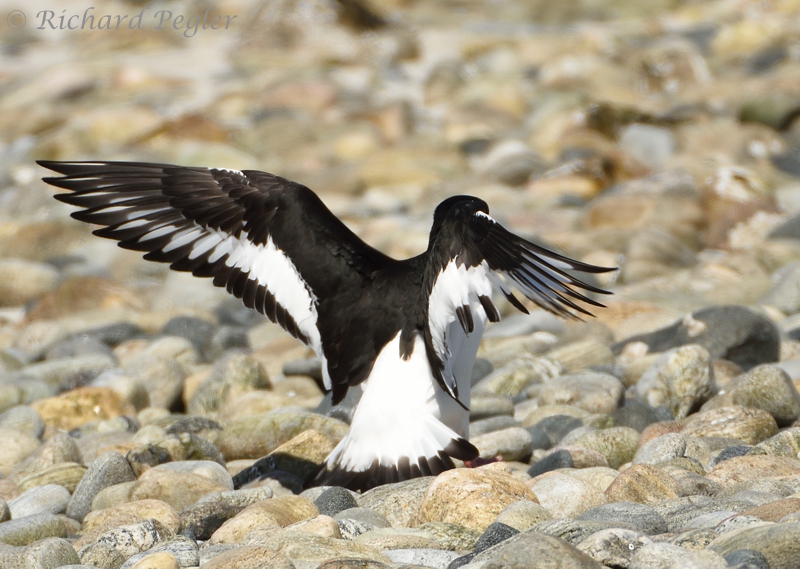
Having arrived above the beach, Lindsay made her way down onto the well-used beach immediately below where we had parked while I set off in a westerly direction to explore the beach that could be reached via a stile in the fence. As I approached the beach, an Oystercatcher made its way noisily towards me on the edge of the grass above the beach.


Oystercatcher (Haematopus ostralegus) - beach west of Borgh
Thinking that I was disturbing it in that area, I quickly headed down to the beach and directly away from the bird. I'd not gone far before what I think was a second bird flew across close in front of me.

Oystercatcher (Haematopus ostralegus) - beach west of Borgh
It then landed a short distance away, and scuttled forward before settling itself down low in the pebbles.


Oystercatcher (Haematopus ostralegus) - beach west of Borgh
I suspect that it had eggs there, and so it was time to beat a hasty retreat! As I left, I met a couple who were about to cross the stile. I told them of the Oystercatchers, and was delighted when they said they'd turn back and not disturb them.

Having rejoined Lindsay, it was time to head off to the beach at Beasdaire for a picnic with a view:- 


Beasdaire beach - a pretty fine picnic spot!
After our lunch, we took a stroll along the beach. I did my usual trick with the birds on an incoming tide.


Sanderling (Calidris alba) - Beasdaire beach
We then headed back to North Uist and visited the machair by Greinetobht, only just managing to find a place to park - it was the busiest place we found in the whole week!


from the car park by Greinetobht
The machair is famous for its flowers, although it was not at its best at this time. However, it was still beautiful. Here's one of the flowers, which. thanks to 'Conehead54', has now been identified as Thrift!

Thrift (Armeria maritima) - near Greinetobht
We did not miss out on the obligatory daily traversal of the Committee Road. A couple alerted us to the presence of a Hen Harrier, but it turned out to be a hovering Common Buzzard pretending to be a Kestrel. Speaking to a seasoned birder who was a little further up the road, he assured me that the only bird of prey in the area for the past half hour had been the Buzzard.


Common Buzzard (Buteo buteo) - Committee Road
Further south on the Committee Road we saw Stonechats with juveniles and a Skylark.


Stonechat (Saxicola rubicola) (male + juvenile) - Committee Road
Skylark (Alauda arvensis) - Committee Road
We returned to Balranald in the hope of seeing Corncrake, passing the obligatory Meadow Pipit on a post as we approached.


Meadow Pipit (Anthus pratensis) - by Balranald
Lindsay decided to stay in the car while I went off to try and find the Corncrakes. There was a person standing by the gate where I'd heard them most the previous day. He turned out to be extremely helpful and an absolute expert at spotting Corncrakes, to the point that I was starting to feel totally inadequate when I was not seeing birds that he said were showing well. In the end, I managed a shot of a bird poking its head out, but failed to grab a usable shot when it broke cover at speed and then flew off into a field opposite.


Corncrake (Crex crex) - Balranald
I felt that I'd left Lindsay in the car for long enough and so returned, and we then set off back towards base. We did, however, stop beside the road that leads to the reserve when we spotted another Whooper Swan. I was, at first, a little worried as it seemed to have a bloody head, but it was behaving as if it was happy enough. It was definitely a different bird to that seen the previous day, although the two locations were very close to each other. Both birds were seen again on later days, one still having its red head.


Whooper Swan (Cygnus cygnus) - near Balranald
A Short-eared Owl was spotted at the same location that we'd seen the mating pair two days earlier, but no sensible photos resulted.

Back at base, three of the property's resident Starlings were enjoying the evening sun. They were using the nest boxes on the garden shed as their homes!


Starling (Sturnus vulgaris) - garden, near Clachan Sands
I'll finish Pt.1 of my account at this point. The second part will probably be somewhat shorter, but possibly a little better from a photographic point of view.

Thank you for dropping by.