Pages

Notes on Use of This Blog


1. I have a policy that I always reply to comments on my blog, even if it's just to say thank you.

2. Please don't submit comments that include your own web address. For obvious reasons, they will not be published.

3. I'm now on Twitter - @RichardPegler1
Showing posts with label Egret Little. Show all posts

Sunday, 12 November 2023

The First Half of October, 2023

Having returned from our visit to the Isles of Scilly on 3rd October, I found myself with nearly two and a half thousand photos to process. This took about three weeks to complete, and limited my time out in the field. I did, however, manage three short excursions, but also found myself distracted by birds in the garden while at my desk, working on the photos. Here are some of my observations from the first half of October.

Thursday, 5th October          Garden

Stock Dove was absent for a few weeks, but is now being seen on an almost daily basis. Occasionally we get two of them.

Stock Dove (Columba oenas) - Garden
Carrion Crow has become a frequent visitor to the garden, and also we sometimes get two together. I think that face radiates intelligence.

Carrion Crow (Covus corone) - Garden

Woodpigeons are also frequent visitors - it's a rare day that we don't see one in the garden - but we rarely see youngsters, such as this one.

Woodpigeon (Columba palumbus) (immature) - Garden
Sunday, 8th October          Garden
 
Our over-the-back neighbour has a box hung on the dividing fence which he fills with peanuts in their shells. These seem to be exclusively attractive to the local squirrels which take great delight in burying them in our garden, although sometimes they will stop and enjoy the contents - as this one did, sitting on the wall of our mini-pond, which I photographed from my study window.
 
Grey Squirrel (Sciurus carolinensis) - Garden

Monday, 9th October          Saltersford Valley Country Park
 
Lookking for a dragonfly fix on a fine weather day, I headed to my favourite local dragonfly location - Saltersford Valley.

I started off by spending time on the boardwalk, which is usually the best location for finding dragonflies. There were several Common Darters here, mostly landing on the boardwalk , which is not very photogenic. Occasionally, however, one would perch on some vegetaion.

Common Darter (Sympetrum striolatum) (male) - Saltersford Valley CP

At one point, a pair of Common Darter appeared in tandem, but I was only able to photograph them on the boardwalk.
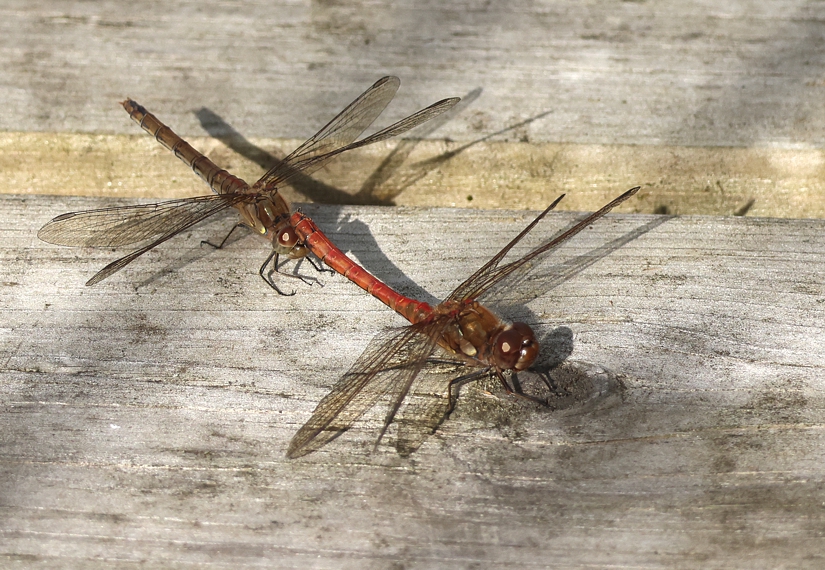
Common Darter (Sympetrum striolatum) (male+female in tandem) - Saltersford Valley CP
I spent quite a long while trying to photograph one of the two Migrant Hawker dragonflies that were patrolling round the boardwalk. I failed to get any flight shots and if they landed it was always away from the boardwalk and partly obscured by the Reedmace. This was, unfortunately, my best shot.
 
Migrant Hawker (Aeshna mixta) (male) - Saltersford Valley CP

I seemed to be getting nowhere fast, so decided to take a walk round the site.
 
A Western Honey Bee looked rather fine on wild Angelica.
 
Western Honey Bee (Apis mellifera) - Saltersford Valley CP

I found a few more Common Darter which, to my advantage, didn't have a boardwalk that they could settle on. 


Common Darter (Sympetrum striolatum) (male) - Saltersford Valley CP

The bright red berries of Guelder-rose stood out like a beacon.

Guelder-rose (Viburnum opulus) - Saltersford Valley CP
A return to the boardwalk gave me an unobstructed view of a perched Migrant Hawker, but at a distance and at an awkward angle for photography.
 
Migrant Hawker (Aeshna mixta) (male) - Saltersford Valley CP

I came away, concious that, apart from the tandem Common Darters, I'd only seen male dragonflies. This however, is not an unusual situation, as males have a tendency to patrol near water, while females tend to come to water to primarily mate or oviposit.
 
I had hoped to find Willow Emerald Damselfly here, as I had not yet positively seen one this season, but I failed. 

Tuesday, 10th October          Thortit Lake Area

I'd had an eye injection in the morning, after which I was supposed to take it easy for 48 hours, and not drive for at least four hours. However, at around 16.00, the effect of the dilation drops had worn off, my eye was not feeling too uncomfortable, and so I decided on a gentle visit to my nearest dragon site, Thortit Lake, to try once more for Willow Emerald.

Having parked my car, as I entered the site, I found five Common Darter roosting on the gate. I was a little surprised to see that these were all females.


Common Darter (Sympetrum striolatum) (female) - near Thortit Lake


As I approached the lake, a Red Admiral kept landing on the path ahead of me and then flying ahead as I got nearer.

Red Admiral (Vanessa atalanta) - Thortit Lake
As I approached the water's edge, a pair of Mute Swan with four youngsters in tow came towards me, obviously expecting to be fed. They soon realised that I would not oblige, and turned away again. My shots including the youngsters were not good, but here's one of one of the adults.
 
Mute Swan (Cygnus olor) (male) - Thortit Lake

I saw two or three Migrant Hawker dragonflies, but not in a position to be photographed. A Coot went swimming by as I was about to head back to base, mindful of the fact that I was supposed to be taking it easy.

Coot (Fulica atra) - Thortit Lake

As I neared the exit gate, I saw that some of the female Common Darters were still on the gate.

Wednesday, 11th October          Garden

Another shot of one of the Stock Doves that visited that day, taken through the glass of my study window.
 
Stock Dove (Columba oenas) - Garden

Thursday, 12th October          Garden

We had been seeing very little of Wren over the past couple of months, and so were absolutely delighted when one showed up this day - not the best of shots, taken from the conservatory, through the double-glazing at an angle.

Wren (Troglodytes troglodytes)  - Garden

Saturday, 14th October          Garden

It has been a quite good year for Comma butterflies. This one visited us this day and sunned itself on Lindsay's nook in the garden.

Comma (Polygonia c-album) - Garden

Sunday, 15th October          Calke Park : Garden

Against my better judgement - it was a fine weather Sunday during the schools half-term holiday -  I set out for a visit to Calke Park. I found myself in a queue for the entrance booths when I was about 500 metres from them, and would have turned back if the road had not been 'one-way'. 

I first headed for Calke Explore, where there is a hide overlooking a bird feeding station. The car park was full, but I managed to squeeze our small Smart car into a gap in the overflow car park.
 
I fully expected to find the bird hide full of unruly children but, to my surprise, there were just four people in there (it has capacity for six) and they left as I arrived (I didn't think I looked that threatening!). 
 
I stayed for about half an hour, but not much was going on and the branches used as photographic props had all been removed, so I photographed very little.
 
The rats were plentiful and very busy seeking food.

Brown Rat (Rattus norvegicus) - Calke Park
The few photos I did take didn't turn out too well and probably the best of a bad bunch was this of a very common, but nonetheless delightful, bird - a Blue Tit.
 
Blue Tit (Cyanistes caeruleus) - Calke Park

With little going on here, I decided to try the other hide on the estate. This is by the main car park near the house. As the house came into sight, I was surprised to see that the overflow car park was full of cars, and a second (unofficial?) overflow car park was in operation. This was, by far, the busiest that I have ever seen Calke Park. Amazingly, however, I managed to find myself a vacant spot in the main car park within a few metres of the hide.
 
I also found that, with just two people in the hide when I got there, I had room to sit in comfort. There was more going on from this hide, although nothing very exciting was seen. The birds were zooming in to the feeders which were suspended on a tensioned wire that went from one side of the clearing to the other. The best photographic opportunities were when the birds approached but were still in the neighbouring trees. Here are a few of the shots that I took.

Nuthhatch (Sitta europaea) - Calke Park

Greenfinch (Carduelis chloris) (female) - Calke Park

Common Pheasant (Phasianus colchicus) (male) - Calke Park

Goldfinch (Carduelis carduelis) - Calke Park

Greenfinch (Carduelis chloris) (male) - Calke Park

Nuthhatch (Sitta europaea) - Calke Park

Mallard (Anas platyrhynchos) (male) - Calke Park

The arrival to the hide of a group of people acted as a signal for me to depart. I stopped for a while just outside the hide to view the deer in the Deer Park.
 
My attention was drawn to a young Fallow Deer that was bounding across the grass at a good speed.

Fallow Deer (Dama dama) - Calke Park

The reason for its haste soon became apparent!

Fallow Deer (Dama dama) - Calke Park

Over on the far side of this area there was a Fallow Deer with what I can only suggest, by the antlers, was a young male Red Deer.

Red Deer (Cervus elaphus) and Fallow Deer (Dama dama) - Calke Park
I then drove round to what is known as The Round Car Park and walked down to the south-west arm of Staunton Harold Reservoir and then headed westward to reach the weir that is the inflow from Calke Park. This is the view eastward from near that location. On my previous visit, the water in the reservoir was so depleted that, with wellington boots on, it would have been possible to walk across the reservoir on a right to left trajectory that approximates to that thin dark line behind the brighter blue strip.

Staunton Harold Reservoir
From near the inflow, on the far side of the water, I spotted a Heron that was looking for its afternoon tea.

Grey Heron (Ardea cinerea) - Staunton Harol Reservoir

As I headed back, a Little Egret arrived, landing in the trees on the far side of the water.

Little Egret (Egretta garzetta) - Staunton Harold Reservoir

An immature Great Crested Grebe was closer as I went along the boardwalk section of the path.

Great Crested Grebe (Podiceps cristatus) - Staunton Harold Reservoir
I arrived back home in time to witness the Sparrowhawk making a nuisance of itself once more. This immature male has been visiting on a 'several times a day' basis, but its hit-rate is relatively low. The visits are, however, frequent enough that many of the other birds have got wise and are staying away from our garden.

Sparrowhawk (Accipiter nisus) (immature male) - our garden


As it stands at the moment, my next post will cover the second half of October, and be somewhat shorter than this one as I did not manage to get out with my camera during that period.

In the meantime, please take good care of yourselves and Nature. Thank you for dropping by - - - Richard
 

Thursday, 12 October 2023

Isles of Scilly, 2023 Pt.1 - 24th and 25th September, 2023

This begins my account of another family holiday on the wonderful Isles of Scilly. Lindsay and I  were accompanied by our daughter Melanie,  granddaughter Georgie,  and Georgie's friend Kerris.

To put things in context, we were both extremely nervous at the prospect of starting out on this journey to the Isles of Scilly. On Friday, 1st September on the way home from having a meeting with Lindsay's surgeon, while travelling at about 40 mph (65 kph) the rear wheels of our car suddenly locked solid and we skidded all over the road before coming to a halt. It was, to say the least, extremely frightening. Fortunately, there were no other cars around at the time. After about two hours the rescue truck arrived and took the car to the nearest Skoda dealership. It was even more unsettling that this could happen less than 200 miles (320 km) after the car had a full service and MoT test at the dealership.

It was the Tuesday before they found time to investigate, and found that the rear offside brake  calliper was broken, and so they replaced that, plus the brake disc and brake pads for an eye- watering price. They then took it out for a test drive and the same thing happened on the test drive as had happened to us. Having retrieved the car and supplied the test driver with clean pants, they got it back on the ramp and found a hole in the 4WD differential casing and came to the conclusion that the diff. was well and truly lunched. With a price now quoted for the repair being close to £6,500 we had a long hard think about whether to go forward with the repair or ditch the car. We decided on the former option. A day later, we were told that there was not a replacement diff. anywhere and it could be weeks or months before they managed to get the part. Arrangements were made for them to supply us with a car for our trip to the Isles of Scilly. We were comforted by the thought that we'd not have to take the long drive to the tip of Cornwall in a car that we'd not had time to regain confidence in.

I was not, therefore, overjoyed to get a call on Thursday 21st September to say that they'd got the part and fixed it, so that we could collect it on the Friday, two days before our departure, giving us no time to have a good run  and gain confidence. If it happened again when we were travelling at 70 mph on a busy motorway we would stand little chance of surviving!

Sunday, 24th September          Ashby de la Zouch to Hayle  :  Hayle, Copperhouse Pool

We managed what for us was a fairly early start, departing from home at 09.15. The first half of the 300 mile journey was in constant drizzle but it dried up later. I drove very gingerly at first but, after about 150 miles I started to gain confidence. We had a few comfort stops en route and arrived at the Premier Inn, Hayle, at 15.15. 

Having unpacked the car, I went off for a walk beside Copperhouse Pool as it is an interesting birding spot. I arrived to find winds of 26mph, gusting to 43 mph, rain threatening, and the tide out so the water was quite a distance from the road. Wind and distance made photography difficult, but there were some interesting birds to see - nothing rare, but with a few a bit different to what I see close to home
 
Close to where I'd parked the car, a Little Egret posed nicely.
 
Little Egret (Egretta garzetta) - Copperhouse Pool, Hayle

Over on the far side of the pool, about 150 metres away, a Cormorant was spreading its wings.
 
Cormorant (Phalacrocorax Carbo) - Copperhouse Pool, Hayle
It was good to see a Black-tailed Godwit probing in the mud for a snack
 
Black-tailed Godwit (Limosa limosa) - Copperhouse Pool, Hayle
Black-headed Gull is a familiar bird localy to home.
 
Black-headed Gull (Chroicocephalus ridibundus) - Copperhouse Pool, Hayle

By far the most numerous bird species present was Canada Goose (I suspect that there were a couple of hundred, or more) - also a familiar sight close to home.
 
Canada Goose (Branta canadensis) - Copperhouse Pool, Hayle

I am used to seeing Redshank at this location and was surprised to only spot one on this occasion.
 
Redshank (Tringa totanus) - Copperhouse Pool, Hayle
The north end of Copperhouse Pool is usually good for Curlew in my experience, and so it was this time too.
 
Curlew (Numenius arquata) - Copperhouse Pool

On my way back to the car, the Godwit was in a slightly better position.
 
Black-tailed Godwit (Limosa limosa) - Copperhouse Pool, Hayle

I'd only been there for about half an hour, and my timing was almost perfect as it started raining when I was just a few metres from the car.
 
I drove back in heavy rain and returned to base to find that Melanie and the girls had just arrived. 

After a chat, for convenience, our evening meals were obtained from 'the Scottish restaurant' with the two youngsters having takeaways and us older folks eating in. 

That night we turned in early at 20.30
 
Monday, 25th September          Copperhouse Pool, Hayle  : Hayle to St. Marys, Isles of Scilly 

The day got off to an unfortunate start, and seemed to be a bit jinxed thereafter. I'd set the alarm to wake Lindsay and I up at 07.00. The alarm went off in the morning and we both started sorting ourselves out when I suddenly noticed that my watch was reading 05.34. Somehow I'd also managed to set an alarm for 05.30!

There was an upside to this mistake as it meant that I had time to return to Copperhouse Pool before we needed to depart for the airport.

In contrast to the previous day, it was a sunny day with just a gentle breeze and I  hadn't reckoned with the early morning sunlight being all but horizontal and straight ahead of me as I looked over the pool. Also, the water level was even lower than it was the evening before. I did manage a few photos, however. I'll leave off the shots of species photographed the previous evening.

I thought that I'd found the Black-tailed Godwit again, but it was only when examining my photos that I realised that I'd been looking at a Bar-tailed Godwit. This is a species that I rarely see.


Bar-tailed Godwit (Limosa lapponica) - Copperhouse Pool. Hayle

A Greenshank was near the bridge.

Greenshank (Tringa nebularia) - Copperhouse Pool, Hayle

Grey Heron is, of course, common almost everywhere.

Grey Heron (Ardea cinerea) - Copperhouse Pool, Hayle
We arrived at Lands End Airport in good time and had already checked in when I noticed that Lindsay was not carrying her binoculars. She'd left them in the car, so I had to hot-foot it back to the car park to collect them. Due to this minor kerfuffle it completely slipped my mind that I had to cancel the rooms that I'd booked at the hotel for that night as a contingency in case our flight was cancelled - flights to the Scillies are a bit vulnerable to weather conditions. By the time I realised this omission we'd already been charged for the rooms.

The flight was uneventful and we were on the Isles of Scilly by 12.30, and soon transported to the self-catering property we had rented on Littleporth, St Marys. Having collected our shopping for the week and had a light late lunch. I set off on what I'd intended to be a short walk along the sea-front that is at the bottom of the garden of the property that we were staying in.
 
I was delighted to see a Wren in the garden of the property.

Wren (Troglodytes troglodytes) - property garden, Littleporth
On Porthcressa beach I found something that I was not sure of the identity of, but was informed that it was the 'holdfast' of Furbelows - a kelp seaweed.
 
Furbelows (Saccorhiza polyschides) (holdfast) - Porthcressa
There was far more seaweed on the beach than I have ever seen before, presumably as the result of recent storms. This Herring Gull was probing some of it for a tasty treat.
 
Herring Gull (Larus argentatus) - Porthcressa
In recent visits to the Scillies, I have seen far fewer Song Thrushes than I had previously been used to. These used to be quite confiding. I have even had them take food from the hand. I wonder if the seeming increase in domestic cats has been the cause. I was pleased to see a Song Thrush this day, gracing the back of a memorial bench on the sea-front.
 
Song Thrush (Turdus philomelos) - Porthcressa

Deciding to go a bit further, I headed up the hill to Buzza Tower, dipping into the small disused quarry near the lower end of the path. Here I found the caterpillar of a White Ermine moth.

White Ermine (Spilosoma lubricipeda) (larva) - quarry below Buzza Tower

Further up the hill, I stopped to photograph a lowly Large White butterfly.

Large White (Pieris brassicae) (male) - path to Buzza Tower


Reaching the hospital, where I had intended to turn back, a message came through that there was a Wryneck on Peninnis Head. I was already halfway there so cleared it with Lindsay that I'd be back late and set off along the lane.

There was not anybody around when I arrived and I was not too sure as to where the bird had been seen. I looked around in the area where I thought it had been and, apart from a momentary double-take when a bird popped up onto the wall, which turned out to be nothing but a Dunnock, I saw little.
 
Dunnock (Prunella modularis) - Peninnis Head
I started looking along the start of the path that runs along the west side of Peninnis. I'd  not gone far before I saw a fellow waving his arms to me a few hundred metres down the path. I hurried to him and he confirmed that he'd had a Wryneck working it's way along the wall in a northerly direction. We continued to search together and at one point he had it spotted, but I misunderstood his directions and was looking in the wrong place, whereupon it flew before I spotted it.  I did get some distant shots of a Whinchat.
 
Whichat (Saxicola rubetra) (female) - Peninnis

We continued to look for the Wryneck for some time before giving up. I decided to continue northward and back to base, while my companion returned to Peninnis Head.  About five minutes later, a message came though on the WhatsApp group saying that Wryneck had been spotted at the place that I'd originally looked at, only about 10 minutes after I'd left that location.

As I continued my walk, another message came through, this time from my previous companion, with a wonderful photo of the Wryneck at the location. I only found some butterflies to photograph.

Small Copper (Lycaena phlaeas) - Peninnis

Peacock (Aglais io) - Peninnis
As I neared base,  I found Lindsay and Melanie sitting on a seafront wall. I joined them and, just to rub it in, another message came through that  there were now two Wryneck at the same location. 

I took a few more photos at Littleporth. A Wren was in the usual corner at the western end of the beach.

Wren (Troglodytes troglodytes) - Littleporth

An Ostercatcher in drab, and rather cryptic, 1st- summer plumage was on the beach and flew as I watched from the sea-wall footpath.


Oystercatcher (Haematopus ostralegus) - Littleporth
The youngsters turned in at around 19.30. Lindsay and I called it a day at 21.30 after what seemed like a long day. 


I will terminate Pt.1 of my account here. Pt.2 will probably follow in about a week's time, when I have had time to process the many photos that I took. I suspect that it might be rather longer than this post.

In the meantime, please take good care of yourselves and nature. Thank you for dropping by - - - - Richard