Pages

Notes on Use of This Blog


1. I have a policy that I always reply to comments on my blog, even if it's just to say thank you.

2. Please don't submit comments that include your own web address. For obvious reasons, they will not be published.

3. I'm now on Twitter - @RichardPegler1
Showing posts with label Shoveler. Show all posts

Sunday, 14 April 2024

Slow March Pt.2 - 16th to 31st March,2024

This blog post gives an account of some of the highlights of what was a rather gentle month in terms of excursions, but included a few welcome harbingers of spring.

Sunday, 17th March          Nature Alive, Coalville

It was a relatively sunny day, and quite warm too. I fancied a short trip out, but had to take into consideration the fact that, being fine weather after a period of poor weather, and a Sunday also, most of my usual haunts that were not still under water would be busy with people. I had heard of the Nature Alive nature reserve in Coalville but never visited. It was formed on a brown-field site of a relatively small area, trapped between a railway line, the Coalville ring road, and a small retail park. It has some ponds, the largest of which was formed by mining subsidence.

Having parked my car and entered the site, I walked up the slope to the embankment (on which a railway branch line to Swarkestone to the north once ran), and then descended the other side and found myself confronted by a torrent of water about 4 inches (10cm) deep running down the path towards me. Fortunately I had put on wellingtons, so was able to pass along the path undeterred. It was only about 15 metres until I reached dry land and was able to explore.

In one of the two smaller ponds I found there was a Coot having a splash-about.

Coot (Fulica atra) - Nature Alive
At the main lake, a pair of drake Mallards were having an interaction.
 
Mallard (Anas platyrhynchos) (male) - Nature Alive
One of them then approached me, possibly hoping to be fed!
 
Mallard (Anas platyrhynchos) (male) - Nature Alive
I carried on past the main lake, finding a few insects enjoying the flowers in the sunshine.
 
Buff-tailed Bumblebee (Bombus terrestris) - Nature Alive

Hairy-footed Flower Bee (Anthophora plumipes) (male) - Nature Alive

There were some eye-catching clumps of Marsh Marigold around.
 
Marsh Marigold (Caltha palustris) - Nature Alive
Arriving back at the main lake, there were two drake Shoveler in the distance.

Shoveler (Spatula clypeata) (male) - Nature Alive
Before I left, I could not resist taking a shot of one of the many magnificent clumps of Primrose that were on the site.

Primula (Primula vulgaris) - Nature alive

Monday, 18th March          Garden

This was a very special day, due to our first (and, so far, only) sighting of the year of Redpoll in our garden. It was a splendid male, and I did manage some shots, although I'd have been happier if I got some that were not on a feeder. Lesser Redpoll is a 'red-listed' species.

Lesser Redpoll (Acanthis cabaret) (male) - our garden
Tuesday, 19th March          Saltersford Valley Country Park  :  Donisthorpe Rail Trail

A quick visit to Saltersford Valley CP in the afternoon was a little disappointing in that the boardwalk was still closed, water levels were very high, and paths were still flooded. I saw nothing of real interest and only photographed a Mute Swan which appeared to have some staining from the discoloured water caused by leakage from the old coal mine workings.

Mute Swan (Cygnus olor) - Saltersford Valley CP
As I had spent so little time here, I decided to check out the disused railway line that is now a public trail, accessible from by the church on Church Street, Donisthorpe.

Again I found little to occupy me, but I did manage to get some photos of a Red-legged Partridge - a species that I have not photographed for a while.

Red-legged Partridge (Alectoris rufa) - Donisthorpe Rail Trail
The only other photos I took were of a lone wild violet.

Common Dog Violet (Viola riviniana) - Donisthorpe Rail Trail
Wednesday, 20th March          Garden  :  Bardon Hill area

We were visited by two male Siskin on this day, and I managed a few shots of one of them, away from the feeders.

Siskin (Spinus spinus) (male) - our garden

The previous day, there had been reports of a group of approximately 25 Waxwings on an industrial estate near Bardon Hill. As Bardon Hill is quite local to me, I felt compelled to visit for what might be my last chance of seeing a Waxwing of the season. I did a bit of research on Google Earth and sorted out where I was going to park in an area where most roads are very busy with trucks. 

Having parked, I only had to walk a couple of hundred metres before I spotted the flock in a distant tree, a little away from the area that they had been reported in. I took some records shots, as shown below.

Bohemian Waxwing (Bombycilla garrulus) - Bardon Hill Industrial Estate
I counted 31 birds before I retraced my steps back to the road that my car was parked on, in the hope of being able to find another viewpoint for the birds that was perhaps a little nearer and not into the light, although it was not particularly bright weather.

I soon realised that there was no prospect of seeing the perched birds from this road and, to my dismay, the flock flew over my head and headed south in the approximate direction of the road that I was on. I followed the road to the end, but saw no sign of the Waxwings anywhere, although I did get a distant view of a Buzzard perched in a tree.

Common Buzzard (Buteo buteo) - Bardon Hill area
Thursday, 21st March          Garden

At the back end of last year, we had got used to regular visits from Magpie. However, this year they have become rather more elusive. On this day, two Magpies visited and I managed to catch one snaffling some dried Black Soldier-fly lavae that I'd tipped out of one of the Hedgehog feeding trays.

Magpie (Pica pica) - our garden
Friday, 22nd March          Our Conservatory

I noticed a small spider crawling up the window frame in our conservatory. I have not been able to positively identify it, but believe it to be one of the Philodromus species. If I had to make a guess, I'd say a female Philodromus dispar. It was released into the wild.

possible (Philodromus dispar) (female) - our conservatory
That afternoon I went to Calke Explore, which I have already reported on.

Friday, 29th March          Garden

This was something of a red letter day, as a Comma butterfly visited the garden - the first of the year. It was a bit tatty, so I believe it to be one that had emerged from winter hibernation.

Comma (Polygonia c-album) - our garden
Although a very common bird, the male Chaffinch is rather handsome.

Chaffinch (Fringilla coelebs) (male) - our garden

Saturday, 30th March          Garden  :  Willesley Wood

This was a good day for buterflies in the garden, with Brimstone, Peacock, and Small Tortoiseshell being seen. I only got usable photos of the Small Tortoiseshell.
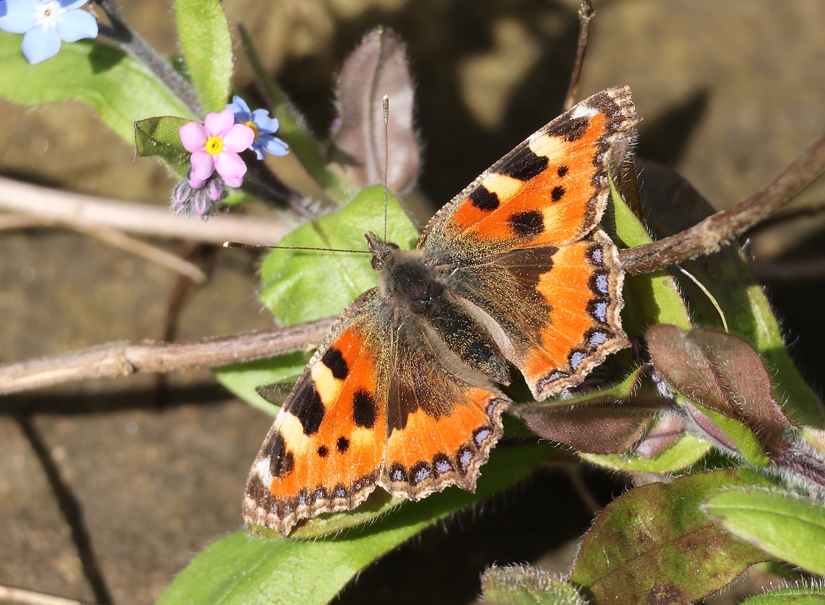
Small Tortoiseshell (Aglais urticae) - our garden
I was also pleased to see my first Bee-fly of the year.

Dark-edged Bee-fly (Bombylius major) - our garden
Seeing the butterflies in the garden prompted me to visit a local place which has been relatively productive for butterflies, including Brimstone.

I arrived and parked the car - although it is close to home, the road between my house and Willesley Wood is very dangerous to walk along as it is a narrow bendy road, running between dense hedges and has no verges.  There is, therefore, no option but to walk in the road, along which cars tend to travel at high speed.

As soon as I entered the site, I saw a Brimstone butterfly but it was distant and mobile, and soon disappeared. 

There were very deep puddles along the path and I was glad that I was wearing wellingtons. As I approached Thortit Lake I was astounded by how high the water level was. I suspect that it was about a metre above its usual level, and was approximately 4 inches (100 cm) deep over the path at one point. I wish, now, that I had taken some photos to illustrate this.

A female Mute Swan was busy tidying a nest, possibly incubating eggs, and it struck me that while this nest was currently like an island near the edge of the water, and quite safe from the many dogs that are walked here, when the water level receded to its normal situation the nest would be some distance from the water, and high and dry.

Mute Swan (Cygnus olor) (female) - Thortit Lake

A little further on, the male swan was dabbling around. That tree trunk, surrounded by water, is usually well out of the water.

Mute Swan (Cygnus olor) (male) - Thortit Lake

Close by, there was a Coot which seemed more confiding than I'm used to with this species.

Coot (Fulica atra) - Thortit Lake

There was little happening on the north side of the lake so I headed off in an anti-clockwise perambulation. Reaching the path on the south side of the lake, I was surprised to see water reaching up to the path. Usually, water is not visible from this path as it is about 150 metres away, through densely packed trees. 

At one point, I had nice views of a Heron.

Grey Heron (Ardea cinerea) - Thortit Lake


I also found my second Bee-fly of the year!

Dark-edged Bee-fly (Bombylius major) -Willesley Wood

I then headed back to my car, stopping to photograph a very tatty Peacock by the exit gate.

Peacock (Aglais io) - Willesley Wood

I was just about to get into my car, when a Brimstone flew by and stopped briefly, further up the lane. I followed it for a while and eventually it stopped long enough for me to take a record shot.

Brimstone (Gonepteryx rhamni) (male) - Willesley Woodside

Sunday, 31st March          Garden

Not a particularly eventful day but I had a rare opportunity to photograph a Wren in the garden - it is not the presence of the Wren that is rare, but the opportunity to photograph one, as they are forever on the move and soon vanish!

Wren (Troglodytes troglodytes) - our garden
 

Thus ended what I believe was the wettest March on record. Fortunately, the weather seems to be improving a little and spring has now sprung - fingers are crossed that we continue to get some more helpful wildlife watching opportunities.

As usual, I expect my next blog post to be in about a week's time. In the meantime, please take good care of yourselves and Nature. Thank you for dropping by - - - Richard


Sunday, 11 February 2024

The First Seven Days of February, 2024

This blog post is a relatively short one, covering just one visit out, and some garden observations.

Thursday, 1st February          Bluebell Arboretum, Smisby

The month got off to a bright start when I decided to make a visit to Bluebell Arboretum, Smisby, which is the first village you come to if you head directly north out of our home town of Ashby de la Zouch.

Bluebell Arboretum holds a sentimental attachment for me as it was the last place I visited with my mother before she died in 2004. Shortly after her death, I made a donation to the arboretum in her memory and, in return, I was offered a lifetime permit for Lindsay and I to visit the arboretum.

It had been a few years since I had last visited and, although the trees in the arboretum would be far from at their best, I thought that maybe I would find some interesting birds. I also felt the need for some quiet contemplation and was confident that the arboretum would be relatively devoid of people. This proved to be the case, but it was virtually devoid of birds too!

I resorted to photographing a bunch of Snowdrops.

Snowdrop (Galanthus nivalis) - Bluebell Arboretum
When I had last visited, my passion for dragonflies and damselflies had not yet developed. On this visit, I was pleased to note that there were small ponds which appeared to have very good potential for the Odonata. 

At one point a Robin came to introduce itself.

Robin (Erithacus rubecula) - Bluebell Wood
I did get a brief glimpse of a Moorhen disappearing into the undergrowth behind one of the ponds, but didn't manage any photos.

Having made a circuit of the arboretum, I found myself in need of the ablutions, so headed to the exit. Having done what needed to be done, I remembered that beyond the west end of the car park there was a lake and, in the past, it had been inhabited by a collection of ducks - clearly imported and pinioned. Out of curiosity, I started heading towards this when a voice called out "are you a tree man, or a birder" - it was the proprietor, Robert, and I stopped for a chat. He told me that, since his wife had died, he'd found that keeping the collection 'topped up' with birds had become difficult, and he'd allowed 'natural wastage' to occur. The only pinioned birds remaining were a pair of Pintail and a pair of Teal. 

I went to have a look, and found several ducks in the lake, including what were presumably the pinioned Pintail and Teal, but also included a few Shoveler and a pair of  Mandarin. Photography was difficult as there was a high chain-link fence in front of me, and other fencing intervening too in some areas.

Teal (Anas crecca) (male) - Bluebell Arboretum

Mandarin Duck (Aix galericulata) (male) - Bluebell Arboretum

I know that I have said this before, but I sometimes find myself surprised by how thin the heads of some species of duck are when viewed from the front - or, in this case, from the back!

Mandarin Duck (Aix galericulata) (female + male) - Bluebell Arboretum

Whereas the plumage of the male Mandarin is spectacular, I feel that the female Mandarin has a serene beauty.

To my mind, the drake Shoveler looked somewhat sinister as it swam away.

Shoveler (Spatula clypeata) (male) - Bluebell Arboretum
The drake Pintail is one of the most handsome of ducks.

Pintail (Anas acuta) (male) - Bluebell Arboretum
Pintail (Anas acuta) (female) - Bluebell Arboretum

I stopped to have another chat with Robert on my way back to the car and mentioned the Mandarins. Robert told me that he considered them a nuisance as he sometimes gets up to around fifty of them and they snaffle up any food that's put out before the other ducks can get to it. 

Bluebell Arboretum is now on my list of places to look for Odonata when the season comes around.

Friday, 2nd February          Garden

The visits by the female Blackcap are becoming less frequent, but we see her most days. She has a penchant for the blitzed peanut and lard mix that I make. Here she is, just about to pop into the jar (out of frame) containing that treat.

Blackcap (Sylvia atricapilla) (female) - our garden
We are starting to get a few more sightings of Long-tailed Tits, but they are not easy to photograph as they are never still.

Long-tailed Tit (Aegithalos caudatus) - our garden

Saturday, 3rd February          Garden

Greenfinches are continuing to pay frequent visits to the garden and, currently, their numbers are second only to that of Goldfinches, with up to six being seen at a time. I think that it was fellow blogger Sonjia (blog 'BREATHTAKING') who commented that the Greenfinches where she is in Portugal can be quite posessive and aggressive at the feeders, and I responded that this was not the case in our garden in my experience. I now find that I am having to reverse that statement as they are now exhibiting that sort of behaviour to their congeners as well as to other species. Here's one  that's on its own.

Greenfinch (Chloris chloris) (male) - our garden

Sunday, 4th February          Garden

We had been seeing a female Siskin on a daily basis for some time, and I had remarked to Lindsay that I wish she'd find a mate. On this day, she brought a male with her. I was unsure at first sighting as the crown was not as dark as males of the species that I'm used to seeing.

Siskin (Spinus spinus) (male) - our garden


Here are the two together on one of our feeders.

Siskin (Spinus spinus) (male + female) - our garden


Tuesday, 6th February          Garden

This was one of our better days for birds visiting the garden with 17 species being observed. However, only the male Siskin was photographed. I'm not too happy about showing photos of birds on feeders, but this is a somewhat clearer shot of the male of the species than others I have managed so far this winter.

Siskin (Spinus spinus) (male) - our garden

Wednesday, 7th February          Garden

I was away for most of the afternoon on a medical visit, but still managed to record 16 bird species putting a foot down in our garden, and took a few photos too.

Pied Wagtail (Motacilla alba yarrellii) (male) - our garden
Chaffinch (Fringilla coelebs) (female) - our garden

Siskin (Spinus spinus) (female) - our garden


This brings me to the end of this post. Busy times are ahead, so I may be away from Blogger for a while. In the meantime, please take good care of yourselves and Nature. Thank you for dropping by - - - Richard


Saturday, 2 December 2023

An Afternoon at Rutland Water - 24th November, 2023

Largely due to the situation at home, I have not been able to get to Rutland Water as much as I would have liked to this year. However, on this day, the weather was forecast to be sunny, if a little chilly, and the situation at home was relatively stable.

I managed to get away late morning and took my usual cross-country 'owling route' with no expectations of seeing an owl, and this turned out to be the case. It's makes me sad to reflect on past travels on this route when, occasionally, the out and back journey would result in Little Owl sightings just reaching double figures, over the 17 Little Owl nest sites that I passed. Virtually every one of these sites has decayed to the point that they are no longer habitable. 

By one of my old sites, however, I was lucky enough to spot two distant Red Kites, one of which came a little closer to the point that I had stopped at.

Red Kite (Milvus milvus) - Skeg Hill

I pulled into my usual picnic spot for a late lunch. This is a location where at one time, while sitting in my car, I could monitor three of those Little Owl sites.

Nothing more of interest was seen before I arrived at Rutland Water - again, this route used to yield good sightings of farmland birds, and I have noted a worrying decline in this aspect too.

Having parked in the Visitor Centre car park at the Egleton side of Rutland Water, I checked in by Tree Sparrow Hide to sort out my camera settings, just finding a Blue Tit as a subject.

Blue Tit (Cyanistes caeruleus) - from Tree Sparrow Hide
I had made up my mind, as my daylight time was going to be limited and the best prospects were towards the far end of the trail to the north, I would make my way directly to the northern end of the reserve and work my way back.

As I ascended the ramp to Plover Hide, which overlooks Lagoon 4, I was closely observed by some sheep. Here's one of them.

Hebridean Sheep (Ovis aries) - by Plover Hide
I had Plover Hide to myself, and found plenty to entertain me although most was rather distant, and the direction of the sun was unfavourable.

Most impressive from this location was a line of a few hundred Golden Plover, interspersed with a few Lapwing. The first image, below, shows a part of the line with the lens at 400mm.The second image is a heavily cropped image of a smaller section of the same group.

Golden Plover (Pluvialis apricaria) - from Plover Hide
Much closer, and on the edge of an island opposite the hide, were some Wigeon which were resting, and a male came drifting by.

Wigeon (Mareca penelope) - from Plover Hide

Wigeon (Mareca penelope) (male) - from Plover Hide

Unfortunately distant, I spotted a pair of Pintail. I'd have loved to get a closer shot of the handsome male of the species.

Northern Pintail (Anas acuta) (male + female) - from Plover Hide
A Lapwing was slowly moving around on the island in front of the hide.

Lapwing (Vanellus vanellus) -from Plover Hide
A drake Shoveler drifted into view.

Shoveler (Spatula clypeata) (male) - from Plover Hide
I now felt that it was time to move on. Bittern Hide was next on the list. By the access track to the hide I found a few Shaggy Ink-cap fungi.

Shaggy Ink-cap (Coprinus comatus) - near Bittern Hide
There were no birds visible in front of Bittern Hide (which overlooks Lagoon 3), where I found myself alone once more, and I was on the verge of giving up when a smallish bird of prey flashed by and headed into some distant trees. By the time I found it in the viewfinder and took a few shots, it was far too distant to ID. As it had come from the direction of Shoveler Hide (which also overlooks Lagoon 3, but with a much broader outlook), I hurried there to see if anyone had spotted it and could ID it for me. I was immediately told it was a Peregrine. Here's the best that I could muster - not good enough for an ID shot, but what is visible fits Peregrine.
 
Peregrine Falcon (Falco peregrinus) - from Bittern Hide
I spent a while in Shoveler Hide, which was almost full with people, as there were birds to be seen, although nothing of great note, and most being beyond the useful range of my lens or sitting on unattractive artificial structures. Here are a few birds that I did photograph.

Shelduck (Tadorna tadorna) (male) - from Shoveler Hide

Cormorant (Phalacrocorax carbo) - from Shoveler Hide

Gadwall (Mareca strepera) (male) - from Shoveler Hide
Keen to see more of the reserve before dusk, I called in at the empty Buzzard Hide (also overlooking Lagoon 3, but with a very narrow field of view) and found little in view except a close-by Cormorant.

Cormorant (Phalacrocorax carbo) - from Buzzard Hide
I decided not to spend time here, and popped over to Smew Hide (Lagoon 2), only to find the view was directly into the bright low sun, and seeing what was out there was virtually impossible, so left again without hesitation.

At Crake Hide, which gives views onto the narrow north-west end of Lagoon 4, I found one other person in attendance. There were good views of Cormorants on the far bank opposite the hide and a Great White Egret a little further away on the far bank. 

Cormorant (Phalacrocorax carbo) - from Crake Hide

Great White Egret (Ardea alba) - from Crake Hide
At one point, the egret flew and joined the Cormorants.

Cormorant (Phalacrocorax carbo) and Great White Egret (Ardea alba) - from Crake Hide


I spent some very pleasant time chatting with my companion, but when a third person arrived it was my cue to depart as there were still other hides I wished to visit before I departed.

My visit to Sandpiper Hide on Lagoon 4 was a very quick one as everything was very distant, and the light was failing fast. Nothing was photographed from here.

It was now time to start making my way back to the car park, calliing in at three hides as I did so.

I cannot remember whether it was at Osprey Hide or Grebe Hide that I photographed this Moorhen.

Moorhen (Gallinula chloropus) - Rutland Water, Egleton side
The last hide visited before returning to my car was Redshank Hide. The main item of interest here was a Great White Egret.

Great White Egret (Ardea alba) - from Redshank Hide
My final shots were of a gull that flew past. I am not sure what the ID of this gull was, and neither ObsIdentify nor Merlin can help with its ID. Germán, in Spain, has now advised that this is a juvenile Great Black-backed Gull, which ties in with one of the suggestions from ObsIdentify.

probable Great Black-backed Gull (Larus marinus) (juvenile) - from Redshank Hide
Having got back to the car, I had a short errand to run in Hambleton before heading home, by a faster route, rather than the countrified one, as darkness rolled in. 

It had been a highly enjoyable afternoon out, even though nothing particularly exciting had been seen.


If all goes according to plan, my next post will cover the second half of November, which included four short trips out, as well as some garden observations.

In the meantime, please take good care of yourselves and Nature. Thank you for dropping by - - - Richard