Pages

Notes on Use of This Blog


1. I have a policy that I always reply to comments on my blog, even if it's just to say thank you.

2. Please don't submit comments that include your own web address. For obvious reasons, they will not be published.

3. I'm now on Twitter - @RichardPegler1
Showing posts with label Egret Cattle. Show all posts

Sunday, 7 April 2024

Slow March Pt.1 - 1st to 15th March,2024

For reasons previously explained, I didn't get out much during March, and most of the excursions I did manage have been covered in previous posts. This will be an account of some of my other observations in the first half of the month.

Friday, 1st March          Garden

Much to our delight, the male Brambling was still visiting us on most days. I was pleased to get a shot of this bird in flight - albeit a rather poor one.
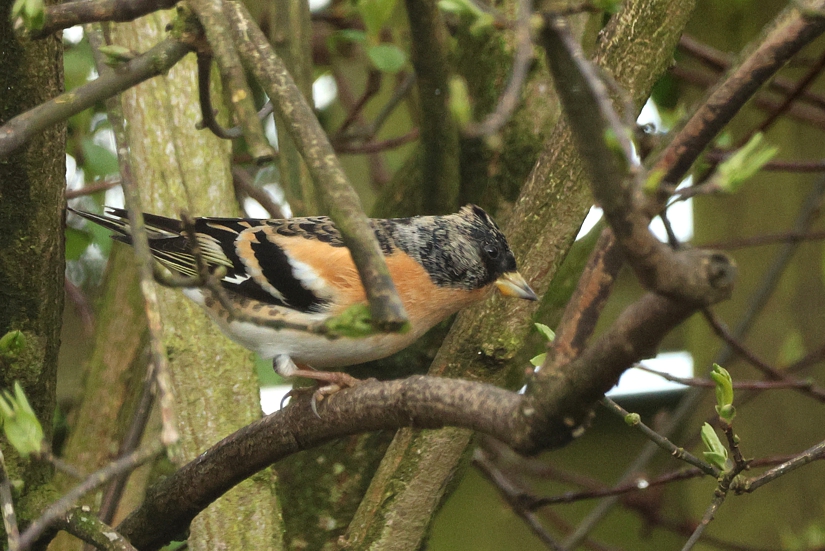


Brambling (Fringilla montifringilla) (male) - our garden

Saturday, 2nd March          Staunton Harold  :  Melbourne Pool

On 29th February, Lindsay and I had visited Melbourne. During that visit, we'd called in at a charity shop in the grounds of Melbourne Hall and Lindsay had spent a little while browsing through the books there. After we'd got back home again, she did some resaerch on a cookery book she'd seen there and come to the conclusion that she wished she had bought it. That day, I'd also taken a walk beside Melbourne Pool and thought I'd seen what might have been a Red-crested Pochard in the distance. This bird is rated locally as being 'uncommon, probably feral'. It is, nevertheless, a very attractive duck.
 
A Saturday is not a good day to visit Melbourne as it gets very busy, and car parking can be hard to find. It made sense, therefore, for me to visit Melbourne on my own this day, not having to worry about parking too far away from the shop for Lindsay to walk. It also meant that I could take more time out to walk round the pool.
 
Due to a long-term road closure and the official diversion route being a long one, I took a short cut through Staunton Harold deciding to stop there briefly to see if the Cattle Egret was still there. A swan greeted me as I arrived.

Mute Swan (Cygnus olor) - Staunton Harold
It took me a little while to find the egret, as it was tucked down in some reeds. Eventually it woke up and became more visible and, by moving further along the road, I got a better photo.
 
Cattle Egret (Bubulcus ibis) - Staunton Harold

Having returned to my car, I headed off to Melbourne and did manage to find a parking space quite close to Melbourne Hall. I hurried to the charity shop and was relieved to find the book that Lindsay wanted was still there. I quickly took it back to the car, and set off to Melbourne Pool with my camera.

I won't trouble you with most of the photos that I took, but this one, of a Black-headed Gull landing on the water, I thought was a bit unusual.

Black-headed Gull (Chroicocephalus ridibundus) - Melbourne Pool

From the road on the east side of the pool I could see a Red-crested Pochard in the far distance - this was with my lens at the full 400mm.
 
Red-crested Pochard (Netta rufina) (male) - Melbourne Pool

If the duck stayed in the same area, I would be able to photograph it from a well-used footpath that ran closer to its location, so I set off in that direction, taking another shot of Black-headed Gull as I did so.

Black-headed Gull (Chroicocephalus ridibundus) - Melbourne Pool

I got to a point where I could get some closer shots, but the bird was still at quite a distance.
 
Red-crested Pochard (Netta rufina) (male) - Melbourne Pool
I then stood behind the trunk of a tree, in the hope that the bird would come even closer - I suspect that this was to the amusement of the several passing dog-walkers. It did, eventually come a little closer, and I got some better shots, although far from perfect, before it drifted out into the centre of the pool. In the first image, below, it is enjoying a good scratch.
 
Red-crested Pochard (Netta rufina) (male) - Melbourne Pool

I returned home, happy to have seen my target, whilst earning a few brownie-points with Lindsay.

Sunday, 3rd March          Garden

The Hedgehogs came out of hibernation early this year, and we have had up to three different ones visit us in a night. On this occasion, there was a bit of an altercation between two hogs, as can be seen in the video below. The cat that appears is one of many that visit our garden (at least five), and I have named 'Ghost'.
 
Hedgehog (Erinaceus europaeus) - our garden
 
Monday, 4th March          Garden
 
A female Blackcap had now become a regular visitor, and was very fond of the 'flutter butter' that I make (blitzed peanuts in lard). She was back to this treat several times a day.

Blackcap (Sylvia atricapilla) (female) - our garden
Tuesday, 5th March          Garden

On this day, the male Brambling brought a female with him. Sadly, it seems that she was not impressed enough to return.

Brambling (Fringilla montifringilla) (female) - our garden

We were still getting frequent visits by three Carrion Crows. This is one of them on that day.

Carrion Crow (Corvus corone) - our garden
Sadly, Stock Dove has become a less frequent visitor, and when we do see one, it is usually a single bird.
 
Stock Dove (Columba oenas) - our garden
Friday, 8th March          Garden
 
Here is the Blackcap again on her favourite twig from which she launched herself into the 'flutter butter' feeder.
 
Blackcap (Sylvia atricapilla) (female) - our garden

Saturday, 9th March          Garden
 
A visit by Great Tit is not unusual in our garden, and they usually go for our sunflower hearts or flutter butter. However, I don't recall ever before seeing one probing in the moss on the wall, like a Wren often does. I missed the shot of the probing, but here is the bird.
 
Great Tit (Parus major) - our garden

Sadly, this next shot is my last one of the male Bullfinch that had been visiting our garden several times a day all winter. Three days later it was taken by a Sparrowhawk, dashing our hopes that, one day, he'd find a mate and bring her to visit.
 
Bullfinch (Pyrrhula pyrrhula) (male) - our garden

Tuesday, 12th March          Garden
 
It had been mainly male Siskins that had shown up in our garden, so the arrival of a female this day was a real pleasure. I only managed shots on a feeder, however.

Siskin (Spinus spinus) (female) - our garden

I was quite excited when a female Sparrowhawk landed on the trellis at the bottom of the garden as, usually, it is male Sparrowhawks that we see.

Sparrowhawk (Accipiter nisus) (female) - our garden

It did not stay long in that position, but shot off to the left round the back of our viburnum, reappearing a second or two later, landing on the ground in front of its previous position. I didn't spot anything in its talons, but could tell from its actions that it had got prey. I still couldn't spot the prey when it saw me and departed at speed. However, when I zoom in close to my photos of it on the ground I can just detect the red breast of a male Bullfinch in its talons, and the lack of subsequent sightings of our Bullfinch bears this out.
 
Sparrowhawk (Accipiter nisus) (female) - our garden

Wednesday, 13th March          Garden
 
This day was quite remarkable, in that we had a group of six Siskin visit - four males and two females. The best photo that I could manage, however, was of just three males on a feeder.

Siskin (Spinus spinus) (male) - our garden

Friday, 15th March          Garden

This day, a male Sparrowhawk stopped briefly in the Rowan outside my study.

Sparrowhawk (Accipiter nisus) (male) - our garden


I'll bring this account to a close now. With luck, Pt.2 will follow in about a week's time. In the meantime, please take good care of yourselves and Nature. Thank you for dropping by - - - Richard

Sunday, 4 February 2024

The Last Ten Days of January, 2024

Much of my time so far this year, as in the latter part of 2023, has been spent on domestic duties, having to take on much of Lindsay's share, due to her relative incapacity. Towards the end of the month, I started to feel that I needed to get out more, if only for short spells, in order to regain some of my sanity. This resulted in me visting four local locations on three separate days. At no time was I away from home for more than two hours.

The first part of this period resulted in sightings of very common species. However, things warmed up a little in the last few days of January.

Monday, 22nd January          Garden

Although we had the pleasure of Siskin and Blackcap females visiting this day, the only photos I took were of a Blackbird. Although a common species, we have seen a worrying decline over the past couple of years in the numbers of this bird visiting our garden. This female is on the edge of our birdbath, before taking a drink.

Blackbird (Turdus merula) (female) - our garden
Friday, 26th January          Garden  :  Saltersford Valley Country Park  :  Oakthorpe

The Siskin and Blackcap were still with us but, again, no photos. I did, however, manage to grab a few shots of a Wren from my study window. As you can see, it had been a while since I last tidied up the garden!

Wren (Troglodytes troglodytes) - our garden
That afternoon, I took some time out, heading to Saltersford Valley Country Park. On my previous visit, I had found the boardwalk section of the area closed off, due to flooding. I was disappointed to find this area was still closed off - with no reason visible. I did take a walk round the remainder of the area that was open and saw very little of interest, only photographing a confiding Robin, and a distant Coot.

Robin (Erithacus rubecula) - Saltersford Valley CP
Coot (Fulica atra) - Saltersford Valley CP

Being a little dischuffed with my visit to Saltersford Valley, and having only been out for a short while, I set off to visit the nearby location, by Oakthorp, where I'd recently seen the Yellow-browed Warbler and more recently photographed Fieldfare, in the hope of getting better Fieldfare images. I only saw one Fieldfare in the distance, which fled when a couple with a dog passed by it. I did, however, spot a Goldcrest, and spent about half an hour trying to photograph it, but failing miserably. The best that I could do was get a couple of record shots of it in flight.
 
Goldcrest (Regulus regulus) - near Oakthorpe

It was then time to head back to Lindsay, only 10 minutes away.
 
Saturday 27th January          Donisthorpe Woodland

The following day I paid a short visit to Donisthorpe Woodland, just down the road from home. Part of this area is alongside a now isolated section of the old Ashby Canal. I passed alongside the canal for a while, only spotting a Mallard on the far side of the canal and a Great Tit in the edge of the woodland, opposite the canal.

Great Tit (Parus major) - Donisthorpe Woodland

Mallard (Anas platyrhynchos) (male)

I then took a circuitous route which took me along the edge of the Moira Furnace site, and then back to my car. I saw disappointingly little during my walk, only stopping to photograph some teazels, a Blackbird, and another Great Tit, which I shan't bother you with here.
 
Teasels are the dead flowerheads of plants of the genus Dipsacus. They are still used by some people for carding wool but, for me, they are an architecturally atractive plant

Teasel (Dipsacus sp.) - Donisthorpe Woodland

Blackbird (Turdus merula) (male) -Donisithorpe Woodland

Sunday, 28th January          Garden  :  Longmoor Lake

This was a good day for visits by birds to our garden, with 18 species setting a foot down. These included 8 Long-tailed Tits - always fun to watch.
 
Long-tailed Tit (Aegithalos caudatus) - our garden

Most exciting, however, was the appearance of a Reed Bunting. We last saw this species in the garden in February 2023, when a female visited. These shots were taken from my studty window.
 
Reed Bunting (Emberiza schoeniclus) (male) - our garden

That afternoon, I made a quick visit to Longmoor Lake. This lake is situated in the Queen Elizabeth II Diamond Jubilee Wood, which is close to our home. In the early days of this wood, when the trees were mere saplings, the area was good for birds, including Barn Owl and Tawny Owl.  However, the trees have grown rapidly, and are so densely placed that it seems to have made it unattractive to the birds. I saw virtually nothing until I reached the lake, some one and a half kilometres from the car park.

I spent a few minutes in the hide and saw that Canada Geese and Greylag  Geese were there in good numbers, as were Wigeon. I took some photos from the hide but didn't stop long as my time was limited.
 
Canada Goose (Branta canadensis) - Longmoor Lake

Greylag Goose (Ansa ansa) - Longmoor Lake
I then walked to the far end of the lake, taking a few more photos as I went.

Wigeon (Anas penelope) (male + female) - Longmoor Lake

I went a little beyond the far end of the lake, before turning back. Immediately I did so, some Long-tailed Tits moved through the hedge beside me. The light was poor, but I did manage a shot that is just about useable. 

Long-tailed Tit (Aegithalos caudatus) -by Longmoor Lake

On the way back, dusk was beginning to fall. I photographed an immature Mute Swan that looked as if it was hoping that I'd feed it, but it soon gave up.

Mute Swan (Cygnus olor) (immature) - Longmoor Lake

It was that time of the afternoon when the geese decide that it is time to return to their night roosts. There is plenty of warning when this is going to happen as their calls build up to a very noisy crescendo before they take off in groups.

Canada Goose (Branta canadensis) - Longmoor Lake

I took a shorter route back to my car, arriving home at the expected time.

Tuesday, 30th January          Staunton Harold

It was only two days before I managed another brief trip out, prompted by a report of a Cattle Egret in a pasture with sheep, opposite the hall at Staunton Harold, and less than ten minutes from our home.
 
Having parked my car, I walked up the road past the sheep pasture, and a little further, before turning back without seeing the egret. Arriving at the public footpath that leaves the road and goes uo the hill through the pasture, I decided to give it a try in case the bird was skulking over the brow of the hill - it wasn't.

As I descended on this footpath, I scanned over the nearby lake, looking at the swans and gulls that were on the grass on the far side of the lake - and there, to my surprise, was the egret, at the water's edge, in a position where it would be clearly visible from the road that leads to the hall.

As I crossed the causeway between the two lakes, I took a shot of a Coot.

Coot (Fulica atra) - Staunton Harold
A little further on, the road takes a curve to the right that brings it closer to the lake, and the egret was clearly visible from there. I got in quite a few shots before it decided to return to where it had originally been seen - the sheep pasture. You may be able to detect that this bird is showing a hint of colour on the forehead - the start of breeding plumage.


Cattle Egret (Bubulcus ibis) - Staunton Harold
Given more time, I would have walked up the road to take some photos of it in the sheep pasture, but I needed to get back to base to check that all was OK with Lindsay.
 
No photography was attempted on the last day of the month, although we had a good number of birds visiting the garden.


Currently, I have no idea when my next blog post will be as we have a plethora of medical visits coming up in the next fortnight, culminating, if all goes to plan, with Lindsay having a second replacement knee on 12th February. I can see that I'm going to be rather busy for a while!

In the meantime, please take good care of yourselves and Nature. Thank you for dropping by - - - Richard

Sunday, 7 January 2024

December 2023, Pt.2

My best wishes for a Happy and Healthy New Year to my readers.

With this post, I bring an account of some of my sightings, both at home and at relatively local locations, for the second half of December.

Friday, 15th December          Garden  :  Bagworth

During breakfast in the conservatory, I took a few photos of Bullfinch and a female Pied Wagtail.

Bullfinch (Pyrrhula pyrrhula) (male) - our garden
Pied Wagtail (Motacilla alba yarrellii) (female) - our garden
With notice that Waxwing had been seen ten miles (16 km) from our home, although it was very dull weather that morning, I decided to go and have a look to see if I could find them. It is not often that we get an irruption year for Waxwings and I wanted to make sure that I did not miss out.

Very specific directions as to where the Waxwings had been seen had been given, and I spent half an hour or so looking without seeing them. I had given up and started to walk back towards my car when I heard a shout from behind me. A lady who was about a hundred metres or so away waved and then turned and started walking away. I was not entirely certain that the wave was intended for me, so was a little concerned about following her and kept my distance in case she was spooked by me. A couple of hundred metres or so further on I saw that she had rejoined a small group with long lenses - they were onto the Waxwings! Having thanked the lady profusely, I set about trying to get some photos.

Initially, I was watching them high in some tall Rowan trees on the west side of the road, and with the poor light, photography was extremely difficult, and the results were not up to much and have been discarded.

After a while, however, some birds flew over the road into some shorter Rowans on the east side of the road, and here I managed some better images, although far from good - I've had to do a fair amount of manipulation on the ones below. I had not seen Waxwings since 2019, and that was in Scotland, so you're going to get rather a lot of images!

Bohemian Waxwing (Bombycilla garrulus) - Bagworth
The birds stayed for just five minutes before departing south and disappearing into the distance. They probably would have returned eventually, but I needed to anwer the call of nature and head home for lunch so departed. It seems that, by mid-day next day, they had gone.

Hopefully, I might get another chance to photograph Waxwings this winter - I'll keep my fingers crossed!

Saturday, 16th December          from the House

This was a bright sunny day with, unfortunately, too much to do at home. Lindsay alerted me to a rather fine sunset, with aspects leading me to believe that they were probably Nacreous clouds -  clouds, that form in very cold conditions over the poles and in the stratosphere, up to 19 miles (31km) high, far above normal clouds. These unusual clouds were being reported in many areas of England at this time.

Sunset - from our house


Tuesday, 19th December          Dadlington

There were reports of nine Cattle Egret at Dadlington. That day, I was committed to take Lindsay to meet up for lunch with a dear friend of hers that she'd not been able to see for well-over a year. As Lindsay is currently unable to drive and barely able to walk, even with a walking frame, my input was necessary. Knowing that they would be in the restaurant for at least two hours, I had time to kill before needing to pick her up again. As I'd last seen Cattle Egret in February, 2018, it was an obvious choice as to how I would spend my time!

I found the place quite easily from the description given, although there were no other birders present. However, someone arrived as I was getting out of my car, and we were instantly looking at the nine Cattle Egrets. Unfortunately they were in the far side of a pasture that had been partitioned off with many fences, so getting a clean shot was virtually impossible. There was, however, one bird that was a little closer and I did manage a few shots that were not behind a wire fence.

Cattle Egret (Bubulcus ibis) - Dadlington
This next shot, of some of the group where most of them were foraging, gives you an idea as to the problems the fencing was giving.

Cattle Egret (Bubulcus ibis) - Dadlington

One of the group seemed a bit restless, and occasionally took to the air, flying round in a wide circle before landing back with the others. The first time it did this, I missed getting a shot, but I did get a few on its subsequent forays.

Cattle Egret (Bubulcus ibis) - Dadlington

At one point, it landed briefly on a fence post.
 
Cattle Egret (Bubulcus ibis) - Dadlington
Three more people arrived and we chatted for a while. I was about to pack up and go to retrieve Lindsay when two of the birds left the pasture and landed in the arable field to the east.
 
Cattle Egret (Bubulcus ibis) - Dadlington

Lindsay had forgotten to take her phone with her, so was unable to ring me to tell me when she was ready. My timing was perfect, however, as they were just finishing as I arrived.

Friday, 22nd December          Garden

The garden trail cams captured an unwanted visitor in the early hours of the morning, in the form of a large Brown Rat. If I have a phobia, it is for rats!

Brown Rat (Rattus norvegicus) - our garden
 
Saturday, 23rd December          Garden
 
We are currently getting three crows visitng our garden on most days. On this day, I took some photos of one of them. I think that their appearance exudes intelligence.
 
Carrion Crow (Corvus corone) - our garden

Late that night, the garden trail cams showed that we'd had a visit from a Fox. It was a very welcome visitor, and it had been a long while since we last saw one in the garden.
 

Fox (Vulpes vulpes) - our garden
 
Monday, 25th December          Garden
 
It was Christmas day and, when I looked at the output from the garden trail cams, I found that we'd been visited by a Hedgehog in the very early hours of the morning. I did, check, but I couldn't spot its sack of presents.
 

Hedgehog (Erinaceus europaeus) - our garden
 
Sunday, 31st December          Garden

New Year's Eve, and a Blackcap just managed to squeeze in a visit before the end of the year. Once again, it was a female - we haven't seen a male since early February.

Blackcap (Sylvia atricapilla) (female) - our garden

That brings me to the end of December and the end of 2023. For various reasons, my blog output might be a bit limited in the next couple of months or so. However, I expect my next post to feature a bird that I have only had the pleasure of encountering three times in my life - in South Shields at a great distance in 2009 (no photos), on the Isles of Scilly at a closer distance in 2014, and recently locally, and at quite close quarters, in 2024.

I hope to return soon. In the meantime, please take good care of yourselves and Nature, and have a wonderful 2024 - - - Richard