Pages

Notes on Use of This Blog


1. I have a policy that I always reply to comments on my blog, even if it's just to say thank you.

2. Please don't submit comments that include your own web address. For obvious reasons, they will not be published.

3. I'm now on Twitter - @RichardPegler1
Showing posts with label Godwit Black-tailed. Show all posts

Thursday, 12 October 2023

Isles of Scilly, 2023 Pt.1 - 24th and 25th September, 2023

This begins my account of another family holiday on the wonderful Isles of Scilly. Lindsay and I  were accompanied by our daughter Melanie,  granddaughter Georgie,  and Georgie's friend Kerris.

To put things in context, we were both extremely nervous at the prospect of starting out on this journey to the Isles of Scilly. On Friday, 1st September on the way home from having a meeting with Lindsay's surgeon, while travelling at about 40 mph (65 kph) the rear wheels of our car suddenly locked solid and we skidded all over the road before coming to a halt. It was, to say the least, extremely frightening. Fortunately, there were no other cars around at the time. After about two hours the rescue truck arrived and took the car to the nearest Skoda dealership. It was even more unsettling that this could happen less than 200 miles (320 km) after the car had a full service and MoT test at the dealership.

It was the Tuesday before they found time to investigate, and found that the rear offside brake  calliper was broken, and so they replaced that, plus the brake disc and brake pads for an eye- watering price. They then took it out for a test drive and the same thing happened on the test drive as had happened to us. Having retrieved the car and supplied the test driver with clean pants, they got it back on the ramp and found a hole in the 4WD differential casing and came to the conclusion that the diff. was well and truly lunched. With a price now quoted for the repair being close to £6,500 we had a long hard think about whether to go forward with the repair or ditch the car. We decided on the former option. A day later, we were told that there was not a replacement diff. anywhere and it could be weeks or months before they managed to get the part. Arrangements were made for them to supply us with a car for our trip to the Isles of Scilly. We were comforted by the thought that we'd not have to take the long drive to the tip of Cornwall in a car that we'd not had time to regain confidence in.

I was not, therefore, overjoyed to get a call on Thursday 21st September to say that they'd got the part and fixed it, so that we could collect it on the Friday, two days before our departure, giving us no time to have a good run  and gain confidence. If it happened again when we were travelling at 70 mph on a busy motorway we would stand little chance of surviving!

Sunday, 24th September          Ashby de la Zouch to Hayle  :  Hayle, Copperhouse Pool

We managed what for us was a fairly early start, departing from home at 09.15. The first half of the 300 mile journey was in constant drizzle but it dried up later. I drove very gingerly at first but, after about 150 miles I started to gain confidence. We had a few comfort stops en route and arrived at the Premier Inn, Hayle, at 15.15. 

Having unpacked the car, I went off for a walk beside Copperhouse Pool as it is an interesting birding spot. I arrived to find winds of 26mph, gusting to 43 mph, rain threatening, and the tide out so the water was quite a distance from the road. Wind and distance made photography difficult, but there were some interesting birds to see - nothing rare, but with a few a bit different to what I see close to home
 
Close to where I'd parked the car, a Little Egret posed nicely.
 
Little Egret (Egretta garzetta) - Copperhouse Pool, Hayle

Over on the far side of the pool, about 150 metres away, a Cormorant was spreading its wings.
 
Cormorant (Phalacrocorax Carbo) - Copperhouse Pool, Hayle
It was good to see a Black-tailed Godwit probing in the mud for a snack
 
Black-tailed Godwit (Limosa limosa) - Copperhouse Pool, Hayle
Black-headed Gull is a familiar bird localy to home.
 
Black-headed Gull (Chroicocephalus ridibundus) - Copperhouse Pool, Hayle

By far the most numerous bird species present was Canada Goose (I suspect that there were a couple of hundred, or more) - also a familiar sight close to home.
 
Canada Goose (Branta canadensis) - Copperhouse Pool, Hayle

I am used to seeing Redshank at this location and was surprised to only spot one on this occasion.
 
Redshank (Tringa totanus) - Copperhouse Pool, Hayle
The north end of Copperhouse Pool is usually good for Curlew in my experience, and so it was this time too.
 
Curlew (Numenius arquata) - Copperhouse Pool

On my way back to the car, the Godwit was in a slightly better position.
 
Black-tailed Godwit (Limosa limosa) - Copperhouse Pool, Hayle

I'd only been there for about half an hour, and my timing was almost perfect as it started raining when I was just a few metres from the car.
 
I drove back in heavy rain and returned to base to find that Melanie and the girls had just arrived. 

After a chat, for convenience, our evening meals were obtained from 'the Scottish restaurant' with the two youngsters having takeaways and us older folks eating in. 

That night we turned in early at 20.30
 
Monday, 25th September          Copperhouse Pool, Hayle  : Hayle to St. Marys, Isles of Scilly 

The day got off to an unfortunate start, and seemed to be a bit jinxed thereafter. I'd set the alarm to wake Lindsay and I up at 07.00. The alarm went off in the morning and we both started sorting ourselves out when I suddenly noticed that my watch was reading 05.34. Somehow I'd also managed to set an alarm for 05.30!

There was an upside to this mistake as it meant that I had time to return to Copperhouse Pool before we needed to depart for the airport.

In contrast to the previous day, it was a sunny day with just a gentle breeze and I  hadn't reckoned with the early morning sunlight being all but horizontal and straight ahead of me as I looked over the pool. Also, the water level was even lower than it was the evening before. I did manage a few photos, however. I'll leave off the shots of species photographed the previous evening.

I thought that I'd found the Black-tailed Godwit again, but it was only when examining my photos that I realised that I'd been looking at a Bar-tailed Godwit. This is a species that I rarely see.


Bar-tailed Godwit (Limosa lapponica) - Copperhouse Pool. Hayle

A Greenshank was near the bridge.

Greenshank (Tringa nebularia) - Copperhouse Pool, Hayle

Grey Heron is, of course, common almost everywhere.

Grey Heron (Ardea cinerea) - Copperhouse Pool, Hayle
We arrived at Lands End Airport in good time and had already checked in when I noticed that Lindsay was not carrying her binoculars. She'd left them in the car, so I had to hot-foot it back to the car park to collect them. Due to this minor kerfuffle it completely slipped my mind that I had to cancel the rooms that I'd booked at the hotel for that night as a contingency in case our flight was cancelled - flights to the Scillies are a bit vulnerable to weather conditions. By the time I realised this omission we'd already been charged for the rooms.

The flight was uneventful and we were on the Isles of Scilly by 12.30, and soon transported to the self-catering property we had rented on Littleporth, St Marys. Having collected our shopping for the week and had a light late lunch. I set off on what I'd intended to be a short walk along the sea-front that is at the bottom of the garden of the property that we were staying in.
 
I was delighted to see a Wren in the garden of the property.

Wren (Troglodytes troglodytes) - property garden, Littleporth
On Porthcressa beach I found something that I was not sure of the identity of, but was informed that it was the 'holdfast' of Furbelows - a kelp seaweed.
 
Furbelows (Saccorhiza polyschides) (holdfast) - Porthcressa
There was far more seaweed on the beach than I have ever seen before, presumably as the result of recent storms. This Herring Gull was probing some of it for a tasty treat.
 
Herring Gull (Larus argentatus) - Porthcressa
In recent visits to the Scillies, I have seen far fewer Song Thrushes than I had previously been used to. These used to be quite confiding. I have even had them take food from the hand. I wonder if the seeming increase in domestic cats has been the cause. I was pleased to see a Song Thrush this day, gracing the back of a memorial bench on the sea-front.
 
Song Thrush (Turdus philomelos) - Porthcressa

Deciding to go a bit further, I headed up the hill to Buzza Tower, dipping into the small disused quarry near the lower end of the path. Here I found the caterpillar of a White Ermine moth.

White Ermine (Spilosoma lubricipeda) (larva) - quarry below Buzza Tower

Further up the hill, I stopped to photograph a lowly Large White butterfly.

Large White (Pieris brassicae) (male) - path to Buzza Tower


Reaching the hospital, where I had intended to turn back, a message came through that there was a Wryneck on Peninnis Head. I was already halfway there so cleared it with Lindsay that I'd be back late and set off along the lane.

There was not anybody around when I arrived and I was not too sure as to where the bird had been seen. I looked around in the area where I thought it had been and, apart from a momentary double-take when a bird popped up onto the wall, which turned out to be nothing but a Dunnock, I saw little.
 
Dunnock (Prunella modularis) - Peninnis Head
I started looking along the start of the path that runs along the west side of Peninnis. I'd  not gone far before I saw a fellow waving his arms to me a few hundred metres down the path. I hurried to him and he confirmed that he'd had a Wryneck working it's way along the wall in a northerly direction. We continued to search together and at one point he had it spotted, but I misunderstood his directions and was looking in the wrong place, whereupon it flew before I spotted it.  I did get some distant shots of a Whinchat.
 
Whichat (Saxicola rubetra) (female) - Peninnis

We continued to look for the Wryneck for some time before giving up. I decided to continue northward and back to base, while my companion returned to Peninnis Head.  About five minutes later, a message came though on the WhatsApp group saying that Wryneck had been spotted at the place that I'd originally looked at, only about 10 minutes after I'd left that location.

As I continued my walk, another message came through, this time from my previous companion, with a wonderful photo of the Wryneck at the location. I only found some butterflies to photograph.

Small Copper (Lycaena phlaeas) - Peninnis

Peacock (Aglais io) - Peninnis
As I neared base,  I found Lindsay and Melanie sitting on a seafront wall. I joined them and, just to rub it in, another message came through that  there were now two Wryneck at the same location. 

I took a few more photos at Littleporth. A Wren was in the usual corner at the western end of the beach.

Wren (Troglodytes troglodytes) - Littleporth

An Ostercatcher in drab, and rather cryptic, 1st- summer plumage was on the beach and flew as I watched from the sea-wall footpath.


Oystercatcher (Haematopus ostralegus) - Littleporth
The youngsters turned in at around 19.30. Lindsay and I called it a day at 21.30 after what seemed like a long day. 


I will terminate Pt.1 of my account here. Pt.2 will probably follow in about a week's time, when I have had time to process the many photos that I took. I suspect that it might be rather longer than this post.

In the meantime, please take good care of yourselves and nature. Thank you for dropping by - - - - Richard


Wednesday, 26 July 2023

New Forest, 2023:- Pt.1 - 7th-8th July

This year, we returned to The New Forest in Hampshire for a family vacation. Lindsay and I were joined by our daughter, Melanie, and granddaughter Georgie for the duration. We stayed at a place just outside Lyndhurst, where we have been fortunate enough to stay on three previous occasions.

A few days before our departure on 7th July,  the long-term weather forecast indicated that we were not in for a good weather week. This is how the stay unfolded - this first instalment is, I'm afraid, a rather long one!

Friday, 7th July          Ashby de la Zouch to Lyndhurst ; Cadnam Common ; Eyeworth Pond

Lindsay and I  left home at 09.50, with the satnav set to 'avoid motorways' to give us a more countrified and leisurely journey.  Our route was a familiar one to us and included a lunch stop at one of our favourite places to eat  - the White Hart in Ashton Keynes, which is near the source of the River Thames. We arrived at 13.45, and both of us had their excellent Ploughman's Lunch which consisted of two types of cheese, pork pie, a hard-boiled egg, ham, salad, coleslaw, two types of pickle, and three different warm crusty breads.

Afterwards, it is our norm to have a short walk beside the Thames, but Lindsay didn't fee up to it on this occasion, so I went alone. There are usually a few damselflies around but I  only had a fleeting glimpse of one unidentified blue damselfly.

You might be surprised at how small the Thames is at this point.
 
River Thames - Ashton Keynes
Our onward journey was equally slow and, due to the main road being closed because of an accident, involved a long diversion down a narrow country lane behind a vehicle with a trailer that had to stop every time we met something coming in the opposite direction.

We arrived at Japonica Cottage, our home for the next seven nights, at 17.30. Our daughter and granddaughter, who had travelled separately and taken a totally different route, arrived just five minutes after we did.

Once we were all settled in, because it was a beautiful sunny evening and possibly the last we'd get. I went out to try and find some dragonflies at Cadnam Common. Being a little unfamiliar with this place, which is quite complex in its layout, having parked my car, I decided to what3words its location so that I could find it again. If you are not familiar with what3words it's a app which can specify an exact location (to within a metre?) anywhere on the planet with a unique combination of three words, and provide directions to get to that point. You can probably imagine my amazement when the what3words for my car's position came up as 'dragonfly.confident.dwelled' !

On my way to the pond, I saw a couple of large hawker dragonflies interacting high up in a distant tree then lost them. At the pond I initially only saw a couple of Emperor dragonflies that were zooming around at high speed. I tried for about 15 minutes to get some flight shots as they were not settling, and failed. I gave up, and made a circuit of the pond, only finding a Broad-bodied Chaser.
 
Broad-bodied Chaser (Libellula depressa) (male) - Cadnam Common
I then went back to keep an eye on the Emperors, and noted that one looked as if it wanted to settle. After half an hour, it did, but not in a very good position. 
 
Emperor (Anax imperator) (male) - Cadnam Common
The evening was still relatively young, and I  didn't want an evening meal, so I decided to head off to Eyeworth Pond to see what might be around. As I was walking back to my car at Cadnam Common, I noticed that the 'heather' flowers were attractive to bees.
 
Cross-leaved Heath (Erica tetralix) - Cadnam Common

Honey Bee (Apis mellifera) - Cadnam Common
Arriving at Eyeworth Pond, I found that, sadly, the bright low evening sun was in the totally wrong direction for the only accessible side of the pond. I did take a few photos, but nothing special was observed or photographed. 
 
By the dam end of the pond there were a couple of ponies grazing. Here is one of them.
 
New Forest Pony - Eyeworth Pond

On the opposite side of the track to the pond, there was a small water-filled gully, and a Blue-tailed Damselfly was ovipositing there. The sunlight was a bit strong and horizontal for a good shot.
 
Blue-tailed Damselfly (Ischnura elegans) (female, f. rufescens) Eyeworth Pond

I wandered back to the car as a family that had been having a picnic just a short way from the car park were packing their car ready to depart. One of them kindly informed me that he'd been surprised to find Sundew beside where they'd been sitting. I went to have a look but found nothing, but I did take some photos of a bright yellow flower which, I believe, is Bog Asphodel.

Bog Asphodel (Narthecium ossifragum) - by Eyeworth Pond

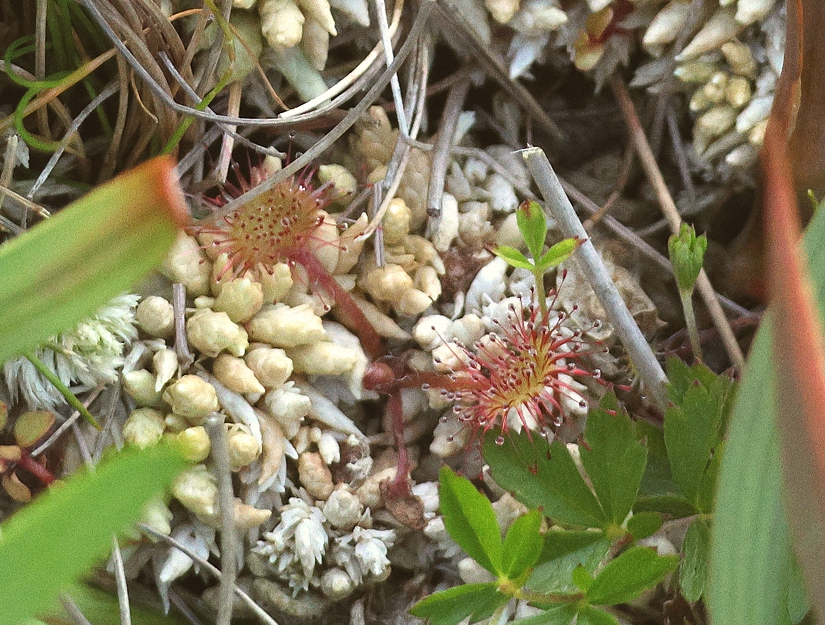
It was only when processing my photos, more than a week after this, that I found that I'd actually taken a shot that evening which, unbeknown to me at the time, included Sundew lurking in a corner !!! The most likely candidate (thanks to Conehead54) is Round-leaved Sundew.

Sundew (Drosera rotundifolia?)  - by Eyeworth Pond
It was then time to head back to base and have a relaxing rest of the evening with the girls.
 
As it was a fine evening, I spent a little time sitting in the garden with a glass of cider. This is the view of our cottage from my position.
 
Japonica Cottage - New Forest
We turned in rather late for Lindsay and I,  at about 23.00.

Saturday, 8th July          Keyhaven Marshes ; Crockford Stream

The day started dull, and it was soon raining. However, the forecast said that the rain would stop locally by mid morning. It also suggested that Keyhaven, on the south coast, would be relatively dry this day. Keyhaven is a place that I have visited twice before and can be an interesting place for finding birds. As the day looked as if it would be a dead loss for looking for dragonflies, this is where I  went.

I set off from base at about 10.20 after the rain had stopped, and arrived at my chosen parking place near Keyhaven at 10.50. From here I had a quite productive walk, and found myself photographing mainly birds and butterflies, with butterflies being the main subjects as I started out from the car park and headed for the sea wall.
 
Canada Goose (Branta canadensis) (adults + young) - Keyhaven Marshes

Small Heath (Coenonympha pamphilus) - Keyhaven Marshes

Peacock (Aglais io) - Keyhaven Marshes

On reaching the sea wall, I took the lower path that runs to the west, adjacent to the two lagoons. At Fishtail Lagoon I was, initially, confused by several ducks on the water. However, the penny dropped and I realised that, for the first time, I was seeing juvenile Shelduck, and in good numbers too.
 
Shelduck (Tadorna tadorna) (juvenile) - Keyhaven Marshes

Black-tailed Godwit on the island of the lagoon were mainly asleep, but one that wasn't seemed to be trying to be inconspicuous.


Black-tailed Godwit (Limosa limosa) - Keyhaven Marshes
I continued on the lower track, photographing a few other items as I went.

Reed Bunting (Emberiza schoeniclus) (female) - Keyhaven Marshes

Parsley Water-dropwort (Oenanthe lachenalii) - Keyhaven Marshes

Small Skipper (Thymelicus sylvestris) (female) - Keyhaven Marshes
Common Blue (Polyommatus icarus) (male) - Keyhaven Marshes
On reaching Keyhaven Lagoon, I was pleased to find one of my two target species present - Avocet. It would seem that they've had some breeding success this year.


Avocet (Recurvirostra avosetta) - Keyhaven Marshes

Avocet (Recurvirostra avosetta) (immature) - Keyhaven Marshes

My other target species was Little Tern. However, I was informed by a local birdwatcher that these had transferred to Normandy Pool at the eastern end of the reserve.
 
Here are a couple of the supporting cast on Keyhaven Lagoon.

Black-headed Gull (Chroicocephalus ridibundus) - Keyhaven Marshes

Little Egret (Egretta garzetta) - Keyhaven Marshes
I had about two hours here before heading back to my car. More butterflies were seen from the path to the car park although I failed, after fifteen minutes or so of attempts, to photograph a Marbled White. I saw many Gatekeepers and they were all male, with the dark 'sex brand' on the upper side of the forewing.
 
Gatekeeper (Pyronia tithonus) (male) - Keyhaven Marshes

Lapwing (Vanellus vanellus) - Keyhaven Marshes

Small Copper (Lycaena phlaeas) - Keyhaven Marshes

 
My plan was to have my picnic lunch at the Hatchet Moor car park and then possibly go and meet up with the girls as I'd promised them that I'd be back in time to take our granddaughter to the ice cream shop in Lyndhurst before 16.00. However, while eating my lunch there, I  got a message to say that they'd already been for an ice cream. This gave me a change of plan - I'd head a couple of km down the road and visit Crockford Stream, which is reckoned to be one of the best dragonfly spots in England.
 
There are five species of odonata that can almost be guaranteed here at this time of year, and are not likely to be found near my home, and these are Beautiful Demoiselle, Southern Damselfly, Small Red Damselfly, Golden-ringed Dragonfly, and Keeled Skimmer.

As I  parked my car, it started raining quite heavily. Fortunately the rain only lasted for about ten minutes, so I collected up my kit and set off for the stream. It was dull and breezy to start with, but things settled down a bit and it got sunnier and warmer. However, photography was not easy as things were blowing around in the breeze.

I had about three hours at Crockford stream and, with improving weather, it did not disappoint.

Beautiful Demoiselle is a gorgeous damselfly and, to my mind, although very different, both sexes are equally attractive. There were plenty of males around. Females, however are harder to find.


Beautiful Demoiselle (Calopteryx virgo) (female) - Crockford Stream

Beautiful Demoiselle (Calopteryx virgo) (male) - Crockford Stream
Both sexes have a habit of flicking open their wings occasionally, and I just managed to catch this with a male.
 
Beautiful Demoiselle (Calopteryx virgo) (male) - Crockford Stream

I also managed some video of this behaviour.
 
The Southern Damselfly is very similar to other blue damselflies, but has distinguishing markings on the second segment of the abdomen. It is a rare and very localised species with two main strongholds - the New Forest and a location in Wales - and a few lesser colonies elsewhere. I only found males on this occasion.
 
Southern Damselfly (Coenagrion mercuriale) (male) - Crockford Stream

The Small Red Damselfly is also a little rare, and I felt lucky to find this species as it has a reputation of shunning breezy weather.
 
Small Red Damselfly (Ceriagrion tenellum) (male+female in cop)- Crockford Stream

Small Red Damselfly (Ceriagrion tenellum) (male)- Crockford Stream

I did take a break at one point to have a chat with a group of four people which included Paul Ritchie. It was Paul who originally introduced me to Crockford Stream six years ago, when I hired his services as a dragonfly guide. I believe Paul still offers guided dragonfly visits in the New Forest, and I strongly recommend his services so, if you are heading that way, do take a look at http://www.hampshiredragonflies.co.uk/
 
After our chat, I spent a short time away from the stream and went to seek out a butterfly target - Silver-studded Blue. This is a relatively rare butterfly in UK and has a strange relationship with ants, which is too complex to go into in this blog post. I found some, but they were mainly well worn, and difficult to photograph as they were in an open area where the breeze was quite strong.


Silver-studded Blue (Plebejus argus) (male) - near Crockford Stream

Back at the stream I was photographing Keeled Skimmer, which were around in good numbers. The female keeled skimmer is a beauty to behold, looking (from above) as if she is made of the purest gold. Sadly, the only female I found on this occasion was too busy with other matters to show anything but her underside!
 
Keeled Skimmer (Orthetrum coerulescens) (male) - Crockford Stream

Keeled Skimmer (Orthetrum coerulescens) (male+female in cop) - Crockford Stream
The real icing on the cake was finding a Golden Ringed Dragonfly that was photographable. I'd seen one soon after I had arrived, but it flashed past and was lost. This one was perching. It did fly occasionally but came back to the same spot. I have found this species to be particularly confiding as far as close-up photography is concerned.
 
Golden-ringed Dragonfly (Cordulegaster boltonii) (male) - Crockford Stream
All my target species had been seen, and it was time to head back to base. 

My timing was good as, soon after my return to base, it started to rain and continued to do so for most of the evening.
 
In spite of forecasts for poor weather, the week was getting off to a promising start.
 
 
Thank you for staying with it up to this point. Part 2 should be considerably shorter and will probably appear, as usual, in about week's time. In the meantime, please take good care of yourselves and Nature - - - - Richard