Herewith, Pt.4 of my account of our family holiday in The New Forest. If you missed any of the earlier installments, you can find them by clicking 'Older Posts' at the bottom of this post.
In spite of a dire weather forecast before we had set off from home at the end of the previous week, we had got off relatively lightly as far as adverse weather was concerned, although the winds had been less than ideal. However, things went downhill a little at about this time, although the weather was still workable with.
Tuesday, 11th July Cadman's Pool : Cadnam Common
The day was forecast to be dull and windy, with the occasional light shower
of rain, and that is just what it turned out to be. The night before, we had
agreed that this would be a family day and, as Georgie (our granddaughter) would
be unlikely to surface much before mid-day, we all had a bit of a much-needed
lie-in, and it was getting on for 09.00 before I was showered and ready for
breakfast.
I spent some time sorting out the aftermath of Sunday night's moth
trapping, but much of the remaing morning was spent chatting. When Georgie did
join us, it was decided that the girls would take Georgie crabbing. This was
definitely 'not my thing', so I fixed up a picnic and departed to try and find
a location that had been recommended to me - Cadman's Pool. I guess this place
might have been more attractive if it was not so windy and dull, and there had
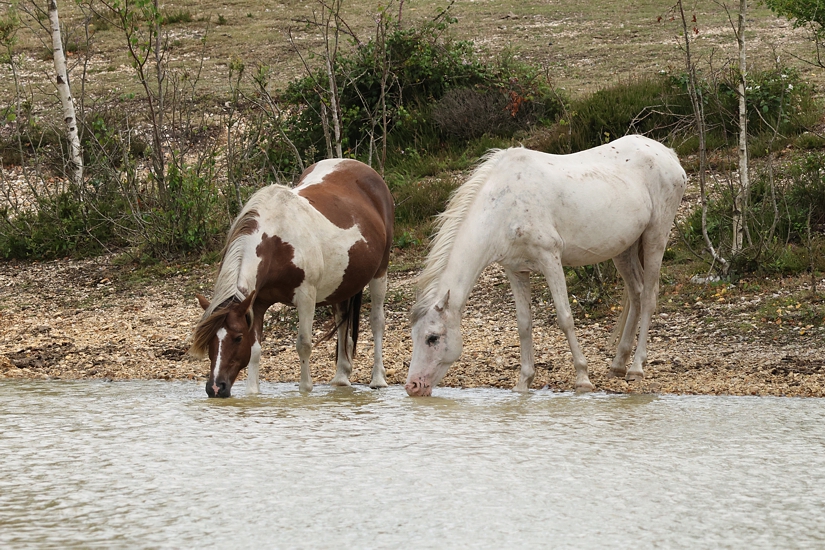
been less people around, but the only photos I took were of New Forest Ponies
that had come to the pool for a drink.
 |
New Forest Ponies - Cadman's Pool
|
From there, I moved on to Cadnam Moor. Yes, it can be confusing having a Cadman and a Cadnam relatively close to each other! My visit was just to check if, by some slim
chance, there were any dragonflies around the small pool - there weren't, but I
did find ponies and donkeys feeding and drinking at the pool. One of the donkeys
was, unusually, white, and it did look to be rather old.
 |
Donkey - Cadnam Common
|
 |
New Forest Pony - Cadnam Common
|
It then started to rain, so I headed back to the car and went into
Lyndhurst to do some shopping and have an ice cream.
I got back to base to find the girls had just beaten me back. They had not managed to go crabbing as, on arrival, they had found the place rather busy. A major part of Georgie's autism is that she has difficulty with people, especially children, and she just couldn't manage to get out of the car.
After a quick
coffee, the girls wanted to go into Lyndhurst to visit 'Down To The Wood' - a
shop selling a huge variety of attractive wooden ornaments, trinkets, games,
etc. Of course, the main objective was for Georgie to have a huge tub of sorbet
from the ice cream shop, resulting in me having my second ice cream of the
afternoon.
The day ended with a relaxing evening back at base.
Wednesday, 12th July Keyhaven : Janesmoor Pond : Stoney Cross : Cadnam Common
The forecast for the day was for fairly high winds, with sunny spells in
the morning and some heavy rain showers in the afternoon. It made sense,
therefore, for me to do the bulk of my outdoor activities in the morning. I am
rarely able to manage an early departure, mainly for technical reasons, but I
did get out at about 08.45 and arrived in the Keyhaven area at 09.30.
The car parking area was full when I arrived, but as I turned the car
round someone departed. At the gate, two persons who were obviously birders were
chatting. As I approached the gate, one of them said "it's gone". It turns out
that, unbeknown to me, the twitchers had been out in force as there had been a
Curlew Sandpiper on the reserve. This would have been a 'lifer' for me.
I spent three hours on a circular walk, seeing a few birds, all at a
distance, and a few butterflies. Frustratingly, I had my fourth sighting of the
week of a Marbled White butterfly here, and still came away without a
shot.
The walk southward from the car park to the sea wall, as usual, yielded mainly insects to photograph.
 |
Grey Heron (Ardea cinerea) - Keyhaven Marshes
|
 |
Little Ringed Plover (Charadrius dubius) - Keyhaven Marshes
|
On reaching the sea wall, I headed westward on the lower path beside Fishtail Lagoon. Here, the juvenile Shelduck were mainly sleeping on an island, while an adult was out on the water.
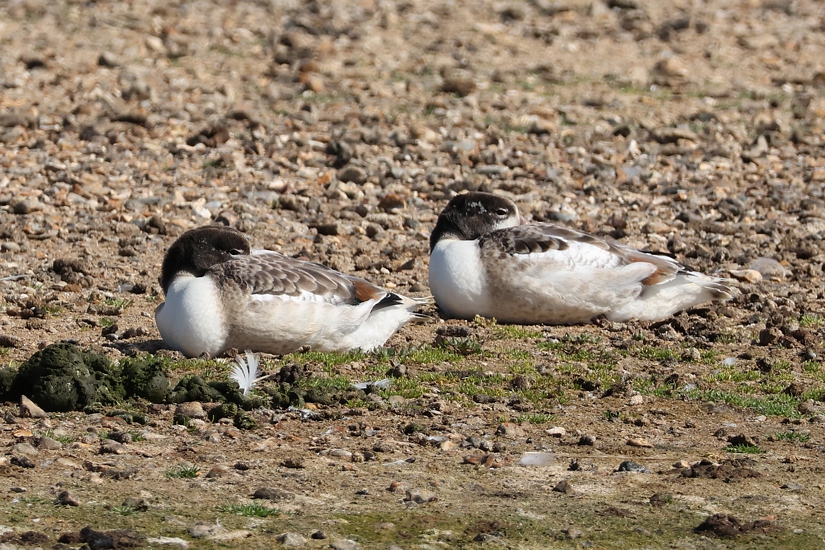 |
Shelduck (Tadorna tadorna) (juvenile) - Keyhaven Marshes
|
 |
| Shelduck (Tadorna tadorna) (female) - Keyhaven Marshes |
There were a couple of Redshank in the water at the edge of the nearside of the island.
 |
Redshank (Tringa totanus) - Keyhaven Marshes
|
A Lapwing was obligingly rather closer than most things.
 |
Lapwing (Vanellus vanellus) - Keyhaven Marshes
|
Most of my time, however, was focussed on photographing those irresistable Avocets. I thought this youngster was particularly charming.
 |
| Avocet (Recurvirostra avosetta) (juvenile) - Keyhaven Marshes |
The adults were quite active. I have included a video clip to show the feeding action, and the sound may give you an indication of the wind factor. I was quite surprised as to how quick that sweeping action was.
 |
| Avocet (Recurvirostra avosetta) - Keyhaven Marshes |
 |
| Avocet (Recurvirostra avosetta) - Keyhaven Marshes |
I then continued towards Keyhaven Lagoon. I had been seeing a few birds at a distance that had me a little puzzled. They were behaving like wagtails, and were grey and white, but had short tails. As I approached Keyhaven Lagoon, three of these were on the path ahead of me. One flew up onto the fence beside the path and I was able to get a shot before it flew off. From my photo, I reckon it was an immature Pied or White Wagtail. Any help with nailing the ID would be much appreciated. Note:- Pete Woodruff has kindly advised me that he believes this to be a Pied Wagtail, and as Pete is a life-long birder I am more than happy to accept this - thank you, Pete.
 |
Pied Wagtail (Motacilla alba yarrellii) (immature) - Keyhaven Marshes
|
Keyhaven Lagoon didn't yield anything of great interest, and the only thing I photographed was a Common Blue butterfly.
 |
Common Blue (Polyommatus icarus) (male) - Keyhaven Marshes
|
The path then continues round and ends up at the place where the Solent cuts inland to Keyhaven. There I found Little Egret and Oystercatcher.
 |
Little Egret (Egretta garzetta) - Keyhaven
|
 |
Oystercatcher (Haematopus ostralegus) - Keyhaven
|
I then headed back eastwards, along the ancient highway that is now a cycle way and constitutes the northern edge of the reserve. In the past, I have seen dragonflies along here, including Golden-ringed, but I had no such luck this time. Part way along this track, I took a northward path through a wooded section that passed close to a good-sized pond. However, the bushes between the path and the water were much more dense than when I previously visited and I could not get a view of the water. I did find a damselfly though.
 |
Blue-tailed Damselfly (Ischnura elegans) (male) - by Keyhaven Marshes
|
Having turned around and gone back to the ancient highway, I continued towards the car park. This stretch was quite rich with butterflies.
 |
Comma (Polygonia c-album) - by Keyhaven Marshes
|
 |
Peacock (Aglais io) - by Keyhaven Marshes
|
 |
Large White (Pieris brassicae) - by Keyhaven Marshes
|
 |
Holly Blue (Celastrina argiolus) - by Keyhaven Marshes
|
 |
Small Skipper (Thymelicus sylvestris) (female) - by Keyhaven Marshes
|
I couldn't resist a shot of one of nature's architectural perfections.
 |
Teasel (Dipsacus fullonum) - by Keyhaven Marshes
|
Shortly before reaching my car, there was a section of track with an open aspect to the north. While looking around, I photographed a couple of distant birds in flight. To my surprise, only when looking at my photos on the computer, I found that one of them was a Sand Martin.
 |
Black-headed Gull (Chroicocephalus ridibundus) - by Keyhaven Marshes
|
 |
Sand Martin (Riparia riparia) - by Keyhaven Marshes
|
I had my picnic lunch at the car, then contacted the girls to arrange to
meet up. We settled on meeting at Stoney Cross, and I arrived there and got a
message to say that they were just down the road at Janesmoor Pond. They'd
stopped there because Georgie had seen Donkeys and wanted to photograph
them.
After a short session there, we went down the Road to the Stoney Cross
parking area, and a very heavy rain shower started as we arrived. Melanie (our
daughter) and Georgie went out in the rain to photograph some deer. I waited until
the rain stopped before I went to photograph them! In the meantime, Melanie and
Georgie had set off for Cadnam Common, using the what3words reference that I'd
given Melanie.
Fallow Deer are known for their wide variation in colour. This group was entirely comprised of males of three or more years of age, as witnessed by the antlers.
 |
Fallow Deer (Dama dama) (male) - Stoney Cross
|
They were very relaxed about the proximity of humans, as can be seen in the following video clips.
We caught up with Melanie and Georgie before they reached Cadnam Common as they had
stopped to photograph some donkeys. We pulled up behind them and Lindsay started
to get out of the car but was stopped in her tracks by the rapid approach of a
donkey coming to greet her. I had opened my window to take some photos but I had
a donkey's head in through the window before I managed. It was far too close for my camera to focus on.
Until I was informed a couple of days prior to this, I was unaware that
there is now a fine of up to £1,000 for feeding or petting the livestock (deer,
ponies, donkeys, pigs) which roam free in the New Forest, and I can now
understand why.
After a brief interlude here, we moved on to Cadnam Common, where we all
got out for a walk, although Lindsay didn't make it as far as the pool. Melanie
and Georgie headed back to the car, while I spent a short time looking for
dragonflies, although the light was not good. I'd not long found one and was photographing a
male Broad-bodied Chaser dipping the rear of its abdomen into the water (as shown in the video clip, below), when the heavens
opened and I got soaked before I got back to the car. I am not sure what this dragonfly was doing (perhaps just washing its anal appendages?), and would be grateful for any suggestions.
 |
Broad-bodied Chaser (Libellula depressa) (male) - Cadnam Common
|
Back at the car, the air-conditioning in the car dried me out somewhat, so we were able to
shop for gifts, cakes, and ice creams in Lyndhurst before heading back to base
for a relaxing rest of afternoon and evening.
It is planned that my next blog post will cover the final day of our New Forest break, and a brief mention of the journey home the following day.
In the meantime, please take good care of yourselves and Nature.
Thank you for dropping by - - - Richard