The frustration of being in lockdown and not leaving the house came to a head on Monday 15th February. Feeling in great need of some excercise, and with further clarification on what was permissible under lockdown regulations, I decided that, provided my main activity was walking, I could legitimately go out in my car, as long as I did not venture far from my home, to reach a safe place where I could have a walk in the countryside, carrying my binoculars and camera - as long as I did not stop for any significant period of time. My mind was made up!
Monday, 15th February
A combination of factors, including weather and personal commitments, put my plans to go out on hold. The Pied Wagtail (not seen since) and female Blackcap both visited this day.
Tuesday, 16th February - Oakthorpe Colliery to Saltersford Valley, and return
With Lindsay out for a walk in the morning (she hadn't been out for even longer than me!), and me with some chores to do, I spent the morning at home, putting faith in the improved weather forecast for the afternoon. I did take a few shots of garden birds.
In the afternoon, I drove to nearby Oakthorpe Colliery - a place that is within walking distance of our home but along a road without verges that is favoured by speeding drivers, one of which nearly took me out last time I walked it - and parked in the car park.
The first part of my walk was along a broad hard-surfaced ride which gave me plenty of room to get out of the way of those persons who don't give a fig about social distancing. The second part was down a narrow track, hedged on both sides, and one of the two hazard stretches on my journey. Fortunately, however, I have never found myself crossing paths with anyone on this stretch. At the end of this, I join a farm access road known as Pastures Lane and I have had a few sightings along here - but not on this occasion. Pastures Lane brings me to a busy road where the speed limit is largely ignored, and this is the other hazard area as it has a narrow sidewalk on just one side, and this is bordered by a tall hedge. Fortunately, not many people use this footpath as stepping out of somebody's way is likely to put one into the path of a speeding car. This road then brings me to the tranquility of Saltersford Valley.
Saltersford Valley was a favoured place for dragonflies and damselflies during the summer, but I have found that it can have some avian interest too, although I have not yet seen anything particularly exciting. Sadly, I did not do well here on this occasion, with little seen, and the only things photographed being a Blue Tit and a distant, partly obscured, Reed Bunting!
 |
| Blue Tit (Cyanistes caeruleus) - Saltersford Valley |
| |
 |
Reed Bunting (Emberiza schoeniclus) (male) - Saltersford Valley
|
My return journey was a little less comfortable as I crossed with a number of people, the majority of whom made no effort to keep their distance and I got the impression that two parties were even going out of their way to pass close to me. I did manage to find a quiet few minutes, however, to attempt some photos of Long-tailed Tits.
 |
Long-tailed Tit (Aegithalos caudatus) - Pastures Lane
|
My first trip out into nature had not been encouraging, but I was determined not to be put off.Wednesday, 17th February - Normanton le Heath area
It was a bit cloudy and breezy, but fairly warm and I went out mid morning to what I used to consider to be my 'local patch' where I once had several Little Owl sites, all of which are I believe, now defunct. This is a fairly good area for Yellowhammer and I saw some in the distance, plus a number of Fieldfare, but my photos are not worth bothering you with here.
Back home, I grabbed a few shots of the female Blackcap that seems to have become a permanent resident but almost exclusively favours two very unphotogenic areas of our garden.
 |
| Blackcap (Sylvia atricapilla) (female) - garden on 16th February, 2021 |
Thursday, 18th February - Babelake Street and across some fields
The day started with sunny spells and there was a strong cool breeze. In the afternoon I visited narrow dead-end lane which I had not visited for a number of years, but which is close to my 'local patch'. My outward journey was facing directly into low sun, making it difficult to see much ahead of me, so I was looking forward to the return journey. However it clouded over as I started back, and was raining before I got back to my car. It had been unproductive in terms of sightings, but it looked as if the lane might have promise in warmer, less windy, weather.
I was disappointed to see on one of the trail cams that we had another visit by Brown Rat that night - I really don't like rats!
Friday, 19th February We now have three Hedgehogs visiting most nights, and one of them is still up to his mountaineering tricks. On this night I forgot to remove the mealworm dish which, it appears, still had some in!
Sunday, 21st FebruaryA mild and sunny day, and it was a delight to see bees in the garden. They mainly favoured the heather, but one was dipping into the crocuses. I have not yet attempted to ID these, and suspect that this might be difficult. - UPDATE:- With thanks to Conehead54 and Diane, these bees have been identified as Western Honey Bees.
 |
Western Honey Bee (Apis mellifera) - garden on 21st February, 2021
|
We are now seeing flowers blooming in the garden. Here are a few.
 |
| Iris - garden on 21st February, 2021 |
 |
| Snowdrop - garden on 21st February, 2021 |
 |
| Crocus - garden on 21st February, 2021 |
This winter, one of our bird feeding facilities has started develping a number of bracket fungi. I am watching progress with interest. |
| Bracket fungus - garden feeding post on 21st February, 2021 |
Monday, 22nd February - Oakthorpe Colliery, Saltersford Valley, Thortit Lake Having not been out for a few days, I took an afternoon trip out, revisiting my route of the previous Tuesday, but adding in another leg on the return journey.
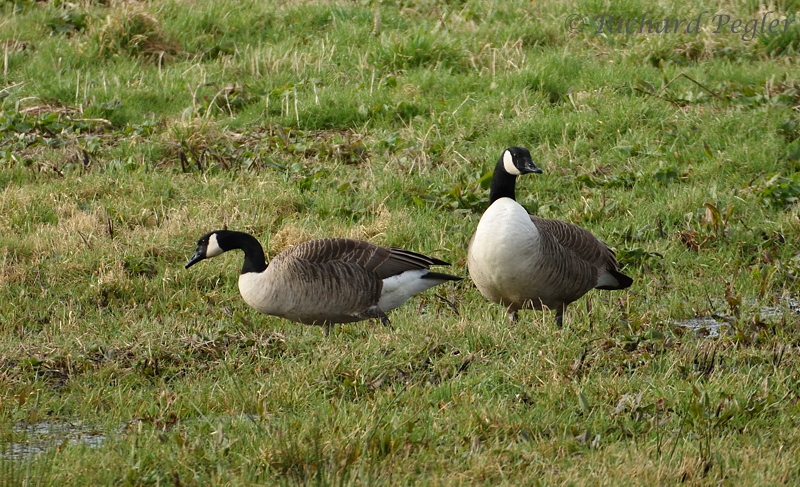
The water level on the lake which is visible in the distance from Pastures Lane was such that it had flooded into neighbouring fields. Some Canada Geese were enjoying puddles in the middle of the field beween the lane and the lake.
 |
Canada Goose (Branta canadensis) - from Pastures Lane
|
Further over, a Mute Swan was in the company of a pair of Coot
 |
Mute Swan (Cygnus olor) + Coot (Fulica atra) - from Pastures Lane
|
Hugging the far side of the lake, was a female Goosander. I spent a while here, hoping for her to come a little nearer, but this was not to be.
 |
Goosander (Mergus merganser) (female) - from Pastures Lane
|
Having reached Saltersford Valley, on the first lake I found a Great Crested Grebe that looked as if it might just be starting its transition into breeding plumage. I moved to a different place where I was a little closer and managed some shots.
 |
Great Crested Grebe (Podiceps cristatus) - Saltersford Valley
|
At the second (main) lake, I was reminded of how some ducks have heads that seem ridiculously narrow when viewed head-on.
 |
Tufted Duck (Aythya fuligula) (male) - Saltersford Valley
|
Further on in my circuit, a pair of Bullfinch were visible through the bare branches. This was as clear a shot as I could get.
 |
Bullfinch (Pyrrhula pyrrhula) (male + female) - Saltersford Valley
|
As I arrived back at the first lake, the grebe was in a much closer position.
 |
| Great Crested Grebe (Podiceps cristatus) - Saltersford Valley |
Heading back along Pastures Lane, I spotted a pair of Red-legged Partridge in a field to the south of the lane.
 |
| Red-legged Partridge (Alectoris rufa) - from Pastures Lane |
|
Back near the lake on the north side, a Great Crested Grebe was in nearly full breeding plumage.
 |
Great Crested Grebe (Podiceps cristatus) -from Pastures Lane
|
The Mute Swan was now out on the water, as were the Canada Geese.
 |
| Mute Swan (Cygnus olor) - from Pastures Lane |
 |
| Canada Goose (Branta canadensis) - from Pastures Lane |
Having returned to Oakthorpe Colliery, I decided to cut through Willesley Wood to take a look at Thortit Lake. To my delight, I found a pair of Goosander here, although they were hugging the far side of the lake.
 |
Goosander (Mergus merganser) (female + male) - Thortit Lake
|
 |
| Goosander (Mergus merganser) (male) - Thortit Lake |
 |
| Goosander (Mergus merganser) (female) - Thortit Lake |
After walking to the far end of the lake, I turned round and headed back to my car, having had a slightly more productive time than on my previous visit to Saltersford Valley.
That night I put out the moth trap, and caught my first two moths of the year, both of which were March Moth - not an auspicious result.
 |
March Moth (Alsophila aescularia) (male) - garden moth trap on 22nd February, 2021
|
Wednesday, 24th February - Oakthorpe Colliery, Thortit Lake, Willesley Park
Leaving the trail cams running a little after sunrise sometimes results in daylight footage, rather than monochrome IR images. On this day, one of the cams caught a Magpie exibiting that wonderful irridescence.
As, on the previous day, the only walk I'd been on was of just over a kilometre to the post box and back, I figured it was time to go a little further afield. I was also wanting to explore new routes for walking. My starting point was my well-trodden route from Oakthorpe Colliery and along the north side of Thortit Lake.
A pair of Great Crested Grebe, in breeding plumage, were already nest building. Here is one of them.
 |
Great Crested Grebe (Podiceps cristatus) - Thortit Lake
|
The male Goosander was there, but there was no sign of the female. I have never noticed before that the top of a Goosander's red bill seems to be relatively flat and almost black.
 |
| Goosander (Mergus merganser) (male) - Thortit Lake |
At the east end of the lake there was much noise from a calling Buzzard which showed briefly.
 |
Common Buzzard (Buteo buteo) - Willesley Woods
|
From here, I walked up Willesley Woodside to the point where it is severed by the A42 road. I then took the track that runs parallel to the A42 before cutting across to another footpath that takes a route through Willesley Park Golf Course. There are woodland sections on this path and there are many ancient trees around. I suspect that this area could do with further exploration. Currently there is no danger from flying golf balls, due to lockdown regulations. Just before I left the golf course, I could not resist a shot of a squirrel.
 |
Grey Squirrel (Sciurus carolinensis) - Willesley Park
|
I then rejoined my outward route and headed back to the car.
Thursday, 25th February - Thortit Lake, Willesley Wood, Willesley Woodside
The most garden excitement this day was spotting our first butterfly of the year. This was a Small Tortoiseshell. Unfortunately, it flew before I could get out there with the camera.
With a busy day in prospect, I took a short walk this day, parking on Willesley Woodside, walking the north side of Thortit Lake before taking a walk through Willesley Wood.
In Willesley Wood I found a charming spot where a number of ornamental figures had been placed by a tree stump.
 |
in Willesley Wood
|
What made this place really magical, however, was the notice that rested against the other side of the tree stump. I hope that you are looking at this on a device wiith a large enough screen to read it.
 |
in Willesley Wood
|
Further along in the wood, I found myself in a sunny ride between young trees. I spent a little time here with some Long-tailed Tits and a Robin.
 |
Long-tailed Tit (Aegithalos caudatus) -Willesley Wood
|
 |
Robin (Erithacus rubecula) - Willesley Wood
|
That night, one of the trail cams caught two Hedgehogs in a couple of clips.
Friday, 26th February
A trail cam caught Starlings having a bath in the 'Duck Pond'.
That morning, I made a return visit to Babelake Street. There is some conjecture about the pronunciation of 'Babelake'. I had always thought of it as being pronounced as 'Babbellake', but I have an aquaintance who lives on the road and always pronounces it as 'Babe Lake". I must remember to ask him if this is the way it should be pronounced, or just his own little joke.
Near the inner end of the lane, I found a couple of Carrion Crows high up in a tree. Here is one of them.
 |
Carrion Crow (Corvus corone) - Babelake Street
|
A short while later, a Buzzard appeared, and was soon being worried by a Crow.
 |
| Carrion Crow (Corvus corone) + Common Buzzard (Buteo buteo) - Babelake Street |
Little else was seen on the rest of the walk, but I still think this area has promise.
Saturday, 27th February - Normanton le Heath area
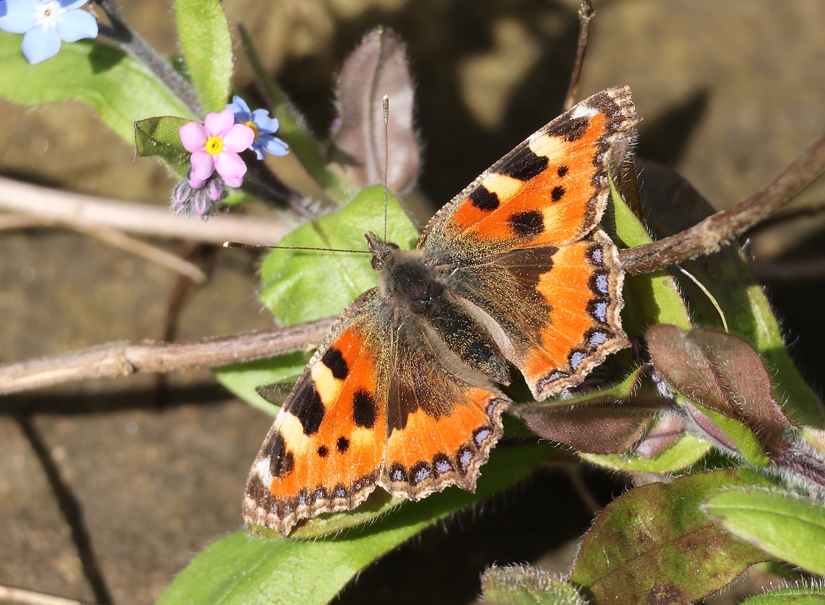
There was excitement this day as we had two different Small Tortoiseshell butterflies visit the garden at different times. At first, I assumed that these were the same individual. However, on examining my shots, I found that the first one had some minor damage to its right hind wing, which the second did not. If it was the other way round, I could not have made this assumption as it could easily have got damaged in the interim - a fact that was born out when the second one flew from its place on the wall and was immediately grabbed by a Great Tit and taken to our Viburnum, where its wings fluttered down as it was eagerly devoured!
 |
Small Tortoiseshell #1 (Aglais urticae) - garden on 27th February, 2021
|
 |
| Small Tortoiseshell #2 (Aglais urticae) - garden on 27th February, 202 |
That afternoon, I went for a walk on my local patch, where virtually nothing was seen and the only photos I took were of a Blue Tit, purely for the purpose of exercising my shutter-button finger. I show this photo because (and you may think I'm going crazy here!) I find that I can't look at it without thinking that the bird's head has an almost human aspect to it.
 |
Blue Tit (Cyanistes caeruleus) -my local patch
|
Well that's it, Folks. I started with a Blue Tit and I've ended on one too.
That second week had given me some good clues for new places to investigate for future walks close to home, and had also given me some much needed exercise. My gizmo tells me that this was the furthest I had walked in a week since our vacation on the Isles of Scilly in March 2020.
This week I am mainly staying in, catching up on some of the things that I should have been doing last week. I have, however, made a start on my latest leatherwork project.
Leatherwork Update
I have now started work on a small 'messenger bag', with the purpose of carrying some of my paraphernalia when I am out dragonfly hunting. The first part of the process was to make a dragonfly motif for the front of the bag. I decided that a detailed realistic representation was well beyond my capabilities, so settled for a stylised motif. The motif is now completed, as shown on the right. It's far from perfect, but I am quite happy with it. I am now working on the main fabric of the bag itself. I have cut out and stained all the leather. I now have to give it a protective coating, then add the metal hardware (I'm waiting for the brass to finish its 'antiquing' process in a pot of vinegar!) and finally screwing and sewing it all together. It will probably be a few weeks yet!
I hope to be publishing my next blog post in a week or two's time. In the meantime, take good care and stay safe.