This is the fourth, and final, part of my account of our travels when Canadian friends, David and Miriam, came to stay. You can find the previous instalments here, here, and here.
Tuesday, 4th August
On this day, we left Grantown on Spey and headed back south into England (just!). In some ways I was sad to be leaving the Grant Arms - this hotel is a wonderful base for a wildlife holiday. However, we were heading towards home and, as I hadn't seen much of my wife for the past fortnight, I was looking forward to it.
I'd had a phone call the previous day to say that the weather forecast was not good and so our pre-arranged boat charter to Bass Rock and Craigleith was cancelled. This was particularly disappointing as our Farne Island visit on our travels to Scotland had also been cancelled due to weather.
We set off south soon after breakfast. As we were now in no hurry, we made a diversion from our route at Braemar in order to check for Dipper on the scenic run up to the Linn of Dee. It was an enjoyable run but no Dipper was seen.
After stop for coffee and cake at the 'taste' café in Braemar, our next stop was at Glenshee in the hope of finding Ring Ouzel again so that David could get photos. He was unlucky, but it was not surprising as the weather was not good at all, and David returned to the car lightly frozen and damp!
We had another stop at the Macmillan Coffee Shop at Quarrymill, near Scone Palace, just outside Perth, for a very enjoyable light lunch. This place is run by volunteers in support of the Macmillan Cancer charity, and they do a wonderful job The food is delicious, and it seems that the ladies compete with each other to produce the best cakes!
After lunch, we took a walk beside the burn that runs through the Quarrymill park. This has been a good place for Dipper on past visits, but not on this occasion. This was our last opportunity, so David and Miriam dipped on Dipper in Scotland!
We were settled into our B&B at the excellent Tweed View House in Berwick upon Tweed by 17h00. Miriam was feeling a little under the weather, so it was just David and I that went out to the local chippy for a fish & chip supper. The weather had picked up a bit by now so, after fish & chips, we returned to the B&B, picked up our birding kit, and set off for Cocklawburn Beach.
Cocklawburn Beach is a favourite place for me. The birds are plentiful, and usually somewhat different to those I find at home, and I found out earlier this year that fossils can be found here too. Having found a suitable place to park, we made our way down to the beach, noting that the Meadow Pipits seemed to have followed us down from Scotland!
From the beach we saw Gannets and Sandwich Terns flying past, a few distant Eider, and a group of three ducks that we were unable to identify at the time. On looking at my photos I found that they were Common Scoter, the ID being clinched by the bird on the right.
 |
| Common Scoter (Melanitta nigra) - off Cocklawburn Beach |
Soon after our arrival, a small group of Turnstone flew in. Photography was getting a little more difficult by now as the light levels were low.
 |
| Turnstone (Arenaria interpres) - off Cocklawburn Beach |
I tried for a few flight shots in the failing light - an exercise that was doomed to failure, but I did manage one identifiable shot of a Sandwich Tern.
 |
| Sandwich Tern (Sterna sandvicensis) - off Cocklawburn Beach |
Just before we left, a group of Ringed Plover arrived on the rocks exposed by the falling tide.
 |
| Ringed Plover (Charadrius hiaticula) - off Cocklawburn Beach |
Tiredness had set in so we returned to Tweed View House for an early night, and a much-needed good night's sleep.
Wednesday, 5th August
We had an excellent breakfast served in our rooms, packed the car, and set off on our travels again.
Miriam had wanted to see Hadrian's Wall on the basis that she was probably not going to see the Great Wall of China in her lifetime, and this would be second best! So we set off towards the outskirts of Newcastle and then headed off west. We soon connected with visible signs of the wall, and found that every man and his dog seemed to have decided to 'walk the wall'. Not wanting to spend a fortune on a car park ticket that allowed parking for a day at any of the official 'wall car parks' when we were only looking for a brief visit, I took David and Miriam to an extensive part of the wall I'd found on a previous occasion, with just enough space to park a vehicle at the roadside. It seems that they were more than happy with this arrangement as this episode is a feature of David's own trip report.
We then cut across country to Alston, where we made a stop for lunch at a place Lindsay and I had stopped at a couple of times before. It was an entertaining, if a little long-winded, experience, but we eventually set off again, suitably replete.
The Bowlees Visitor Centre, near Middleton in Teesdale (just corrected a Freudian typo there - wrote 'Middleton in Teasdale'!) was nominated by me as a suitable place for a comfort stop with, perhaps, the possibility of finding the elusive Dipper. This place had changed out of all recognition since my previous visit, and it's now a superb facility. I asked the lady behind the Information Desk about recent Dipper sightings, and she recommended a short walk from the Centre to the Tees above Low Force - a place I'd not been to before - rather than the stream virtually next to the Centre. As the rain had departed and it had turned bright and sunny, we took her advice.
Low Force is a very pretty spot, and there were quite a few people around taking advantage of this fact, but I did manage a person-free image.
 |
| Low Force - near Middleton in Teesdale |
By crossing the suspension bridge, we left most of the people behind and had a pleasant walk beside the water. Eventually I spotted a very distant Dipper and this time David and Miriam saw it!
 |
| Dipper (Cinclus cinclus) - near Low Force |
I tried to find a position where we could get a better view of this bird but, sadly, it was on the far side of an island in the river. Whilst looking I did find a beetle that I don't believe I have ever seen before, although I understand that they are not rare. At first I thought that it had orange spots on its thorax and head, but when I looked at my images I found that it was host to some orange bugs. Initially I thought these were ticks, but I now know different.
 |
| Sexton Beetle (Nicrophorus vespilloides) - near Low Force |
The beetle is a Sexton Beetle, sometimes also known as a Burying Beetle. It serves
a useful purpose in that it buries carrion so that its larval offspring
have a well-stocked larder on hand. It is not unusual for these beetles to carry Gamasid mites. These are not parasitic on the beetles, but are just hitching a ride from one meal to the next - sharing the beetle's food source! However, some Gamasid mites are not that innocuous. They can carry disease! Indeed, those living on rats were, it seems, responsible for The Black Death!
We returned to the Bowlees Centre and I thanked the lady behind the desk for her pointer to the Dipper. David bought us an excellent locally-produced ice cream, and then we were on our way.
We arrived home in Ashby shortly before 7 p.m. and had a relaxing evening chatting, eating, and topping it off with 'Le Colonel' (for those that didn't see my previous mention of this, it's lemon sorbet drowned in vodka).
Thursday, 6th August
At David's request, after breakfast we set off to make a return visit to Rutland Water, leaving Miriam to stay and spend some time with Lindsay. This time we visited the Egleton side. It's now that I confess to having a sense of guilt as I look at my images and realise that I must have spent more than a little time along the way photographing damsels and dragons. My apologies, David. Here are some of the guilty spoils of that session.
 |
| Common Darter (Sympetrum striolatum) (male) - Rutland Egleton |
 |
| Common Darter (Sympetrum striolatum) (female) - Rutland Egleton |
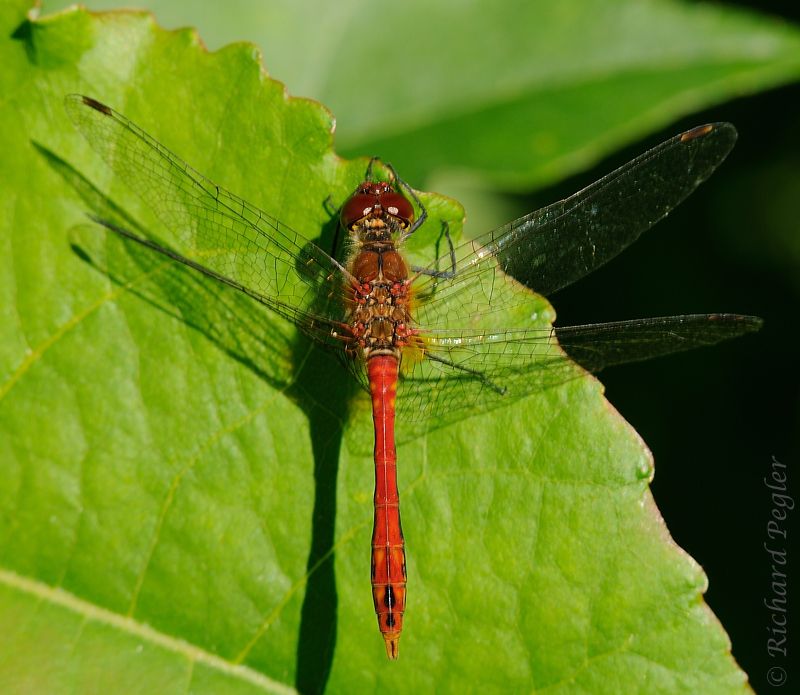 |
| Ruddy Darter (Sympetrum sanguineum) (male) - Rutland Egleton |
 |
| Ruddy Darter (Sympetrum sanguineum) (female) - Rutland Egleton |
 |
| Southern Hawker (Aeshna cyanea) (female) - Rutland Egleton |
 |
| Common Blue Damselfly (Enallagma cyathigerum) (female - dark form) - Rutland Egleton |
 |
| Common Blue Damselfly (Enallagma cyathigerum) (immature female) - Rutland Egleton |
I did also photograph this bee. I've not been able to find any reference to a bee with a white tail AND a white front. Any help with ID would be much appreciated.
 |
| Bee species - Rutland Egleton |
Although not represented by my photos, we did spend quite a time in the hides, enjoying the birds, particularly at Shoveler Hide. I took this photo of a Curlew from there, although the light had gone by then.
 |
| Curlew (Numenius arquata) - Rutland Egleton |
We'd seen a juvenile Little Owl at my Site No.44 on the way out (no photos), and managed to pick up a further two (both adults) at my Site No.41 and a single bird at No.46 (worryingly with a pair of Sparrowhawks sitting on a branch above it).
 |
| Little Owl (Athene noctua) - my Site No.41 |
We agreed that it had been a pleasant day, even if not particularly exciting, and it had been great to enjoy some sunshine for a change!
A short vigil in the garden with Miriam, looking for Hedgehogs, didn't come up with the goods. Until a couple of weeks before their visit, we'd had one Hedgehog that you could almost set your clock by at 22h00. Visits had, however, become somewhat more sporadic since then.
Friday, 7th August
The general consensus of opinion was that a relatively gentle day was needed. We started off with Miriam, David, and I driving to the edge of Calke Park, and walking in.
Soon after we set off on foot, we found juvenile Goldfinch on the thistle heads.
 |
| Goldfinch (Carduelis carduelis) (juvenile) - Calke Park |
Further up the way, I stopped to scan for owls at my Site No.49. Suddenly I saw what I thought was a female Redstart, and then there was a male Redstart! Apparently it's a while since a Redstart was seen in the park! I only managed distant record shots of the male, and didn't manage to positively ID the female.
 |
| Redstart (Phoenicurus phoenicurus) (male) - Calke Park |
We were continuing up the road when Miriam said "there's a Little Owl". She'd spotted one in a distant tree near Site No.49! It was close enough that there was no doubt in my mind that it belonged to Site No.49.
 |
| Little Owl (Athene noctua) - my Site No.49 |
We carried on until we got the the hide beside the car park at Calke. Here we spent a while watching the birds. Nothing exciting to me was seen, but David was pleased to get close views of species that he was not overly familiar with.
 |
| Dunnock (Prunella modularis) - Calke Park |
 |
| Robin (Erithacus rubecula) (juvenile) - Calke Park |
 |
| Nuthatch (Sitta europaea) - Calke Park |
As we left the hide, some of the park's Red Deer stags were nearby.
 |
| Red Deer (Cervus elaphus) (male) - Calke Park |
We made our way back to the car, checking the tree where we'd seen the Little Owl. It wasn't there, but I spotted one on a bit of fallen tree beside the tree.
 |
| Little Owl (Athene noctua) - my Site No.49 |
We'd assumed that this was probably the same owl as we saw on the outward - that was until a couple of weeks ago when, whilst checking my photos from that day, I saw that the owl on the ground had just snuck into one of my images (bottom right) of the owl in the tree! It was reassuring to see that there were two owls still around as I'd not seen an owl here for a while.
 |
| Little Owls (Athene noctua) - my Site No.49 |
We checked for the Redstart on our return, but didn't see it.
After a light lunch at home, David and I set off for a local lake. Hicks Lodge has turned up some good sightings in the past, but I'd not been there for a long while - I think that this might have been my first visit this year!
There were a few Common Blue butterflies around, but they were not very cooperative! I didn't do too badly, however. I was extremely pleased to get this one as it was exhibiting the orange lunules on the upper wings, commonly associated with the female of the species, but was extremely blue as for a male, also! This seems to be more in keeping with the Scottish and Irish races of the females of the species!
 |
| Common Blue (Polyomatus icarus) (female?) - Hicks Lodge |
I don't know my moths well enough to decide whether this is a Five-spot or Six-spot Burnet. I'm pretty sure, however, that it's a Six-spot with the outer two of the six spots merging! I think that a Five-spot would be a bit unusual in these parts!
 |
| (probable) Six-spot Burnet (Zygaena filipendulae) - Hicks Lodge |
A Migrant Hawker was flying in the same area, and kindly settled to enable its photo to be taken.
 |
| Migrant Hawker (Aeshna mixta) (immature male) - Hicks Lodge |
David was feeling in need of a rest, and sat down on a bench beside one of the lakes whilst I went on a further dragonfly hunt. I wasn't too successful, only managing the following.
 |
| Common Emerald (Lestes sponsa) - Hicks Lodge |
I returned to David, and took some photos of a Tufted Duck that was keeping a watchful eye on a chick from a distance.
 |
| Tufted Duck (Aythya fuligula) - Hicks Lodge |
We had to set back relatively early as I'd been called to an extraordinary meeting of a club, of which I am a member, that evening. As we were departing, I saw a Brown Hawker flying around, and it looked as if it wanted to settle - something that they don't often do in my experience! It did, but I only managed a relatively poor image before it was off again.
 |
| Brown Hawker (Aeshna grandis) (female) - Hicks Lodge |
I'm pleased to say that the meeting that night didn't last too long and we were able to take up my pal John's invitation for David to sit out at his place with a chance of seeing a Barn Owl - John had been with me at the meeting. We sat David down in my chair-hide in John's garden, but without the cover over. John went indoors and I went and sat quietly in my car with the intention of having a doze. I didn't get much of a chance, however, as about half an hour later, David appeared having had a delightful period of watching the female Barn Owl which had emerged and had a stretching session before departing.
We got back in time to join the girls in a gin and tonic before bed.
Saturday, 8th August
After breakfast, I took David back to John's house, this time with Miriam too. Two birds on David's target list were Tree Sparrow and Jay, and John has these regularly on feeders in his garden (lucky beggar!)
I left David and Miriam sitting with mugs of tea watching the feeders whilst I went off to scout for dragonflies at a nearby fishing lake. It seemed that, round the edge of the lake, there were frogs everywhere. This one hopped out of my way onto an old pile of blanket weed that had been hauled out of the lake.
 |
| Common Frog (Rana temporaria) - Ibstock |
The weather wasn't ideal for dragonflies, and the photography was even less ideal!
 |
| Common Darter (Sympetrum striolatum) (immature female) - Ibstock |
 |
| Common Darter (Sympetrum striolatum) (male) - Ibstock |
 |
| Blue-tailed Damselfly (Ischnura elegans) - Ibstock |
I spent around an hour here before returning to pick up David and Miriam. They'd seen Tree Sparrow, but the Jays hadn't shown up.
We returned home for lunch and, in the afternoon David and I set off to check up on some Little Owls and to see what else we could find. There was disappointment at my LO Site No.03 when I discovered that the tree had suffered badly since my last visit and was almost certainly not still a viable nest site. We found Little Owls at my Sites Nos.02 and 17, but little else of interest, so it ended up being rather a flat afternoon for sightings. We had to be back in good time as David and Miriam had requested that we book a table at a hostelry of our recommendation as they wished to buy us dinner.
We had a splendid dinner at The Coopers Arms in Weston on Trent and a thoroughly enjoyable time - thank you, David and Miriam - after which we returned to base and sat chatting whilst enjoying 'Le Colonel' once more!
Months before their arrival, Miriam had expressed a wish to see a Hedgehog, knowing that we have them visit our garden. Miriam had another attempt to see them that night, and did not have to wait long before a Hedgehog walked right past where she was sitting and started to feed in the nearby feeding station. Mission accomplished!!!
 |
| Miriam's Hedgehog - our garden |
Sunday, 9th August
The girls were off to a international quilting show with our daughter, Melanie, at the NEC this day, and David and I went off to Rutland Water with Hobby being the target bird for David. Our first call was at Swithland Reservoir, where local birders told us that Hobby had not been seen there for a few weeks. We didn't stay long, as we felt that we'd get a better chance by going to Rutland Water.
En route we passed my Little Owl Site No.44 and one of the adults was showing quite well.
 |
| Little Owl (Athene noctua) - my Site No.44 |
A little further on, we enjoyed the graceful flight of a Red Kite. This one seemed to have a deformity in that its lower mandible looked to be significantly shorter than the upper one.
 |
| Red Kite (Milvus milvus) - north-east Leicestershire |
I had several attempts a photographing dragonflies at Rutland Water, whilst David spent more time in the hides. I don't think either of us saw anything of great moment, however. My shutter almost certainly got less activations than at any time during the 17 previous days!
 |
| Common Darter (Sympetrum striolatum) (male) -Rutland Egleton |
 |
| Common Darter (Sympetrum striolatum) (male + female) -Rutland Egleton |
We needed to return relatively early that day as I was cooking the evening meal and David and Miriam needed to get packed up ready to depart for home the next morning.
Sadly, my tiredness was beginning to catch up with me and I made a bit of a pig's ear of dinner that night - although it seemed to go down quite well, it should have been so much better!
I don't know about anyone else but I felt in a decidedly sombre mood that night as we enjoyed a farewell 'Le Colonel' together. Tomorrow, my new-found friends would be departing.
I'll not report on the last day, when I drove David and Miriam to Manchester Airport, and said a quick 'farewell' to them both at the drop-off parking area. It wasn't my happiest moment!
In Conclusion
This visit by David and Miriam was arranged on the basis of a friendship formed between David and I as fellow bloggers on the internet. Some may say that that's a recipe for disaster, but I believe that David and I both had total confidence that all would work out just fine, even if we were to uncover unforeseen differences. I'm not sure that our wives, however, had the same confidence, as they hadn't been party to all the communication that passed between David and myself.
I'd done quite a lot of work in the preparations for David and Miriam's visit, but this was not, I confess, for altruistic reasons. In my most recent working past, I had a tour business, providing tours for a different kind of enthusiast. I've been retired for just under ten years now, and I got a real kick out of revitalising the old skills and organising the arrangements for this visit.
As far as the actual visit was concerned, David and Miriam turned out to be charming and delightful company. Yes, I did push myself a little harder than I would normally have done, with driving nearly 3,000 miles (4,500 km) during their visit, and indulging in wall-to-wall birding for 18 days, but I got so much more out of the experience, which was fully enhanced by their company! I wouldn't have missed it for the world!!
Given the opportunity, would I do it any differently? Yes, I possibly would! Towards the end of the Scottish leg of the visit I started to get the impression that we'd been pushing Miriam too hard. Miriam has a real interest in wildlife and has superb powers of observation (visual and hearing), but David is the dyed-in-the-wool birder, driven by a wish to see everything possible. I feel that, in trying to provide David with as much from his wish list that I could, I deprived Miriam of some of the things that she'd have liked to have done. If this is the case, Miriam, I apologise and promise to redress the balance next time! If I've got it wrong, I apologise to you both for misreading the signs.
Do I look forward to getting together with David and Miriam again? I'd be darned upset if I thought that it wasn't going to happen!
My thanks to all at the Grant Arms for making our stay there so highly enjoyable. My thanks also to Liz and Graham for a truly enjoyable, if brief, stay at Tweed View House.
My thanks to David and Miriam for the life-enriching pleasure of your company.
Last, but not least, my thanks to my wonderful wife, Lindsay, for looking after us all so well - you're a star!
Thank you for dropping by. The next post from me will probably be a brief one! Sighs of relief all round!!