Pages

Notes on Use of This Blog


1. I have a policy that I always reply to comments on my blog, even if it's just to say thank you.

2. Please don't submit comments that include your own web address. For obvious reasons, they will not be published.

3. I'm now on Twitter - @RichardPegler1
Showing posts with label Thrush Mistle. Show all posts

Tuesday, 18 April 2023

A Visit to Rutland Water - on 4th April, 2023

It had been a while since I last visited Rutland Water, largely because of Lindsay's post-surgery knee problems - I didn't feel comfortable leaving her alone for any great length of time. Things in that direction are beginning to get back to normal, however, and I at last felt that a longer spell out was in order. 

The weather forecast for this particular day was quite favourable and so, having packed a picnic lunch, I set off rather late in the morning for Rutland Water, taking my usual cross-country scenic route.  This route is not as happy a one as it used to be as, at one time, I had nine Little Owl nest sites along it and it was not that unusual to spot ten different owls during the two-way journey. Sadly, on this occasion, I noted that only two of those sites still looked as if they might be able to support a Little Owl, and one of those was very dubious. The main issue was one of natural tree decay, but tree removal or drastic reduction (2 cases), and building decay (2 cases) were also evident. 

At Cold Newton, a pheasant sauntered across the field beside me.

Common Pheasant (Phasianus colchicus) (male) - Cold Newton
As I approached Newbold I noted a Red Kite but by the time I stopped the car and got my window down it was a bit more distant.


Red Kite (Milvus milvus) - near Newbold

I stopped for my picnic by what was my Little Owl Site No.34, and was disappointed to see further decay to the nest tree and is, therefore, the one that I labelled as 'dubious' above.

It must have been a few years since I last saw a hare, so I was delighted this day to see one streak across the field beside me.

Brown Hare (Lepus europaeus) - Newbold
While having my lunch, a message had come through about a Bearded Tit being seen from one of the hides. Arriving at Rutland Water, as I left the car park, I noticed a thrush in the paddock beside the car park. At first, I assumed that it was a Song Thrush, but it turned out to be a Mistle Thrush.
 
Mistle Thrush (Turdus viscivorus) - Rutland Water, Egleton

I made my way directly to Shoveler hide, from which the Bearded Tit had been spotted just two hours earlier. I arrived to find seven people in the hide, none of whom were aware that this bird had been seen there earlier. Shortly after my arrival another message came through to say that the bird had been heard fying away about half an hour after it had first been spotted.
 
I settled in for a while to watch what was in front of the hide, where the water level was higher than I'd ever seen it before.
 
A Coot came drifting by. I am not sure if that is a long black tongue that it is showing, or something that it is trying to swallow. I didn't notice it at the time that I took the shot.

Coot (Fulica atra) - Rutland Water, from Shoveler Hide

A drake Pochard kept its distance.

Pochard (Aythya ferina) (male) - Rutland Water, from Shoveler Hide

A pair of Gadwall were a little more cooperative than the Pochard.

Gadwall (Mareca strepera) (male) - Rutland Water, from Shoveler Hide

Gadwall (Mareca strepera) (female) - Rutland Water, from Shoveler Hide

A Cormorant posed rather nicely on one of the small platforms.

Cormorant (Phalacrocorax carbo) - Rutland Water, from Shoveler Hide
There were many Shelduck out on the water, but only one came close, and another flew by.


Shelduck (Tadorna tadorna) (male) - Rutland Water, from Shoveler Hide
Appropriately, a drake Shoveler presented itself for a photo.

Shoveler (Spatula clypeata) (male) - Rutland Water, from Shoveler Hide
It is always a delight to see when a Cormorant (or Shag) spreads its wings, and I was pleased to catch this one.
 
Cormorant (Phalacrocorax carbo) - Rutland Water, from Shoveler Hide

A Greylag Goose presented itself too.
 
Greylag Goose (Anser anser)  - Rutland Water, from Shoveler Hide
Shortly after taking that last shot, I took a stroll down to Buzzard Hide where little was visible, except at a great distance, and then moved on to Crake Hide, where I was disappointed to see the water level was so high that the usual scrape area was completely under water. I didn't stay long, as nothing was happening and so returned to Shoveler Hide.
 
Once back at Shoveler Hide I caught a second Cormorant with spread wings.

Cormorant (Phalacrocorax carbo) - Rutland Water, from Shoveler Hide

Somebody in the hide alerted the rest of us to an extremely distant Marsh Harrier flying across in front of us. I raised my camera, more in hope than expectation, and managed to just about get a record shot.

Marsh Harrier (Circus aeruginosus) (female) - Rutland Water, from Shoveler Hide

A gentleman arrived at the hide and, in conversation, mentioned that there were several (he thought maybe twelve) Avocet on Lagoon 4. As it was nearly six years since I last saw an Avocet, I was keen to go and try to find these, so I headed to Plover Hide, which overlooks the north-east corner of Lagoon 4.

I had forgotten how small Avocet are, and didn't find them for a few seconds after opening the hatch in the hide (it was empty when I arrived). I soon had them spotted however. I didn't count them but think that the estimate of twelve wasn't far off the mark. They kept me entertained for the next quarter of an hour or so, although they never came closer than about 50 metres.


Avocet (Recurvirostra avosetta) - Rutland Water, from Plover Hide
I was occasionally distracted from the Avocets by the activities of Black -headed Gulls.


Black-headed Gull (Chroicocephalus ridibundus) - Rutland Water, from Plover Hide
There was another distraction when I spotted a Brimstone butterfly approaching from the left of the hide. I kept my eye on it for a while, hoping it would come in front of the hide, but it kept its distance and I only got a record shot.
 
Brimstone (Gonepteryx rhamni) (male) - Rutland Water, from Plover Hide

Here's one last shot of an Avocet, with a Great Crested Grebe for size comparison.
 
Avocet (Recurvirostra avosetta) - Rutland Water, from Plover Hide
I was not able to stop late as our daughter and granddaughter were coming for tea, and it is an hour and a half, or more, from Rutland Water to home, so I set off back towards my car.

On the way back, I called in at Osprey Hide and got a departing shot of a drake Teal. I have never before noticed that the 'teal green' on the head can dramatically change colour in some light conditions.

Teal (Anas crecca) (male) - Rutland Water, from Osprey Hide
As I left the hide and walked down the tree-lined track, I noted a small bird flitting about up in the branches to my right. It shot across the track and onto a tree trunk on my left, and I saw it was a Treecreeper. It was on a dark trunk, and I was facing strait into the sun. I'd got totally wrong settings and the only shot that I managed to salvage was this one, which doesn't show the salient features of the species - except for its relatively cryptic plumage!
 
Treecreeper (certhia familiaris) - Rutland Water, from near Osprey Hide

I also called in at Redshank Hide where a pair of Greylag Geese were fairly close by. I have absolutely no idea why it crossed my mind to make goose-like noises, but I was amazed that one of the geese responded and, for a little while, we enjoyed an intimate conversation! Here's a shot of that goose, responding.

Greylag Goose (Anser anser)  - Rutland Water, from Redshank Hide

My journey home resulted in an owl-free day, but I did have another sighting of a Hare at Newbold.

Brown Hare (Lepus europaeus) - Newbold

I needed top stop to answer the call of nature near Burrough on the Hill, and was more than surprised to see yet another Hare - no sightings of Hare for years and then three separate sightings in a day!

Brown Hare (Lepus europaeus) - near Burrough on the Hill

Thus ended my excitement for the this outing.

I had throughly enjoyed being at Rutland Water, but found the journey there and back to be depressing on two counts - the previously mentioned disappearance of the Little Owls, and the fact that I used to take this route every Thursday with my old pal, John Truman, who sadly died a year and a half ago.


I have a suspicion that my next blog post, which I will probably schedule for a week's time, will be rather different to any blog post I have produced before.

In the meantime, please take good care of yourselves and Nature. Thank you for dropping by - - - Richard
 

Monday, 9 January 2023

The Last Days of 2022

My last blog post covered a period which terminated on 8th December - the day that Lindsay and I departed on a journey to have her fitted with a new right knee. The time since then has had a number of ups and downs, with rather more downs than we expected or would have wished for. I'm sorry to say that, as I write this, Lindsay's recovery is still being marred by an infection that could have serious consequences.

Saturday, 10th December

I returned home this day after a meeting with Lindsay's surgeon, with Lindsay remaining in hospital.

In my last blog post I said that I was a little disappointed that my departure from home with Lindsay had coincided with the arrival of avian winter visitors. In spite of only getting home at mid-day, this day I managed to record 17 species putting a foot down in our garden before sunset four hours later, and I did photograph a few of the more common birds.

The Magpie was being greedy, and stocking up on peanuts.

Magpie (Pica pica) - garden on 10th December, 2022
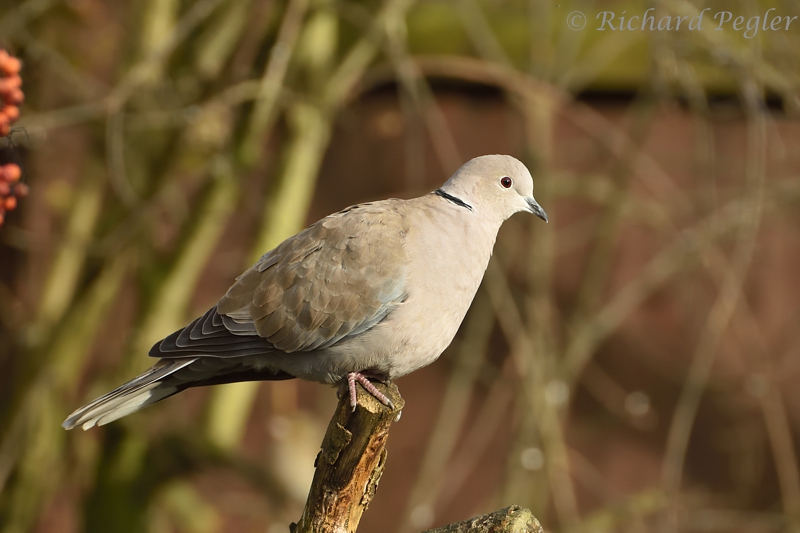
Collared Dove (Streptopelia decaocto) - garden on 10th December, 2022
Carrion Crow (Corvus corone) - garden on 10th December, 2022
I did also get some shots of one of our much less common winter visitors. At this point in time, there were still plenty of berries left on our Rowan tree.

Mistle Thrush (Turdus viscivorus) - garden on 10th December, 2022
Sunday, 11th December

We had a very cold morning, with a sprinkling of snow. I was called mid-afternoon to collect Lindsay from hospital, but I did manage to get a few shots of the two wagtails that visited that day - (possible - doubt due to a comment from 'Conehead54, see below) White Wagtail and Pied Wagtail. My records list them as two different species but, technically, one (Pied) is a sub-species of the nominate (White) species.

(possible) White Wagtail (Motacilla alba) - garden on 11th December, 2022

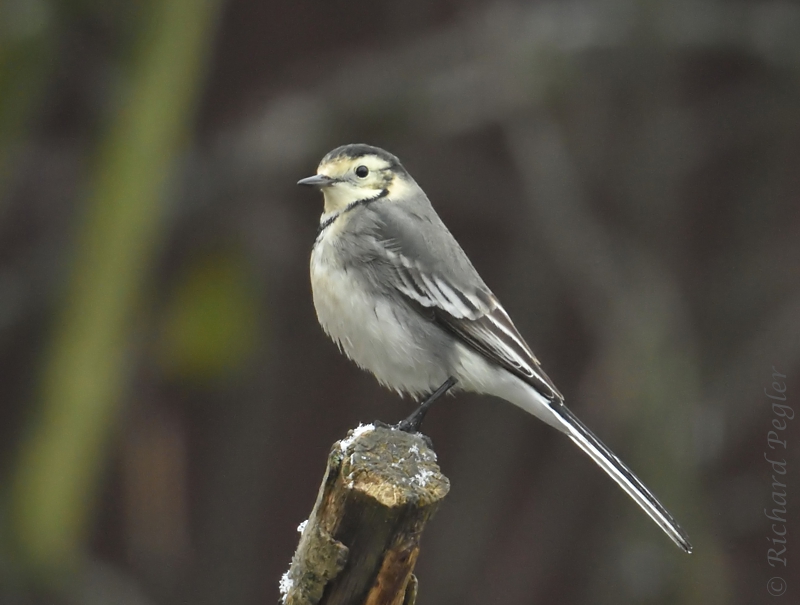
Pied Wagtail (Motacilla alba yarrellii) - garden on 11th December, 2022
Monday, 12th December

At the start of the week, we had a little more snow and we were still being visited by Pied and (possible) White Wagtails.

(possible) White Wagtail (Motacilla alba) - garden on 12th December, 2022

Pied Wagtail (Motacilla alba yarrellii) - garden on 12th December, 2022
Tuesday, 13th December

Dunnock is a daily visitor to the garden and sometimes we get up to three of them. However, I don't often photograph them. This rather dull day was an exception, however. I find the faces of this species to be particularly attractive.

Dunnock (Prunella modularis) - garden on 13th December, 2022

We also had visits by Mistle Thrush and Redwing this day, although only Redwing was photographed.

Redwing (Turdus iliacus) - garden on 13th December, 2022
Both Pied and (possible) White Wagtails were still with us, and the Pied Wagtail offered itself up for some more imtimate shots.

Pied Wagtail (Motacilla alba yarrellii) - garden on 13th December, 2022
Thursday, 15th December

This was a very cold day, although I did not record the termperature. I did, however, photograph frost on our conservatory window, which made an attractive pattern.

Frost on our conservatory window, on 15th December, 2022
Fortunately, it was also a sunny day. We were pleased to welcome the winter visitors again.
 
I was pleased to get the first image, below, of one of the two Redwings that visited as it shows how the top-of-head plumage overhangs their eyes - a fact that I don't recall noticing before.


Redwing (Turdus iliacus) - garden on 15th December, 2022
A first winter male Blackcap, with its black cap fringed with brown, was back with us this day also, and has continued to be an intermittent vistor.
 
Blackcap (Sylvia atricapilla) (1st winter male) - garden on 15th December, 2022
There was beautiful golden light towards sunset, and I photographed two of our visitors which were still around.
 
Redwing (Turdus iliacus) - garden on 15th December, 2022
Mistle Thrush (Turdus viscivorus) - garden on 15th December, 2022
Friday, 16th December
 
It had been a while since we last saw a Bullfinch in the garden so I was delighted to spot a male visiting, although it was a very dull day, the bird was about as far away as it was possible to be in our garden, and so my shots were not good.
 
Bullfinch (Pyrrhula pyrrhula) (male) - garden on 16th December, 2022
I was rather pleased with the background colours in this next image, so please excuse yet another Mistle Thrush.
 
Mistle Thrush (Turdus viscivorus) - garden on 16th December, 2022
I was pleased to get some video clips of the (possible) White Wagtail that visited just before sunset.
Saturday, 17th December
 
Needing to keep my trigger finger exercised, I took some shots of a Redwing in the garden.
 
Redwing (Turdus iliacus) - garden on 17th December, 2022
Sunday, 18th December
 
We had a remarkable 23 species of bird put a foot down in our garden this day (in summer it's an execeptional week when we get 20 species in the week). We had all three wagtails ((possible) White, Pied, and Grey), although White Wagtail was not photographed.

Pied Wagtail (Motacilla alba yarrellii) - garden on 18th December, 2022
Grey Wagtail (Motacilla cinerea) - garden on 18th December, 2022
For me, the most exciting visitor that day was a Song Thrush - a species that rarely visits us, with the previous visit being on 28th November, 2021.
 
Song Thrush (Turdus philomelos) - garden on 18th December, 2022
The male Bullfinch was back. I've said it before, and I'll say it again - Bullfinches are some of the messiest eaters in the avian world I know of.
 
Bullfinch (Pyrrhula pyrrhula) (male) - garden on 18th December, 2022
A little more excitement was caused by the Redpoll that showed up. I only managed a record shot on one of our feeders at the top of the garden.
 
Lesser Redpoll (Acanthis cabaret) with Goldfinch - garden on 18th December, 2022
Wednesday, 21st December
 
We had another visit by Song Thrush, which put on a good show. Fortunately, there were still a few berries left lower down on our Rowan - they have all been consumed now.
 

Song Thrush (Turdus philomelos) - garden on 21st December, 2022
I was also delighted when Stock Dove made a return visit.
 
Stock Dove (Columba oenas) - garden on 21st December, 2022
Thursday, 22nd December
 
The star visitor this day was a male Sparrowhawk. Sadly, it did not linger long enough for me to get a decent shot, and it left without its dinner.

Sparrowhawk (Accipiter nisus) (male) - garden on 22nd December, 2022
Friday, 23rd December
 
A non-wildlife item to report for this day. Last Christmas I made a leather bag for Lindsay. On seeing it, our daughter asked if I would consider making one for her, but to a different design, and with a cat motif. How could I refuse !?  I'd promised her it would be her Christmas present, but that was before we learned of Lindsay's pre-Christmas knee operation. Much to my relief, after working on it for a couple of months, I finished it just two days before Christmas. I think that she was pleased with the result.
 
the bag that I made for our daughter for Christmas 2022
Sunday, 25th December
 
The week ended with what I believe is possibly our highest ever weekly tally of birds setting foot in our garden - 27 species (although I confess to a slight cheat here as Pied Wagtail is a sub-species of White Wagtail).  These were (in alphabetical order):-  Blackbird (5) ; Blackcap ; Bullfinch (2) ; Chaffinch (5) ; Crow, Carrion ; Dove, Collared (4) ; Dove, Stock ; Dunnock (2) ; Goldfinch (14) ; Greenfinch (3) ; Jackdaw ; Magpie (4) ; Redpoll, Lesser ; Redwing ; Robin (2) ; Sparrow, House (3) ; Sparrowhawk ; Starling (8) ; Thrush, Mistle (2) ; Thrush, Song ; Tit, Blue ; Tit, Coal ; Tit, Great ; Wagtail, Pied ; Wagtail, (possible) White ; Woodpigeon (5) ; Wren.


Due to a number of factors, no further significant photos were taken before the end of the year.

I am sorry if you find the subject matter in this blog post is too repetitive, but the winter visitors are something that I have really cherished and I wanted to give them a level of coverage that reflected their importance to me. Having the garden, and the winter visitors, has been a real benefit to my wellbeing while I am confined to home looking afdter Lindsay.

Hopefully I will be able to publish another blog post in about a week's time, but I have little material to offer as I write this as the winter visitors seem to have now departed! In the meantime, please take good care of yourselves and Nature.

Thank you for dropping by - - - Richard