This return visit to the Isles of Scilly for Lindsay and I, plus our daughter, Melanie, and granddaughter, Georgie, had been eagerly anticipated as a relief from the confinements of a cautious attitude to the Covid pandemic. None of us had the intention to throw caution to the wind, but we did feel the time had come to try and recapture some elements of a 'normal life'.
Sunday, 6th March Ashby de la Zouch to Hayle, Cornwall
Lindsay and I set off from home in Ashby de la Zouch at 09.40. The weather was as
forecast - cloudy with sunny intervals and a breeze giving a chill factor to the
nominal 6°c temperature. Traffic conditions were good for the whole journey and
after a few comfort stops and a break for a picnic lunch in a car park we
arrived at the Premier Inn, Hayle, at 15h15. Our daughter Melanie, and
granddaughter Georgie had a late start, not leaving their Leicester home until
14.00.
With time on our hands until the girls arrived, Lindsay and I set off to
visit the pool at Hayle, known as Copperhouse Pool.
We attempted to fill the car with diesel just before reaching the pool and had a sense of deja vu when we were told that there was no fuel to be had in the area as everybody had been filling their vehicles because fuel prices were about to increase dramatically. We'd been met with similar news when we arrived at Hayle in September, but it was a supply, rather than demand, problem on that occasion. We resigned ourself to hoping the situation wss resolved by the time of our return.
The north side of the pool has a
very pleasant walk along it. However, Lindsay, who is troubled by a damaged
knee, could only manage a short distance before having to resort to the comfort
of a bench with a view, leaving me to continue to the far end and back on my
own. This gave me the opportunity to photograph a few birds on the pool although
they were mainly rather distant due to the tide being out.
 |
| view over Copperhouse Pool |
 |
| Little Egret (Egretta garzetta) - Copperhouse Pool, Hayle |
 |
| Shelduck (Tadorna tadorna) (female) - Copperhouse Pool, Hayle |
 |
| Teal (Anas crecca) (female) - Copperhouse Pool, Hayle |
 |
| Teal (Anas crecca) (male) - Copperhouse Pool, Hayle |
 |
| Bar-tailed Godwit (Limosa lapponica) - Copperhouse Pool, Hayle |
 |
| Redshank (Tringa totanus) - Copperhouse Pool |
 |
| Oystercatcher (Haematopus ostralegus) - Copperhouse Pool, Hayle |
Lindsay and I turned in at 21.00 as we had an early start the next day, with
the alarm set for 04.45.
Monday, 7th March Hayle ; Land's End Airport ; St Marys, Isles of Scilly
I woke at 04.43, 2 minutes before the alarm was due to go off, and we
started to make preparations for our departure.
We checked out of the hotel at 06.30 and were at Lands End airport in good
time for a 07.15 check in. Our Twin Otter G-CEWM, built in 1979, departed on time
at 08.15 for the 15 minute, rather bumpy, flight to St Mary's on the Isles of
Scilly. Paulger's Transport got us to our accommodation by 09.00 where we were expecting
to have to leave our luggage in the car port as check in time was 15.00. We
were, therefore, delighted to find a note on the door saying that we had
immediate entry.
To give you some idea of location that we are in love with, the property that we stay at can be seen pretty-much precisely in the centre of the header image while this blog post is current.
We were on a self-catering stay, and our luck continued when I called the Coop at 10.00 to see if we could bring
our click and collect order forward from the 14.00 to 16.00 slot, and was told
that it was being picked now and would be ready in 10 minutes.
The next task was for me to pick up the buggy that we'd hired for the week from
Scilly Carts. We were now all set up for our stay.
Our luck with the weather was, however a little less fortuitous. It was
rather windy (28 to 34 mph) with a temperature of 7°c with a wind chill factor
taking it down to 2°c.
Feeling rather tired after the long drive and early start, and in
consideration of the weather, I had a very gentle day, just taking a stroll
along Porthcressa beach front and in the afternoon taking Lindsay for a drive
around the island in the buggy. Few birds were photographed.
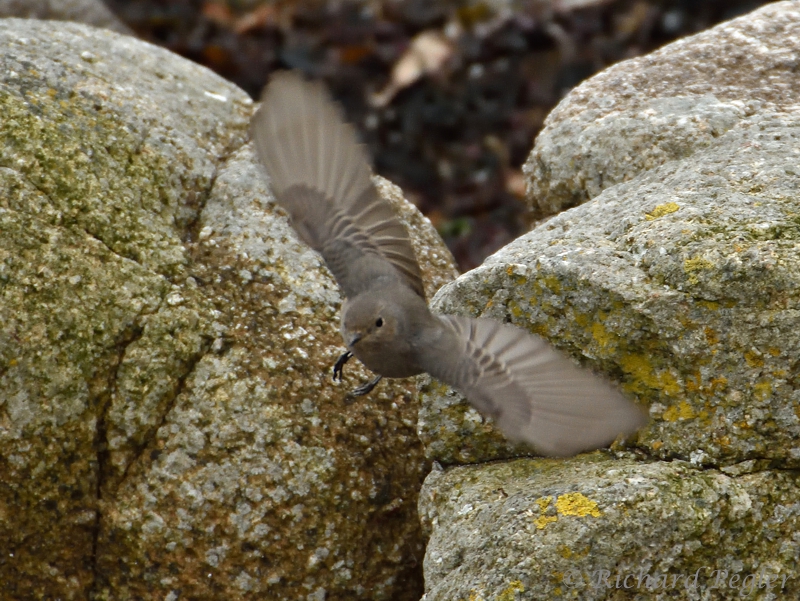
The property we stay at is at the Littleporth end of Porthcressa and backs onto the beach. On the beach at the bottom of the garden, Rock Pipit is pretty-much a given. The amount of wrack present at this time was something that I'd not witnessed here before. This was very attractive to gulls and shore birds.
 |
| Rock Pipit (Anthus petrosus) - Littleporth |
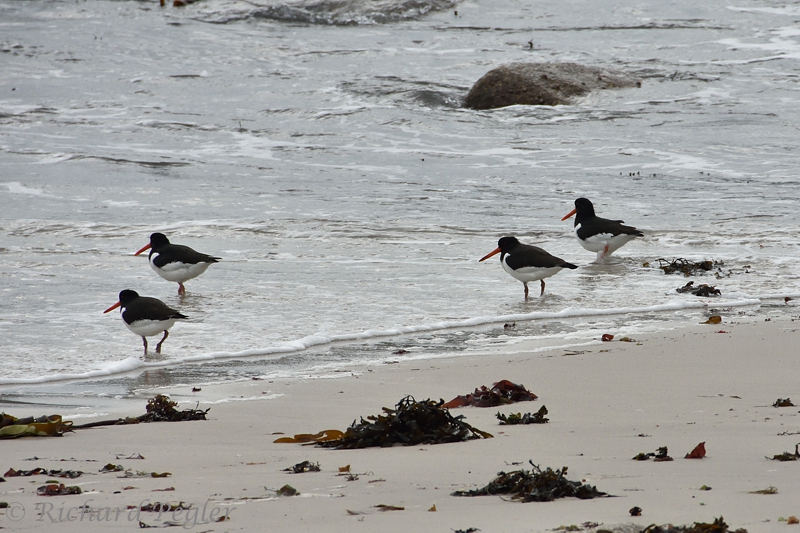 |
| Oystercatcher (Haematopus ostralegus) - Littleporth |
 |
| Black Redstart (Phoenicurus ochruros) - Littleporth |
 |
| Herring Gull (Larus argentatus) - Littleporth |
 |
| Wren (Troglodytes troglodytes) - Littleporth |
 |
| The Porthcressa Three - Porthcressa! |
 |
| The Three's new friend - Porthcressa |
Tuesday, 8th March Porthcressa ; Lower Moors ; Newford Ponds ; Hugh Town
We woke to strong winds (37 to 47 mph) and a temperature of 9°c which felt
like 4° with wind chill factored in.
An after breakfast visit to the sea front at the bottom of the garden
revealed a mass of gulls and other shore birds in a feeding frenzy at the
water's edge. As I was getting too much sea spray on my camera, I didn't stay
there for long.


 |
| gulls - Littleporth |
 |
| Turnstone (Arenaria interpres) - Littleporth |


 |
| Greenshank (Tringa nebularia) - Lower Moors |
 |
| Herring Gull (Larus argentatus) - Lower Moors |
The girls went out to do some shopping for goodies, and I made another
visit visit to Porthcressa beach at 11.30. The weather had improved, and was
brighter, with less wind. The (20 to 30, I didn't count them) Turnstones on the
beach were very confiding.

 |
| Turnstone (Arenaria interpres) - Porthcressa |
 |
| Pied Wagtail (Motacilla alba yarrellii) - Littleporth |
After lunch, the girls wanted to go to a beach that they refer to as
Treasure Beach to collect sea glass for a craft project. I drove them out there,
leaving them with the buggy while I returned to Lower Moors. There was even less
of interest there than earlier in the day.

 |
| Mallard (Anas platyrhynchos) (male) - Lower Moors |
 |
| Herring Gull (Larus argentatus) - Lower Moors |
 |
| Road block, Isles of Scilly style - Newford Ponds |
 |
| Moorhen (Gallinula chloropus) - Newford Ponds |

 |
| Shag (Phalacrocorax aristotelis) - Hugh Town Harbour |
Lack of interesting photographic subjects was getting to be a little
frustrating, and I found myself photographing another Herring Gull as I passed
along Porthcressas beach before arriving back at base. The images from these last two locations were not worth keeping.
It was dark by the time we finished our evening meal, and we had another
relatively early night after a relaxing evening.
Wednesday, 9th March Porthcressa ; Lower Moors ; Higher Moors
We woke up to strong winds, gusting up to 60 mph, and rain, with both forecast
to get worse during the day, making the day a total washout.
I braved a walk along Porthcressa sea front at around 10.00 and found my self
walking like a drunk with the wind gusts and nearly blown over a couple of
times, so cut across to Hugh Town harbour where it was a little less windy. I'd
not taken my camera with me, just binoculars, but saw nothing of interest.
Later that morning, I volunteered to do the daily cake run to Becky's
Scilly Cakes. This was also a less than pleasant excursion, but totally
necessary!
I spent some time debating whether to go out birding in the afternoon,
thinking that perhaps I could take the buggy to one, or both, of the locations
that have hides, and sit in the dry. However, with the wind causing the rain to
be horizontal, I'd have been soaked by the time I got there, and the wind would
be keeping the birds tucked down.
However, I went against my instincts, and took the buggy to Old Town, where
I went off into Lower Moors and sat in the ISBG Hide. All I saw was a drake
Mallard and, briefly, four Herring Gull, and it was not worth breaking the
camera out of the bag. For my last ten minutes there, there were absolutely no
birds visible, so I decided to see if Higher Moors had more to offer. By the
time that I got back to the buggy, I was well and truly soaked.
Arriving at Higher Moors, I set off on the path to Sussex Hide, soon
encountering muddy water that was ankle-deep - and I was only wearing walking
boots! Undeterred, I pressed on, arriving at the hide to find just a Mallard
and Moorhen visible through the rain. I didn't stop there for long, and moved on
to Seaward Hide, where only Coot and Herring Gull were added to the list and,
again, the camera stayed in the bag.
I was now cold and wet and it was time to get back to base and have a
shower and get into clean dry clothes.
I arrived back to find the best bird of the day awaiting me. Melanie had,
in my absence, skilfully crocheted me a bird. I shall treasure it and have named
it Blue!
 |
| 'Blue' - by Melanie Pegler |
Thursday, 10th March Porthcressa ; Peninnis ; Lower Moors
There was a much better day in prospect, with a forecast for sunny intervals,
temperatures around 10°c, feels like 6°, and wind speeds of around 25 to 30
mph.
After breakfast, I walked along Littleporth sea front, and was surprised to get
a brief view of Grey Wagtail.
 |
| Grey Wagtail (Motacilla cinerea) (male) - Littleporth |
 |
| Wren (Troglodytes troglodytes) - Littleporth |
 |
| Black Redstart (Phoenicurus ochruros) - Littleporth |
 |
| Pied Wagtail? (Motacilla alba yarrellii) - Littleporth |
 |
| Greenshank (Tringa nebularia) - Littleporth |
Out in the bay, a pair of Shag were resting on a rock.
 |
| Shag (Phalacrocorax aristotelis) -Porthcressa |
 |
| Buff-tailed Bumblebee (Bombus terrestris) (queen) - Littleporth |
After this, I set off to make a round trip to Peninnis Head. As I passed
along Porthcressa beach, I found a very small Portuguese Man O'War washed up on
the sand.
 |
| Portuguese Man O'War (Physalia physalis) - Porthcressa |
The Portuguese Man O'War is not a jellyfish. It is a
colonial hydrozoan, made up of small individual animals called zooids -
each with their own specific function, e.g. feeding or breeding. They
can't live separately and function together as one "animal".
The Potuguese Man O'War lives at the surface of the open ocean, held
afloat by a gas-filled bladder. This has a crest like structure at the
top which acts as a sail. They can't swim and are at the mercy of the
winds - which is why they often end up washed ashore after big storms.
They are fearsome predators, catching small fish and crustaceans with
their long stinging tentacles. It's these tentacles that you need to
watch out for too - they can sting long after the animal has died.
I then headed up to Buzza Hill and along to Peninnis. Little was seen en
route, or on Peninnis Head, but I could not resist taking some shots of the wonderful rock formations on the head, and the usual Stonechat were around although they
kept their distance.
 |
| Pulpit Rock - Peninnis |
 |
| Rocks - Peninnis |

 |
| Stonechat (Saxicola rubicola) (male) - Peninnis |
 |
| Stonechat (Saxicola rubicola) (female) - Peninnis |
 |
| Meadow Pipit (Anthus pratensis) - Peninnis |
 |
| Portuguese Man O'War (Physalia physalis) - Porthcressa |
Later in the afternoon I took the girls off to Old Town so that they could
collect sea glass on the beach, and I set off once more to Lower Moors. The wind
had increased a little and there was a chill in the air. This time I was lucky
and found the Jack Snipe that I'd been looking for. I would never have spotted
it behind the reeds if it wasn't for its continual bobbing motion and I didn't
get a clear shot, but it was a delight to watch.
 |
| Jack Snipe (Lymnocryptes minimus) - Lower Moors |
I'll save the notes on the rest of our stay for a subsequent blog post. In the meantime, take good care of yourself, and Nature. Thank you for dropping by - - - - Richard
FOR SOME REASON, BLOGGER IS REFUSING TO LET ME RESPOND TO COMMENTS. If it is also preventing you leaving comments, please drop me an email - richard@peglermail.co.uk - thank you.

